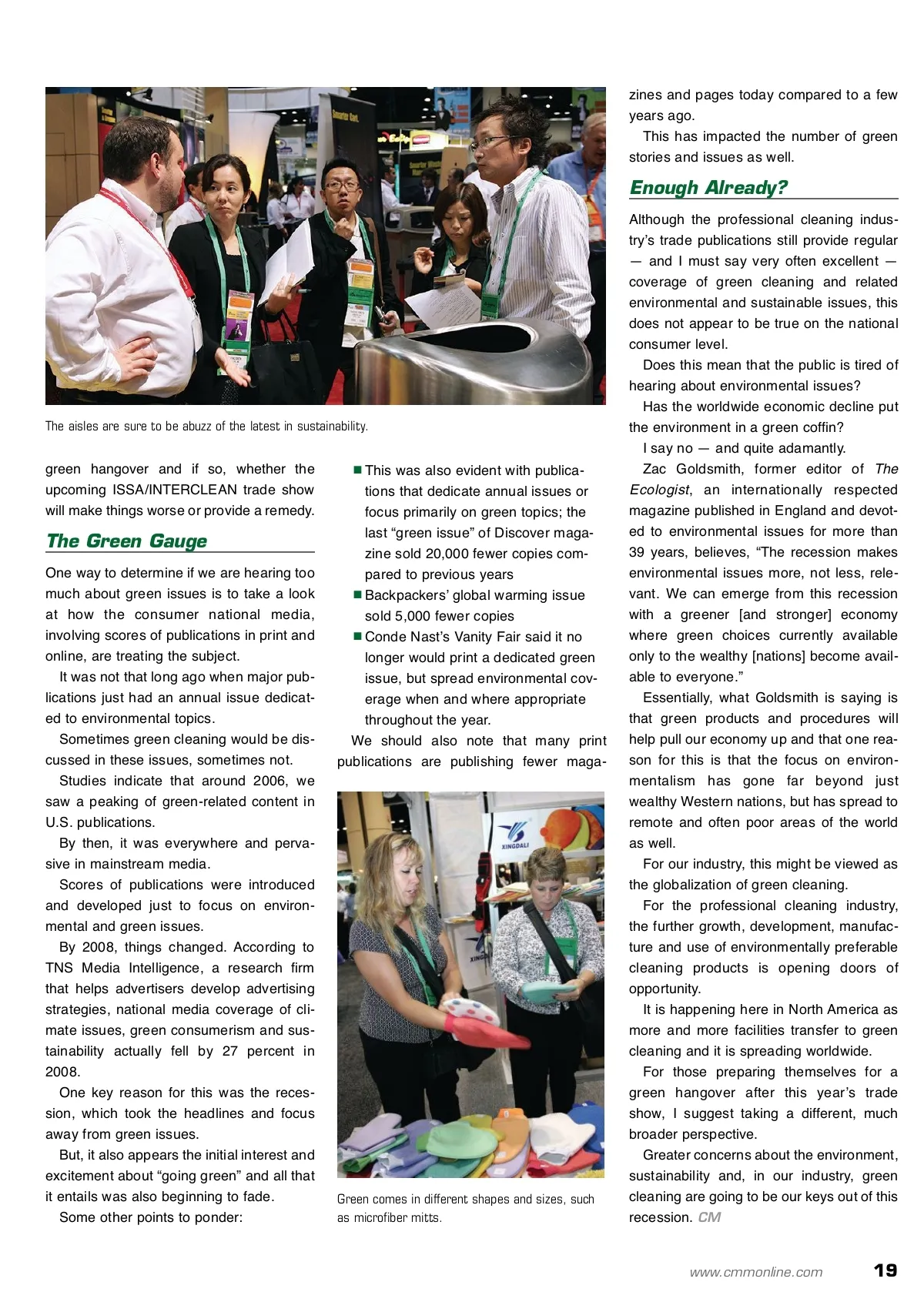
zines and pages today compared to a few years ago. This has impacted the number of green stories and issues as well. Enough Already? Although the professional cleaning indus-tryʼs trade publications still provide regular — and I must say very often excellent — coverage of green cleaning and related environmental and sustainable issues, this does not appear to be true on the national consumer level. Does this mean that the public is tired of hearing about environmental issues? Has the worldwide economic decline put the environment in a green coffin? I say no — and quite adamantly. Zac Goldsmith, former editor of The Ecologist , an internationally respected magazine published in England and devot-ed to environmental issues for more than 39 years, believes, “The recession makes environmental issues more, not less, rele-vant. We can emerge from this recession with a greener [and stronger] economy where green choices currently available only to the wealthy [nations] become avail-able to everyone.” Essentially, what Goldsmith is saying is that green products and procedures will help pull our economy up and that one rea-son for this is that the focus on environ-mentalism has gone far beyond just wealthy Western nations, but has spread to remote and often poor areas of the world as well. For our industry, this might be viewed as the globalization of green cleaning. For the professional cleaning industry, the further growth, development, manufac-ture and use of environmentally preferable cleaning products is opening doors of opportunity. It is happening here in North America as more and more facilities transfer to green cleaning and it is spreading worldwide. For those preparing themselves for a green hangover after this yearʼs trade show, I suggest taking a different, much broader perspective. Greater concerns about the environment, sustainability and, in our industry, green cleaning are going to be our keys out of this recession. CM The aisles are sure to be abuzz of the latest in sustainability. green hangover and if so, whether the upcoming ISSA/INTERCLEAN trade show will make things worse or provide a remedy. The Green Gauge One way to determine if we are hearing too much about green issues is to take a look at how the consumer national media, involving scores of publications in print and online, are treating the subject. It was not that long ago when major pub-lications just had an annual issue dedicat-ed to environmental topics. Sometimes green cleaning would be dis-cussed in these issues, sometimes not. Studies indicate that around 2006, we saw a peaking of green-related content in U.S. publications. By then, it was everywhere and perva-sive in mainstream media. Scores of publications were introduced and developed just to focus on environ-mental and green issues. By 2008, things changed. According to TNS Media Intelligence, a research firm that helps advertisers develop advertising strategies, national media coverage of cli-mate issues, green consumerism and sus-tainability actually fell by 27 percent in 2008. One key reason for this was the reces-sion, which took the headlines and focus away from green issues. But, it also appears the initial interest and excitement about “going green” and all that it entails was also beginning to fade. Some other points to ponder: This was also evident with publica-tions that dedicate annual issues or focus primarily on green topics; the last “green issue” of Discover maga-zine sold 20,000 fewer copies com-pared to previous years Backpackersʼ global warming issue sold 5,000 fewer copies Conde Nastʼs Vanity Fair said it no longer would print a dedicated green issue, but spread environmental cov-erage when and where appropriate throughout the year. We should also note that many print publications are publishing fewer maga-Green comes in different shapes and sizes, such as microfiber mitts. www.cmmonline.com 19
CMM – Archives Oct 2009: 19