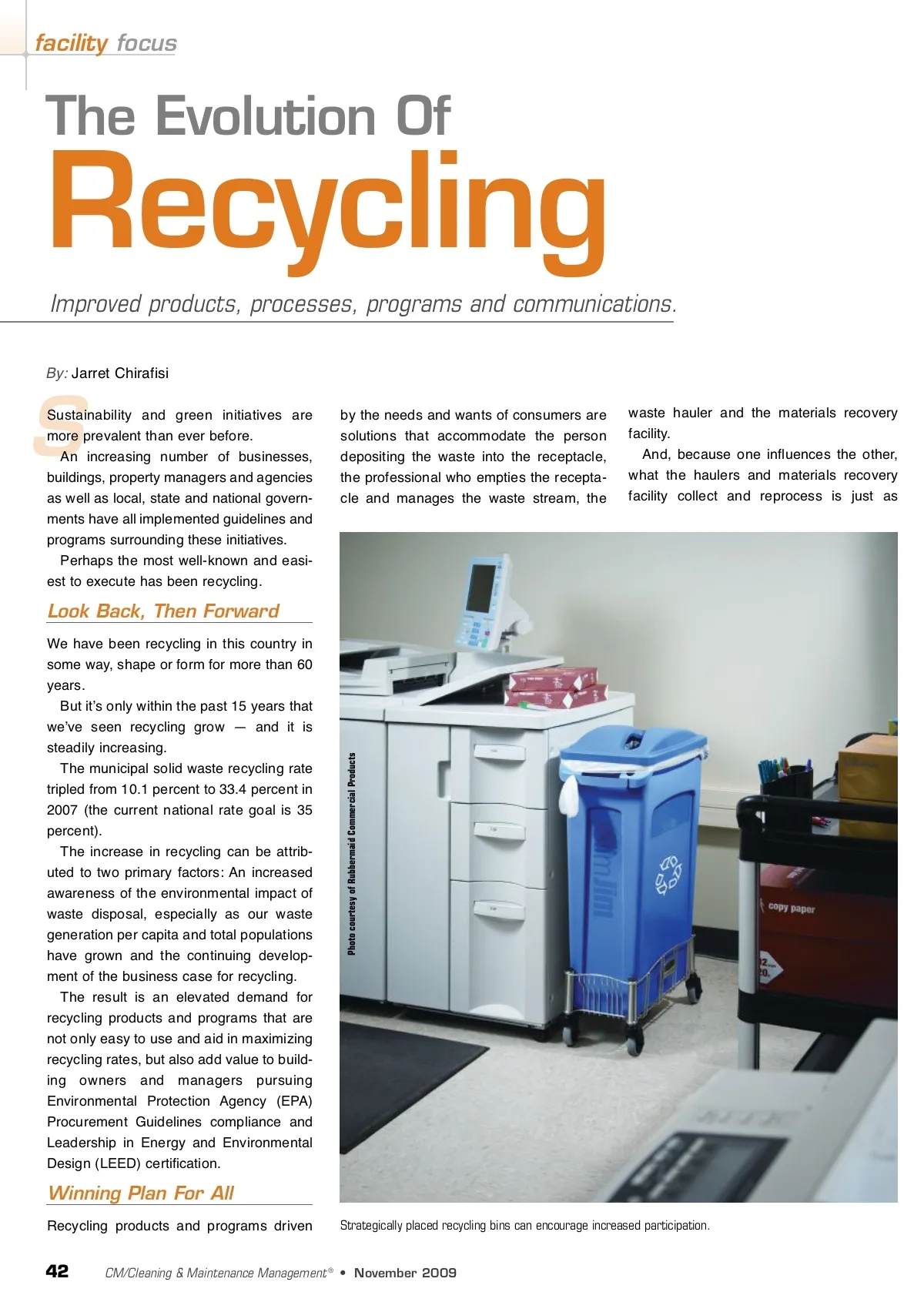
important as the products being used to collect these materials. The goal for all facility managers is to have solutions that enable end users to work smarter. In recycling, itʼs no wonder trends are leaning toward the desire to have recycling stations that permit centralized recycling but are adaptable to suit the varied needs of end users. Another trend taking greater shape is the desire to purchase a complete recycling solution rather than individual products. Many successful recycling initiatives address everything from communicating directly to those who are recycling to assisting the professionals who manage the waste stream and helping facility man-agers pull everything together, from pur-chase to set up. End users across all segments have options to choose from once they under-stand what they are required or able to recycle. The product choices, then, should be driven by what best fits the needs at hand. In an office environment, for instance, paper may be the main recyclable. In this case, desk-side recycle bins should be considered along with a cube truck to manage emptying the bins. In a retail setting, multi-stream recycling stations may be more appropriate to handle multiple recyclable types. Choices donʼt stop at product type because variables such as material choice — recycled content, material type and durability — and procurement guidelines should be taken into account. The ability to customize solutions to meet end user needs is another variable that should be considered as it ensures the recy-cling solution is able to achieve maximum recycling rates while remaining easy to use. The ability for recycling solutions to com-municate effectively is also critical. As the most immediately noticeable green initiative, standard blue and/or deco-rative recycling containers with familiar chasing arrows communicate responsible practices and make recycling easier. Signage positioned with recycling sta-tions also calls attention to the recycling program and allows the facility to engage recyclers with messages about the facility and its commitment to sustainability. Over the past four years, the growth in the recycling rate has climaxed around 35 percent. It is possible to continue to improve that rate, particularly as individuals increas-ingly adopt recycling habits that include recycling items they did not previously recycle. In the end, that improvement will be driven in part by improved recycling prod-ucts, processes, programs and communi-cations. CM Jarret Chirafisi is the product manager -utility refuse and sustainability team leader for Rubbermaid Commercial Products. For more information about RCP, visit www.rcpworksmarter.com. CMI now offers... 3 Levels of Custodial Certification 1 Custodial Training Certification Attend one of CMI’s three-day Train the Trainer courses offered regularly throughout the country. You’ll learn the skills and receive the tools you need toimplement CMI’s Custo -dial Technician training program. 2 Custodial Supervisor Certification Train and certify your key supervisors on the business management duties and people skills of successful custo-dial supervisors. 3 Custodial Technician Certification Train and certify your front-line cleaning workers on the equipment, materials, supplies and best-practice procedures they need to get the job done right with minimal impact on the environment. Call CMI today to find out how our training and certification courses will help you to meet the training requirements of ISSA’s Cleaning Industry Management Standard (CIMS) and help you achieve points toward LEED certification. For more information, contact Bea Kelley at 518.640.9172 or [email protected] www.cminstitute.net www.cmmonline.com 43
CMM – Archives Nov 2009: 43