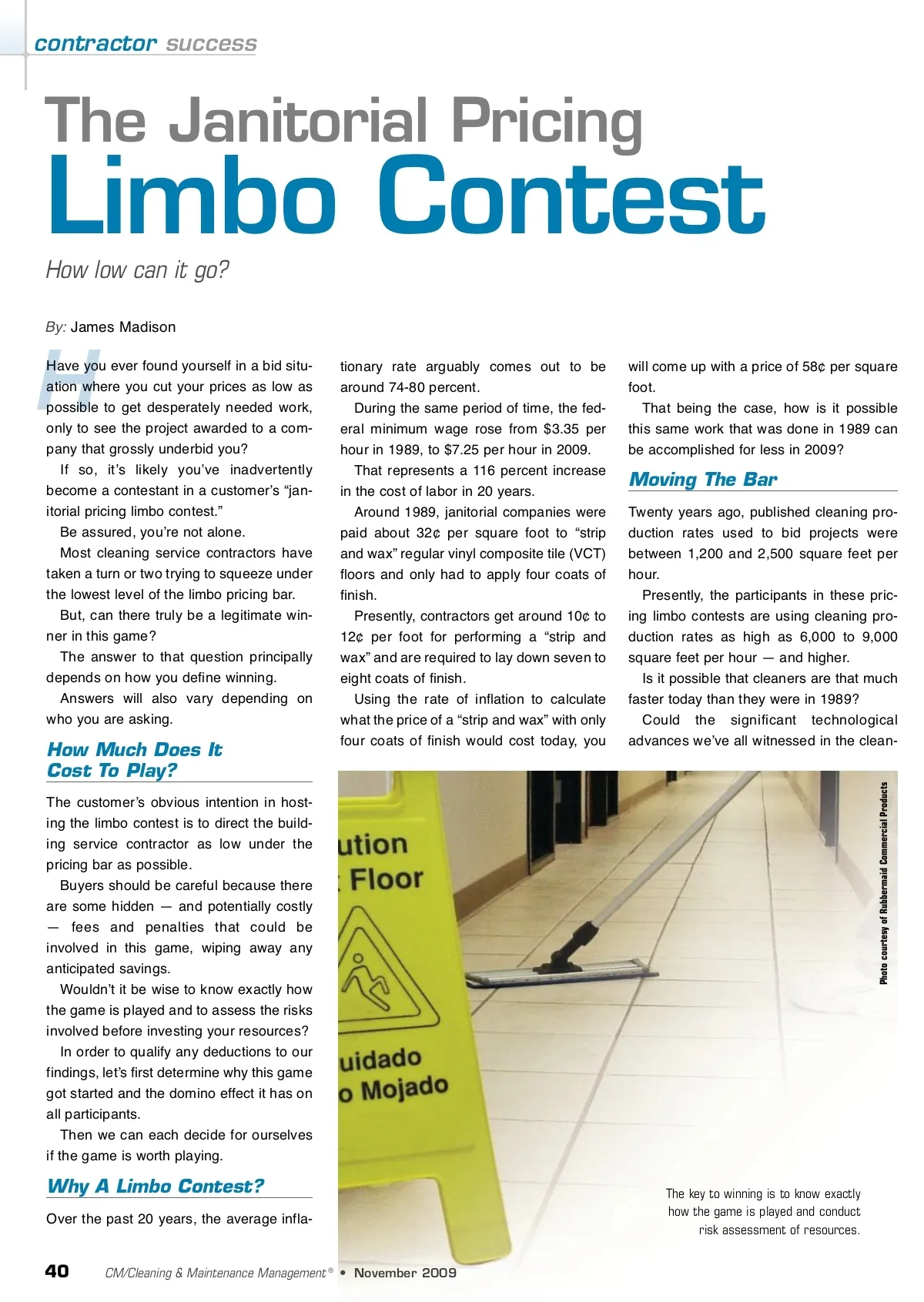
contractor success The Janitorial Pricing How low can it go? By: James Madison Limbo Contest Have you ever found yourself in a bid situ-ation where you cut your prices as low as possible to get desperately needed work, only to see the project awarded to a com-pany that grossly underbid you? If so, itʼs likely youʼve inadvertently become a contestant in a customerʼs “jan-itorial pricing limbo contest.” Be assured, youʼre not alone. Most cleaning service contractors have taken a turn or two trying to squeeze under the lowest level of the limbo pricing bar. But, can there truly be a legitimate win-ner in this game? The answer to that question principally depends on how you define winning. Answers will also vary depending on who you are asking. tionary rate arguably comes out to be around 74-80 percent. During the same period of time, the fed-eral minimum wage rose from $3.35 per hour in 1989, to $7.25 per hour in 2009. That represents a 116 percent increase in the cost of labor in 20 years. Around 1989, janitorial companies were paid about 32¢ per square foot to “strip and wax” regular vinyl composite tile (VCT) floors and only had to apply four coats of finish. Presently, contractors get around 10¢ to 12¢ per foot for performing a “strip and wax” and are required to lay down seven to eight coats of finish. Using the rate of inflation to calculate what the price of a “strip and wax” with only four coats of finish would cost today, you will come up with a price of 58¢ per square foot. That being the case, how is it possible this same work that was done in 1989 can be accomplished for less in 2009? H Moving The Bar Twenty years ago, published cleaning pro-duction rates used to bid projects were between 1,200 and 2,500 square feet per hour. Presently, the participants in these pric-ing limbo contests are using cleaning pro-duction rates as high as 6,000 to 9,000 square feet per hour — and higher. Is it possible that cleaners are that much faster today than they were in 1989? Could the significant technological advances weʼve all witnessed in the clean-Photo courtesy of Rubbermaid Commercial Products How Much Does It Cost To Play? The customerʼs obvious intention in host-ing the limbo contest is to direct the build-ing service contractor as low under the pricing bar as possible. Buyers should be careful because there are some hidden — and potentially costly — fees and penalties that could be involved in this game, wiping away any anticipated savings. Wouldnʼt it be wise to know exactly how the game is played and to assess the risks involved before investing your resources? In order to qualify any deductions to our findings, letʼs first determine why this game got started and the domino effect it has on all participants. Then we can each decide for ourselves if the game is worth playing. Why A Limbo Contest? Over the past 20 years, the average infla-The key to winning is to know exactly how the game is played and conduct risk assessment of resources. 40 CM/Cleaning & Maintenance Management ® • November 2009
CMM – Archives Nov 2009: 40