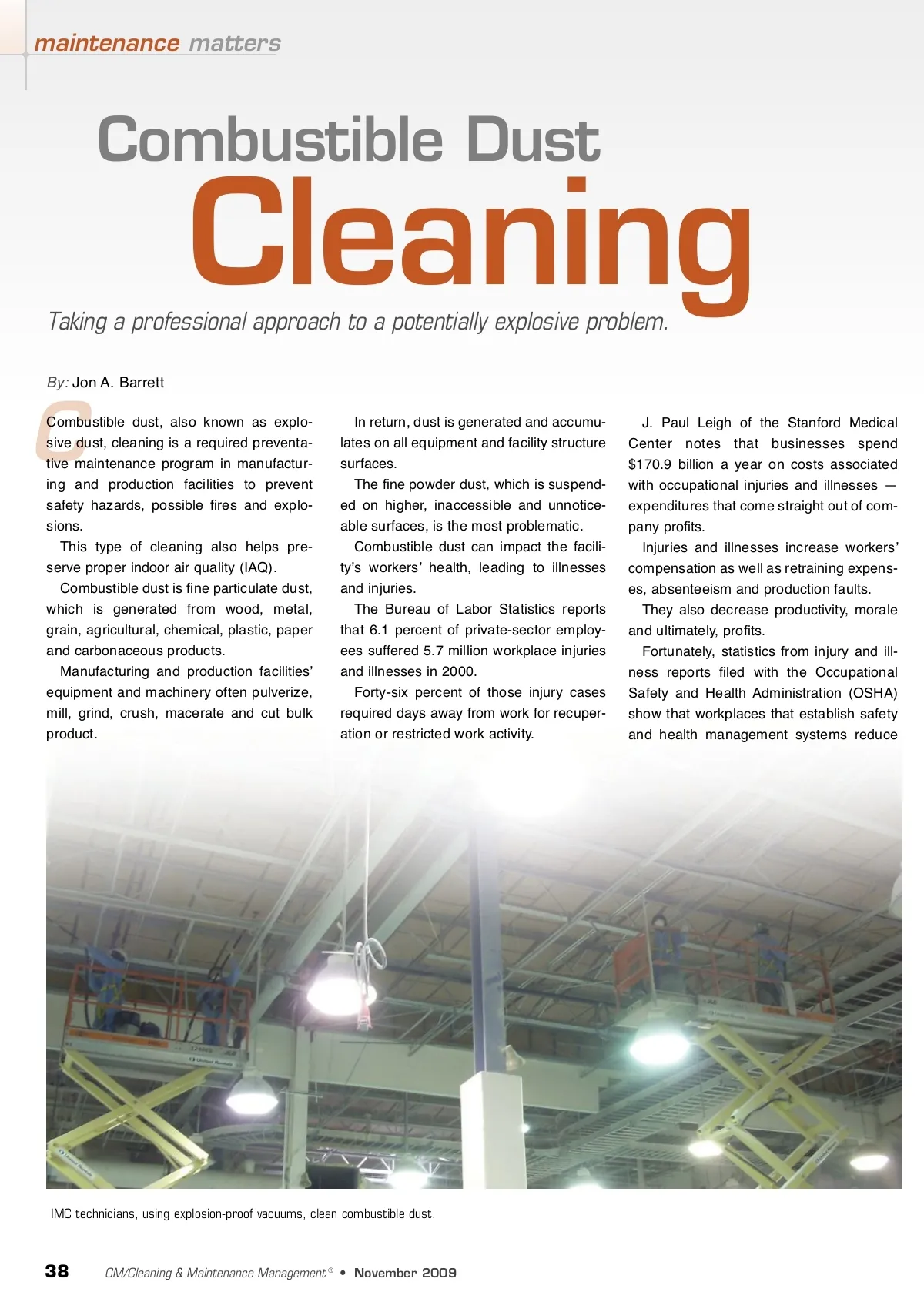
their injury and illness costs by 20-40 percent. “In todayʼs competitive business environ-ment,” notes OSHA Administrator John L. Henshaw on the organizationʼs website, “the black-and-blue of workplace injuries can be the difference between operating in the black and running in the red.” Where To Target Some of the cleaning services that may be required to control combustible dust and areas to target include: High ceilings and surfaces Heating, ventilation and air condition-ing (HVAC) systems Dust collectors Conveyor belts Silo tanks Lab fume hood cleaning Dust control vacuuming. These services help prevent airborne dust and particulates from accumulating in the manufacturing and production facility. These services may also help promote equipment longevity, decrease utility costs for operating equipment, increase the brightness of lighting, stabilize insurance rates and allow a greater return on invest-ment on manufacturing equipment. Combustible dust cleaning should be performed by a certified and trained clean-ing company. The certified cleaning contractor should have the proper industrial and commercial cleaning equipment. ders and fiberglas A-frame ladders for the interior work, is necessary. Standing and portable floodlights may be required for night work and hard-to-see areas. Performing combustible dust cleaning requires several important procedures. The first and most important procedure is safety. Preventing static electricity, sparking and any electrical charge is the first preventa-tive step. Proper grounding of in-house electrical systems, equipment, forklifts, high-reach equipment, vacuums, extension cords and lighting is mandatory. Testing and sampling the powder and bulk dust particulate is required to see if the dust particulate is combustible or explosive. Material Safety Data Sheets (MSDSs) of each product will be useful in testing the dust. Safety First The simple act of dragging a piece of metal across a concrete floor can create a spark, which can lead to a dust explosion. Proper lock-out/tag-out documentation, slip and fall prevention, high reach and harness protection and confined space awareness are some examples of safety musts. Donning proper personal protection equipment (PPE), including safety lanyards and harnesses, hard hats, safety glasses, ear protection, disposable gloves, special coveralls and steel toe boots, is essential as well. Placing orange safety cones and yellow caution tape in working areas is required to inform others of hazardous conditions. Additionally, preparation is one of the most critical procedures of combustible dust cleaning. Proper preparation will contain dust and particulate and will alleviate a possibly unhappy customer. Preparation materials will include cover-ing your customerʼs equipment, contents, walls and floors. The covering will also serve as a con-tainment barrier for any possible reconta-mination. Trashcan containers or 55-gallon drums Recommended Equipment Industrial, explosion-proof, high-efficiency particulate air (HEPA) filter equipped vacu-ums are the main pieces of equipment for this type of cleaning. Broom sweeping and compressed air is not a viable means of cleaning combustible dust, according to the National Fire Protection Association (NFPA) 654 Standard. The act of broom sweeping and com-pressed air actually stirs up dust and partic-ulates into the air, which may create more issues with sensitive equipment and possi-ble dust explosions. High-reach equipment, such as high-reach platforms, scissor lifts, articulate booms, scaffolding, fiberglas extension lad-with liners can be used to collect the debris. Combustible dust cleaning involves sev-eral main aspects of cleaning. First, always work from ceiling to walls to floor. The actual cleaning and removing of dust and particulate buildup will consist of sever-al cleaning techniques and methods. Cleaning and removing grease and par-ticulate buildup should be performed by HEPA vacuuming and/or mechanical wet wiping. This portion of cleaning should be per-formed under containment to prevent any cross contamination of other areas and equipment. Mechanical cleaning procedures are based on parameters set by the NFPA, the Fire Protection Research Foundation, the National Air Duct Cleaning Association (NADCA), the Institute of Inspection, Cleaning and Restoration Certification (IICRC), the American Biorecovery Association (ABRA), the Indoor Air Quality Association (IAQA) and OSHA. Not all cleaning vendors are alike in safe cleaning procedures, techniques, quality and pricing. Be aware of vendors who only clean using dirty rags, brooms, push brooms, compressed air, dustpans and contaminat-ed cleaning equipment. Facility owners should ask the vendor they hire to provide a liability insurance and workersʼ compensation certificate. Photos of past work can document in detail the quality cleaning the vendor has performed. A certificate of completion for com-bustible dust cleaning is also required for insurance policies. In addition, a clean and safe facility is important for worker morale. CM Jon Barrett is the business development specialist with Interior Maintenance Company Inc., located in Lansdowne, Pennsylvania. He is: NFPA and Fire Protection Research Foundation trained for Explosive Dust Cleaning; Chilworth Technology trained for Dust Explosion Inspection; an Institute of Inspection, Cleaning and Restoration Certification (IICRC) technician; and American BioRecovery Association (ABRA) certi-fied technician in several categories. Jon is also an International Kitchen Exhaust Cleaning (IKECA)-Professional Exhaust Cleaning technician. He can be reached at [email protected] or by phone at 267-886-7903. www.cmmonline.com 39
CMM – Archives Nov 2009: 39