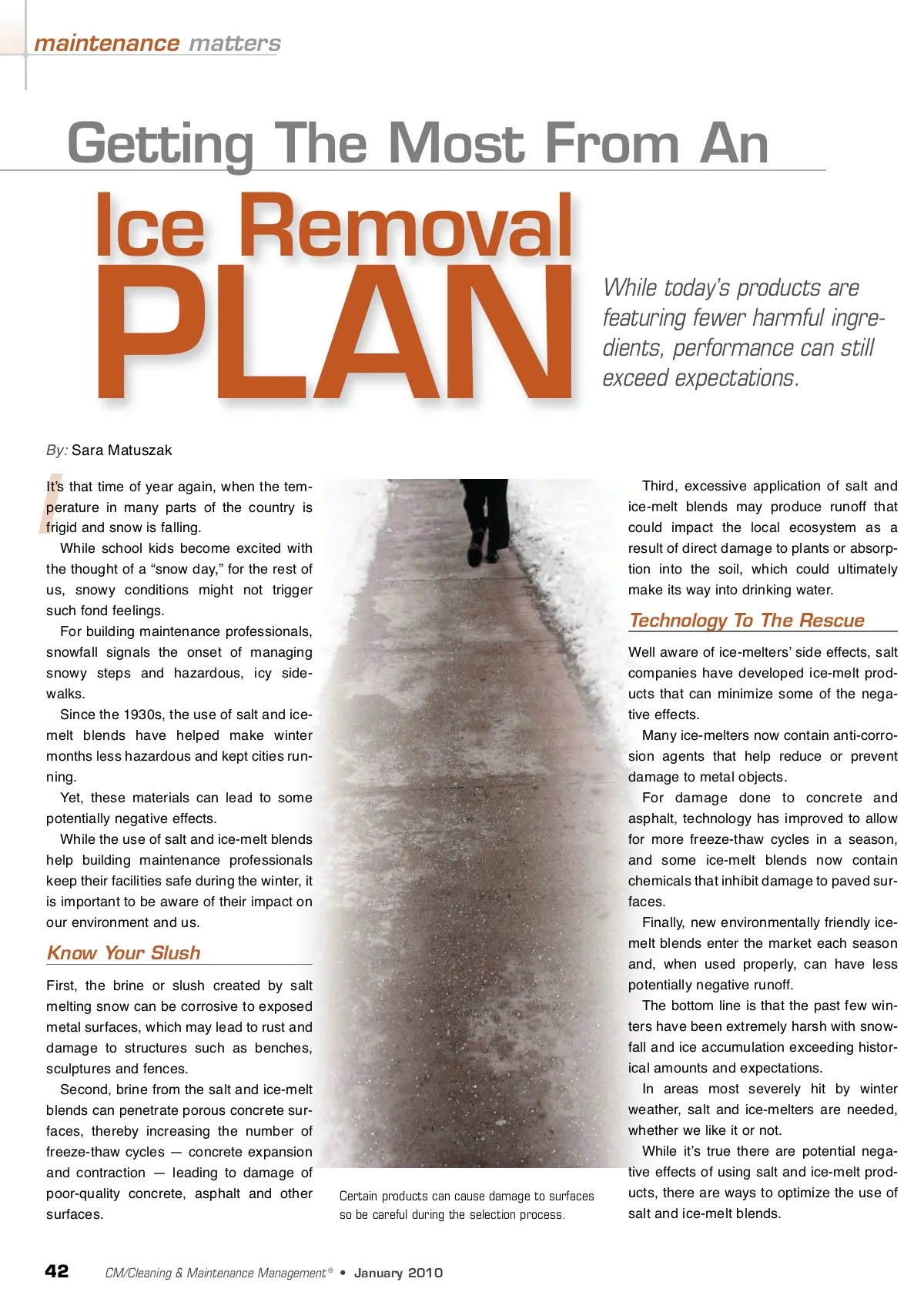
The following tips can minimize the neg-ative impacts without compromising the safety of clear sidewalks and parking lots. Select The Right Ice-melt Snow and ice affect a large portion of the United States each year. Yet, the severity of winter storms can vary significantly by state and even regions within a state. For example, North Carolina may experi-ence several instances of snowfall and ice each year; however, snow and ice in this region may not last for long periods of time due to higher average temperatures. On the other hand, snow and ice that typ-ically bombard the Northeast can accumu-late for weeks at a time and not melt away quickly. Clearly, residents in the state of North Carolina have different needs than those in the Northeast and should purchase ice-melters with different capabilities and ben-efits based on their needs. Although snow and ice melt more quickly in the Southeast, slip-and-fall hazards still exist, so ice and snow cannot go unad-dressed. Those living in less harsh climates can purchase salts and ice-melt blends that donʼt melt in sub-zero temperatures, but melt faster. Additionally, building maintenance pro-fessionals in more temperate regions have the opportunity to use more environmental-ly friendly or specialty compounds, which tend to be less effective at lower tempera-tures, but can be less damaging to surfaces and vegetation. Conversely, Northern and Northeastern states that are faced with bitterly cold and frequent winter storms throughout the sea-son may need to focus on ice-melt blends that are fast-acting and effective at extremely low temperatures. This can help make sidewalks and park-ing lots safer as quickly as possible and for longer periods of time. These areas might also consider pur-chasing ice-melt blends that are both effec-tive at low temperatures and include anti-corrosive agents to reduce negative impacts on surfaces. Those customers specifically concerned about the safety of pets and plants can use ice-melt blends containing fertilizers such as urea or potassium chloride. These chemicals are plant-friendly and can be less toxic to the environment while still effective at melting snow at low temper-atures. Use The Optimum Amount Of Salt Or Ice-melt Blend In many instances, salt and ice-melt blends are applied under the assumption of “if a lit-tle bit can go a long way, a lot can go even further.” Unfortunately, this is not the case. Year after year, ice-melt users subject themselves to significant waste as a result of using ice-melters inefficiently. This waste can also translate into unnec-essarily high levels of salt and chemicals introduced into the environment. Salt and ice-melt products have a specif-ic melting capacity given the chemical makeup of the compound and environmen-tal conditions. Over-application does not increase the melting capacity; it only increases accumulation of salt on the sidewalk or parking lot. So, when it comes to application, building maintenance professionals should apply salt or ice-melt blends as directed on the back of the product package or as directed by an ice-melt product professional. Using a visible ice-melting product is also a practical way to prevent over-application. Ice-melting crystals that are dyed a par-ticular color help building maintenance pro-fessionals determine how much product has been applied during application, pre-venting overuse. Additionally, the visible ice-blend prod-ucts alert customers that the job has been completed. Letʼs face it, over-application equates to wasted time, wasted money and compro-mised safety. Itʼs well worth the effort upfront to under-stand how much product to apply in order to optimize the dollars spent and minimize the runoff in the environment. clear sidewalks and parking lots safely and reduce the impact on surroundings. Building maintenance professionals can employ two primary application strategies to help increase salt and ice-melt efficacy: Pre-application of salt and ice-melt blends before heavy winter storms arrive and clearing brine as it forms. First, application of salt and ice-melt blends prior to snowfall or ice formation can help prevent the initial development of ice and promote the formation of brine ear-lier on. Pre-application makes it easier to clear sidewalks and can reduce the need for a second application of salt or ice-melt blend. Second, clearing or shoveling the brine that forms as the ice begins melting helps to prevent large and thick blocks of ice from forming or refreezing — or both. Proactively dealing with the brine can also reduce the need for a second applica-tion of salt or ice-melt blends and can make sidewalks and parking lots safer. Building maintenance professionals can employ these simple strategies to ensure they are making the most of salt or ice-melt blends and minimizing the amount of runoff introduced into the environment and on nearby surfaces. Most industry experts agree that the 2010 winter is shaping up to be snowy and icy. Taking the responsibility to select the right salt or ice-melt blend can not only help to make the winter months more tolerable in the short term, but it can also help to ensure surface and environmental sustain-ability in the long term. If you are unsure what type of product to use, consult a professional or manufac-turer to aid in selecting the appropriate ice-melter. CM Sara Matuszak is senior associate brand manager for Morton Ice Melting Solutions. Morton Ice Melting Solutions is a brand of Morton Salt, a leading salt producer in North America for over 150 years. Morton Ice Melting Solutions consist of ice control products for both professional and consumer use, including the economical Morton ® Safe-T-Salt ® Rock Salt, the fast-acting Morton ® Ice Melter Blend, the subzero-performing Morton ® Calcium Chloride and the environmen-tally friendly Morton ® EcoSafe Ice Melter. For more information, visit www.mortonsalt.com or call 1-800-789-SALT. Pre-And Proper Application Proper application of salt and ice-melt blends can help to improve performance, which means less product is necessary to www.cmmonline.com 43
CMM – Archives Jan 2010: 43