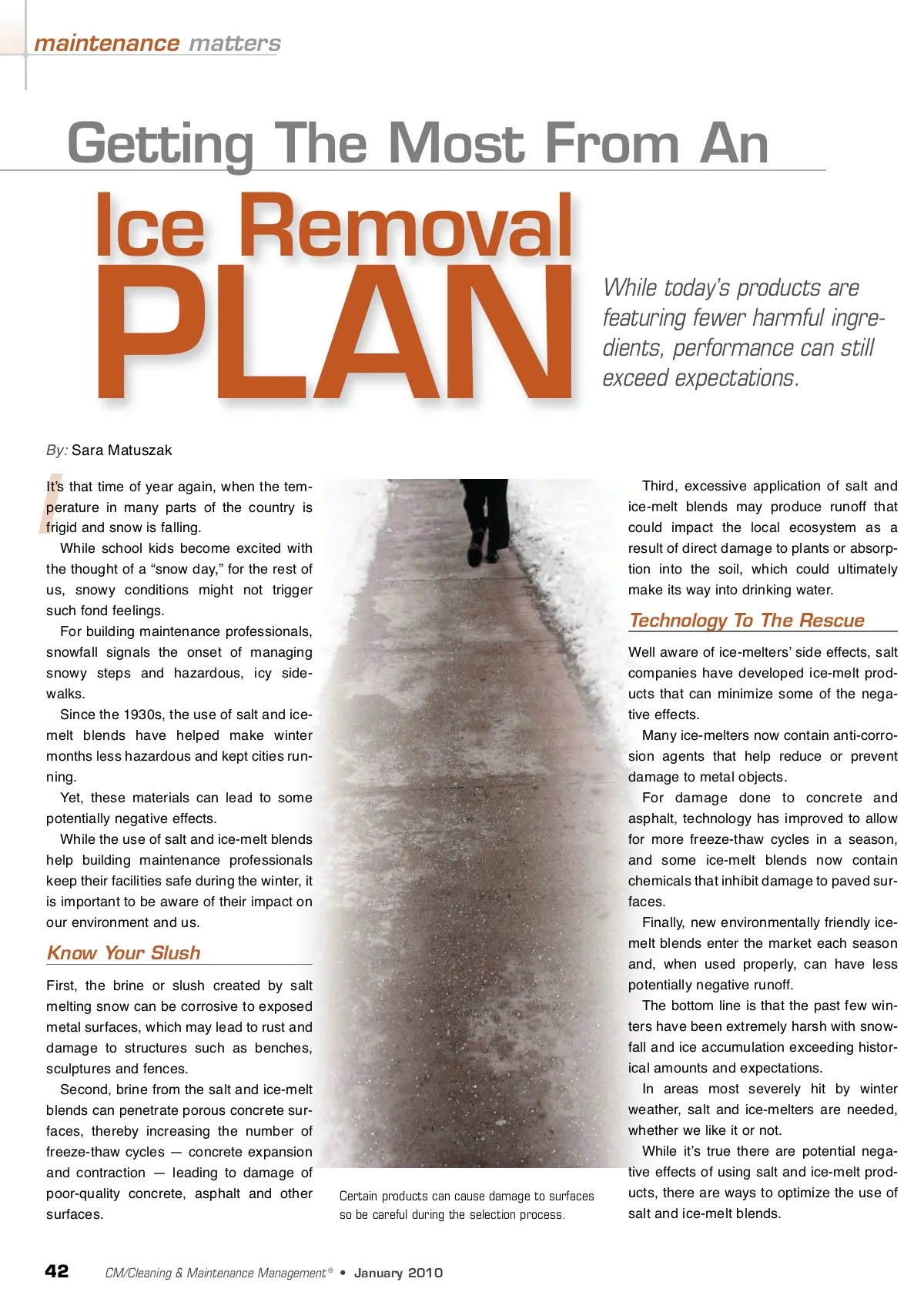
maintenance matters Getting The Most From An PLAN By: Sara Matuszak Ice Removal While today’s products are featuring fewer harmful ingre-dients, performance can still exceed expectations. I Itʼs that time of year again, when the tem-perature in many parts of the country is frigid and snow is falling. While school kids become excited with the thought of a “snow day,” for the rest of us, snowy conditions might not trigger such fond feelings. For building maintenance professionals, snowfall signals the onset of managing snowy steps and hazardous, icy side-walks. Since the 1930s, the use of salt and ice-melt blends have helped make winter months less hazardous and kept cities run-ning. Yet, these materials can lead to some potentially negative effects. While the use of salt and ice-melt blends help building maintenance professionals keep their facilities safe during the winter, it is important to be aware of their impact on our environment and us. Third, excessive application of salt and ice-melt blends may produce runoff that could impact the local ecosystem as a result of direct damage to plants or absorp-tion into the soil, which could ultimately make its way into drinking water. Technology To The Rescue Well aware of ice-meltersʼ side effects, salt companies have developed ice-melt prod-ucts that can minimize some of the nega-tive effects. Many ice-melters now contain anti-corro-sion agents that help reduce or prevent damage to metal objects. For damage done to concrete and asphalt, technology has improved to allow for more freeze-thaw cycles in a season, and some ice-melt blends now contain chemicals that inhibit damage to paved sur-faces. Finally, new environmentally friendly ice-melt blends enter the market each season and, when used properly, can have less potentially negative runoff. The bottom line is that the past few win-ters have been extremely harsh with snow-fall and ice accumulation exceeding histor-ical amounts and expectations. In areas most severely hit by winter weather, salt and ice-melters are needed, whether we like it or not. While itʼs true there are potential nega-tive effects of using salt and ice-melt prod-ucts, there are ways to optimize the use of salt and ice-melt blends. Know Your Slush First, the brine or slush created by salt melting snow can be corrosive to exposed metal surfaces, which may lead to rust and damage to structures such as benches, sculptures and fences. Second, brine from the salt and ice-melt blends can penetrate porous concrete sur-faces, thereby increasing the number of freeze-thaw cycles — concrete expansion and contraction — leading to damage of poor-quality concrete, asphalt and other surfaces. Certain products can cause damage to surfaces so be careful during the selection process. 42 CM/Cleaning & Maintenance Management ® • January 2010
CMM – Archives Jan 2010: 42