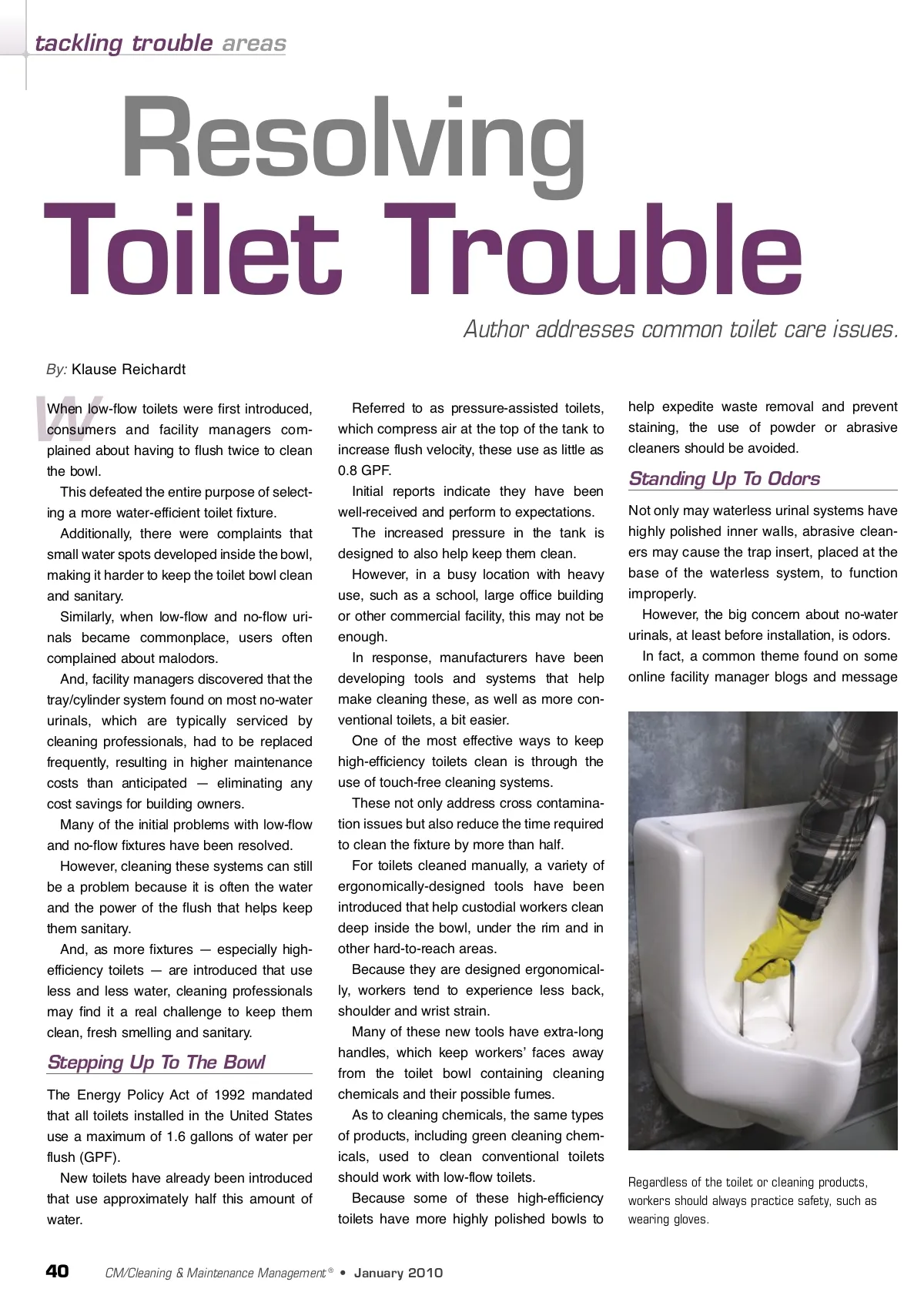
boards is that they like the water and cost savings of no-water urinals, but not the smell. There are different reasons why odors may be present, some of which have nothing to do with the fact that a waterless urinal has been installed. The University of California at Los Angeles (UCLA) conducted a study to determine if odor problems differed between waterless and traditional urinals. The researchers found that urinal odors in general were more a function of urine on floors and surrounding surfaces than the type of urinal installed. In most cases, when there are odor prob-lems with waterless urinal systems, it is because they are not being maintained prop-erly, according to Douglas Yon, a project manager with Facility Engineering Associates (FEA) and David Cosaboon, a staff engineer with FEA. This is usually because custodial workers have not been taught how to properly clean them. Some of the areas to check and ways to prevent odor problems include: Look to see that the trap insert is cor-rectly placed and seated in the drain. This helps prevent sewer odors from being released. To perform correctly, most urinal sys-tems require a sealing liquid to be poured into the trap. Check to see if this needs to be replenished. Many waterless urinal manufacturers will advise using certain cleaning chem-icals and products for their systems. It is best to follow their instructions. Wipe clean all areas of the urinal. If dis-infectants are used, allow for proper “dwell” time before wiping clean. Because the inner surface of a waterless system stays dry, it actually minimizes the possibility of bacteria to develop. It is the growth of bacteria that causes odors in most water-based urinal systems; this makes proper cleaning and maintenance all the more important. Further, in studies conducted by Julius Ballanco, president of JB Engineering Sales Company Inc. and Code Consulting Inc. in Munster, Indiana, waterless systems pro-duce no unusual odor problem as long as the manufacturerʼs recommendations for main-taining the urinal are followed. Ultimately, for both high-efficiency toilets and no-water urinals, proper training is the key to keeping these systems clean, sanitary and free of odors and problems. And, just as introducing green cleaning products to a facility has proven to be an opportunity to retrain workers on proper cleaning procedures, the introduction of water-efficient toilets and urinals can be an opportunity to fine-tune restroom cleaning skills. CM Klaus Reichardt is founder and managing partner of Waterless Company. He is also a frequent author and presenter regarding water conservation issues. He may be reached at [email protected]. www.cmmonline.com 41
CMM – Archives Jan 2010: 41