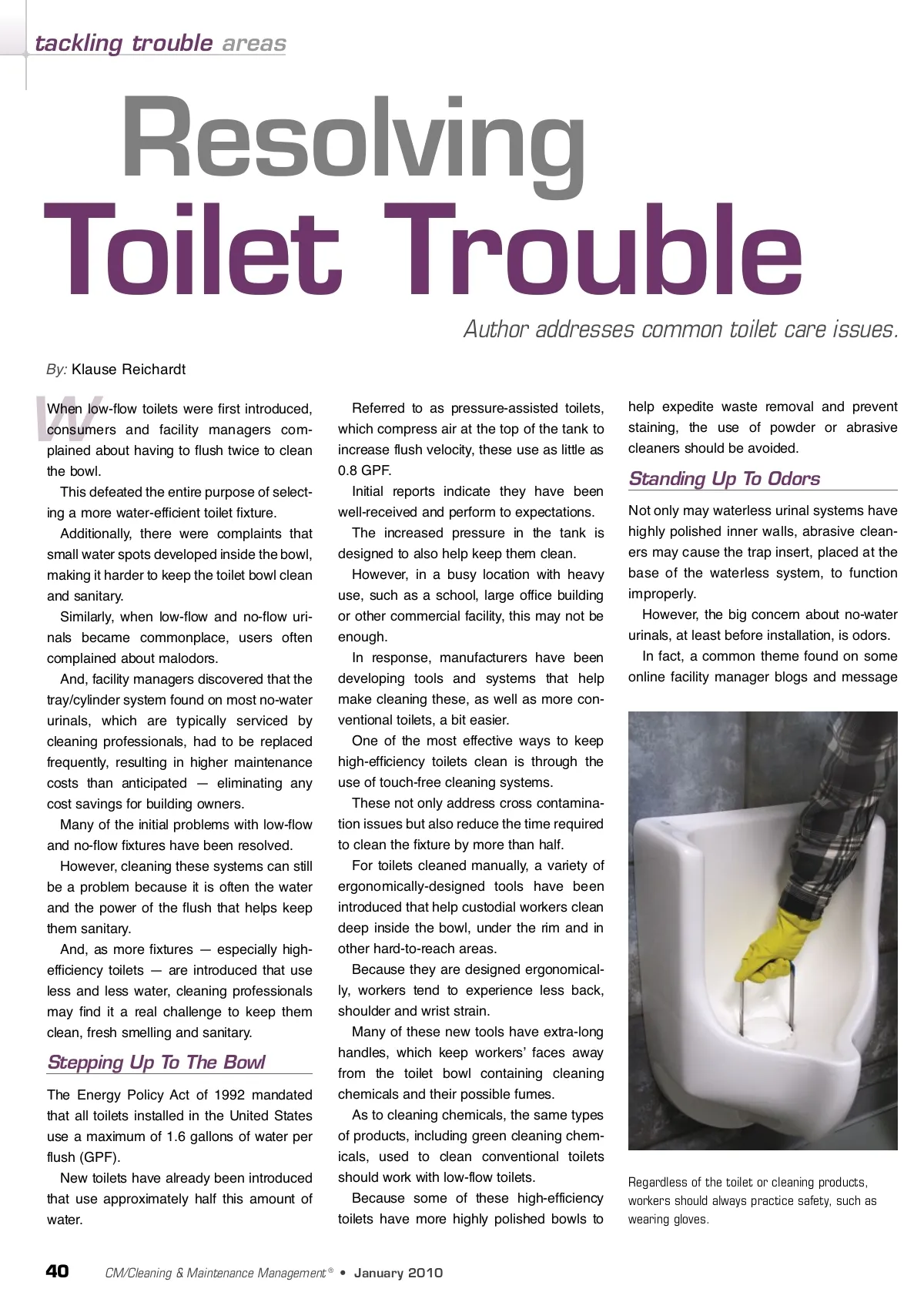
tackling trouble areas Resolving Toilet Trouble By: Klause Reichardt Author addresses common toilet care issues. help expedite waste removal and prevent staining, the use of powder or abrasive cleaners should be avoided. W When low-flow toilets were first introduced, consumers and facility managers com-plained about having to flush twice to clean the bowl. This defeated the entire purpose of select-ing a more water-efficient toilet fixture. Additionally, there were complaints that small water spots developed inside the bowl, making it harder to keep the toilet bowl clean and sanitary. Similarly, when low-flow and no-flow uri-nals became commonplace, users often complained about malodors. And, facility managers discovered that the tray/cylinder system found on most no-water urinals, which are typically serviced by cleaning professionals, had to be replaced frequently, resulting in higher maintenance costs than anticipated — eliminating any cost savings for building owners. Many of the initial problems with low-flow and no-flow fixtures have been resolved. However, cleaning these systems can still be a problem because it is often the water and the power of the flush that helps keep them sanitary. And, as more fixtures — especially high-efficiency toilets — are introduced that use less and less water, cleaning professionals may find it a real challenge to keep them clean, fresh smelling and sanitary. Stepping Up To The Bowl The Energy Policy Act of 1992 mandated that all toilets installed in the United States use a maximum of 1.6 gallons of water per flush (GPF). New toilets have already been introduced that use approximately half this amount of water. Referred to as pressure-assisted toilets, which compress air at the top of the tank to increase flush velocity, these use as little as 0.8 GPF. Initial reports indicate they have been well-received and perform to expectations. The increased pressure in the tank is designed to also help keep them clean. However, in a busy location with heavy use, such as a school, large office building or other commercial facility, this may not be enough. In response, manufacturers have been developing tools and systems that help make cleaning these, as well as more con-ventional toilets, a bit easier. One of the most effective ways to keep high-efficiency toilets clean is through the use of touch-free cleaning systems. These not only address cross contamina-tion issues but also reduce the time required to clean the fixture by more than half. For toilets cleaned manually, a variety of ergonomically-designed tools have been introduced that help custodial workers clean deep inside the bowl, under the rim and in other hard-to-reach areas. Because they are designed ergonomical-ly, workers tend to experience less back, shoulder and wrist strain. Many of these new tools have extra-long handles, which keep workersʼ faces away from the toilet bowl containing cleaning chemicals and their possible fumes. As to cleaning chemicals, the same types of products, including green cleaning chem-icals, used to clean conventional toilets should work with low-flow toilets. Because some of these high-efficiency toilets have more highly polished bowls to Standing Up To Odors Not only may waterless urinal systems have highly polished inner walls, abrasive clean-ers may cause the trap insert, placed at the base of the waterless system, to function improperly. However, the big concern about no-water urinals, at least before installation, is odors. In fact, a common theme found on some online facility manager blogs and message Regardless of the toilet or cleaning products, workers should always practice safety, such as wearing gloves. 40 CM/Cleaning & Maintenance Management ® • January 2010
CMM – Archives Jan 2010: 40