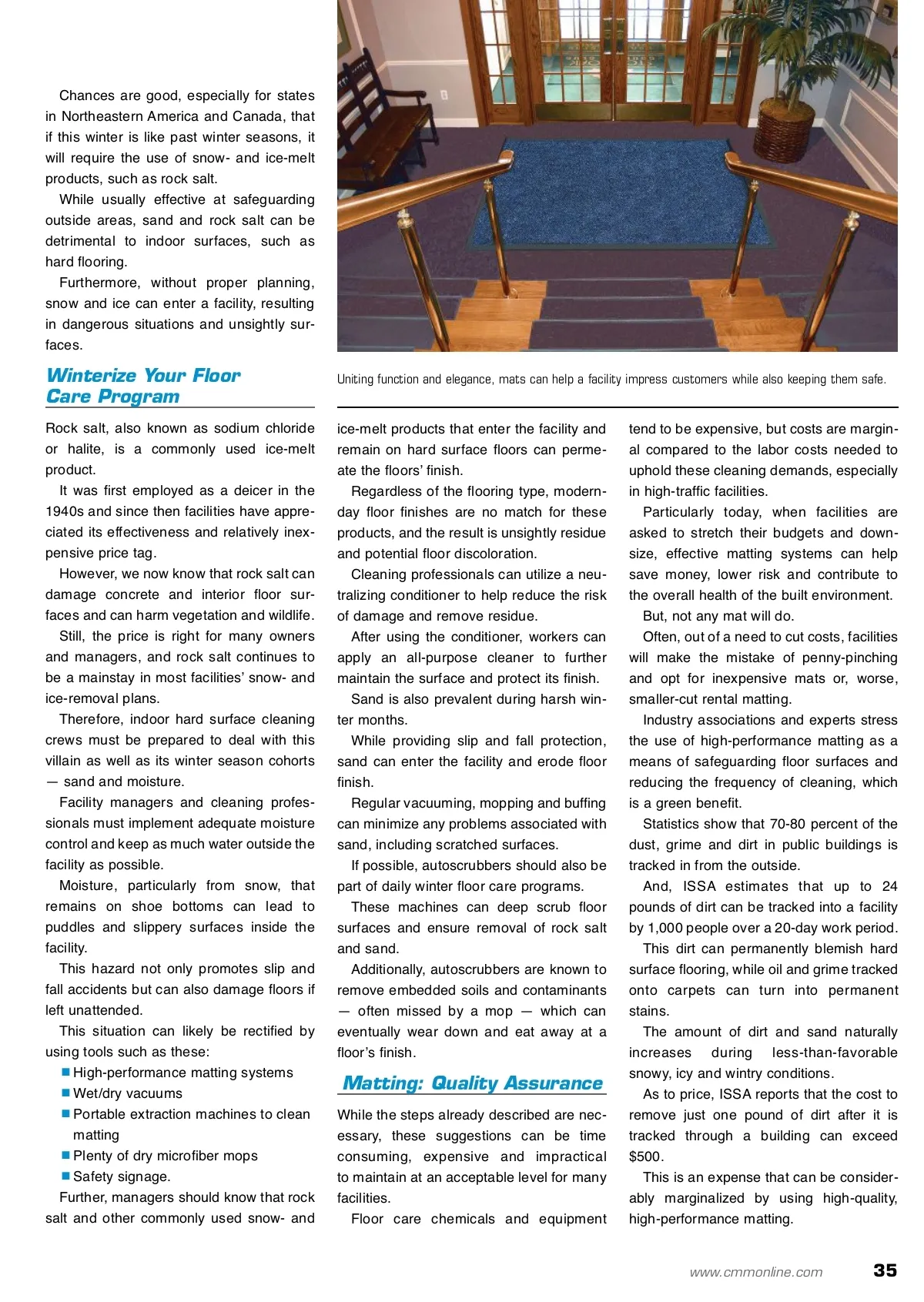
Chances are good, especially for states in Northeastern America and Canada, that if this winter is like past winter seasons, it will require the use of snow-and ice-melt products, such as rock salt. While usually effective at safeguarding outside areas, sand and rock salt can be detrimental to indoor surfaces, such as hard flooring. Furthermore, without proper planning, snow and ice can enter a facility, resulting in dangerous situations and unsightly sur-faces. Winterize Your Floor Care Program Rock salt, also known as sodium chloride or halite, is a commonly used ice-melt product. It was first employed as a deicer in the 1940s and since then facilities have appre-ciated its effectiveness and relatively inex-pensive price tag. However, we now know that rock salt can damage concrete and interior floor sur-faces and can harm vegetation and wildlife. Still, the price is right for many owners and managers, and rock salt continues to be a mainstay in most facilitiesʼ snow-and ice-removal plans. Therefore, indoor hard surface cleaning crews must be prepared to deal with this villain as well as its winter season cohorts — sand and moisture. Facility managers and cleaning profes-sionals must implement adequate moisture control and keep as much water outside the facility as possible. Moisture, particularly from snow, that remains on shoe bottoms can lead to puddles and slippery surfaces inside the facility. This hazard not only promotes slip and fall accidents but can also damage floors if left unattended. This situation can likely be rectified by using tools such as these: High-performance matting systems Wet/dry vacuums Portable extraction machines to clean matting Plenty of dry microfiber mops Safety signage. Further, managers should know that rock salt and other commonly used snow-and Uniting function and elegance, mats can help a facility impress customers while also keeping them safe. ice-melt products that enter the facility and remain on hard surface floors can perme-ate the floorsʼ finish. Regardless of the flooring type, modern-day floor finishes are no match for these products, and the result is unsightly residue and potential floor discoloration. Cleaning professionals can utilize a neu-tralizing conditioner to help reduce the risk of damage and remove residue. After using the conditioner, workers can apply an all-purpose cleaner to further maintain the surface and protect its finish. Sand is also prevalent during harsh win-ter months. While providing slip and fall protection, sand can enter the facility and erode floor finish. Regular vacuuming, mopping and buffing can minimize any problems associated with sand, including scratched surfaces. If possible, autoscrubbers should also be part of daily winter floor care programs. These machines can deep scrub floor surfaces and ensure removal of rock salt and sand. Additionally, autoscrubbers are known to remove embedded soils and contaminants — often missed by a mop — which can eventually wear down and eat away at a floorʼs finish. Matting: Quality Assurance While the steps already described are nec-essary, these suggestions can be time consuming, expensive and impractical to maintain at an acceptable level for many facilities. Floor care chemicals and equipment tend to be expensive, but costs are margin-al compared to the labor costs needed to uphold these cleaning demands, especially in high-traffic facilities. Particularly today, when facilities are asked to stretch their budgets and down-size, effective matting systems can help save money, lower risk and contribute to the overall health of the built environment. But, not any mat will do. Often, out of a need to cut costs, facilities will make the mistake of penny-pinching and opt for inexpensive mats or, worse, smaller-cut rental matting. Industry associations and experts stress the use of high-performance matting as a means of safeguarding floor surfaces and reducing the frequency of cleaning, which is a green benefit. Statistics show that 70-80 percent of the dust, grime and dirt in public buildings is tracked in from the outside. And, ISSA estimates that up to 24 pounds of dirt can be tracked into a facility by 1,000 people over a 20-day work period. This dirt can permanently blemish hard surface flooring, while oil and grime tracked onto carpets can turn into permanent stains. The amount of dirt and sand naturally increases during less-than-favorable snowy, icy and wintry conditions. As to price, ISSA reports that the cost to remove just one pound of dirt after it is tracked through a building can exceed $500. This is an expense that can be consider-ably marginalized by using high-quality, high-performance matting. www.cmmonline.com 35
CMM – Archives Jan 2010: 35