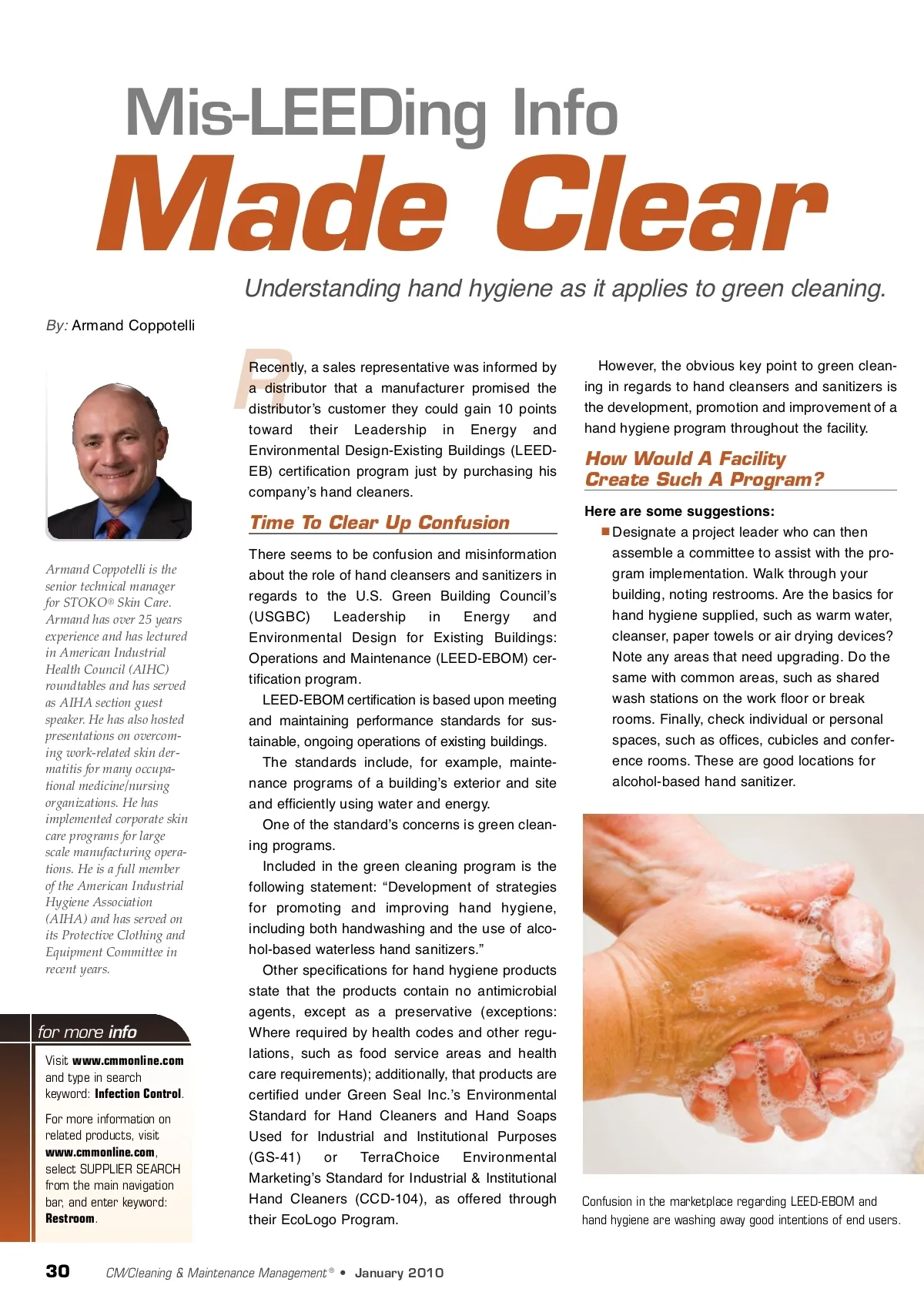
Mis-LEEDing Info Made Clear By: Armand Coppotelli Understanding hand hygiene as it applies to green cleaning. Recently, a sales representative was informed by a distributor that a manufacturer promised the distributorʼs customer they could gain 10 points toward their Leadership in Energy and Environmental Design-Existing Buildings (LEED-EB) certification program just by purchasing his companyʼs hand cleaners. However, the obvious key point to green clean-ing in regards to hand cleansers and sanitizers is the development, promotion and improvement of a hand hygiene program throughout the facility. R Armand Coppotelli is the senior technical manager for STOKO ® Skin Care. Armand has over 25 years experience and has lectured in American Industrial Health Council (AIHC) roundtables and has served as AIHA section guest speaker. He has also hosted presentations on overcom-ing work-related skin der-matitis for many occupa-tional medicine/nursing organizations. He has implemented corporate skin care programs for large scale manufacturing opera-tions. He is a full member of the American Industrial Hygiene Association (AIHA) and has served on its Protective Clothing and Equipment Committee in recent years. How Would A Facility Create Such A Program? Here are some suggestions: Designate a project leader who can then assemble a committee to assist with the pro-gram implementation. Walk through your building, noting restrooms. Are the basics for hand hygiene supplied, such as warm water, cleanser, paper towels or air drying devices? Note any areas that need upgrading. Do the same with common areas, such as shared wash stations on the work floor or break rooms. Finally, check individual or personal spaces, such as offices, cubicles and confer-ence rooms. These are good locations for alcohol-based hand sanitizer. Time To Clear Up Confusion There seems to be confusion and misinformation about the role of hand cleansers and sanitizers in regards to the U.S. Green Building Councilʼs (USGBC) Leadership in Energy and Environmental Design for Existing Buildings: Operations and Maintenance (LEED-EBOM) cer-tification program. LEED-EBOM certification is based upon meeting and maintaining performance standards for sus-tainable, ongoing operations of existing buildings. The standards include, for example, mainte-nance programs of a buildingʼs exterior and site and efficiently using water and energy. One of the standardʼs concerns is green clean-ing programs. Included in the green cleaning program is the following statement: “Development of strategies for promoting and improving hand hygiene, including both handwashing and the use of alco-hol-based waterless hand sanitizers.” Other specifications for hand hygiene products state that the products contain no antimicrobial agents, except as a preservative (exceptions: Where required by health codes and other regu-lations, such as food service areas and health care requirements); additionally, that products are certified under Green Seal Inc.ʼs Environmental Standard for Hand Cleaners and Hand Soaps Used for Industrial and Institutional Purposes (GS-41) or TerraChoice Environmental Marketingʼs Standard for Industrial & Institutional Hand Cleaners (CCD-104), as offered through their EcoLogo Program. for more info Visit www.cmmonline.com and type in search keyword: Infection Control . For more information on related products, visit www.cmmonline.com , select SUPPLIER SEARCH from the main navigation bar, and enter keyword: Restroom . Confusion in the marketplace regarding LEED-EBOM and hand hygiene are washing away good intentions of end users. 30 CM/Cleaning & Maintenance Management ® • January 2010
CMM – Archives Jan 2010: 30