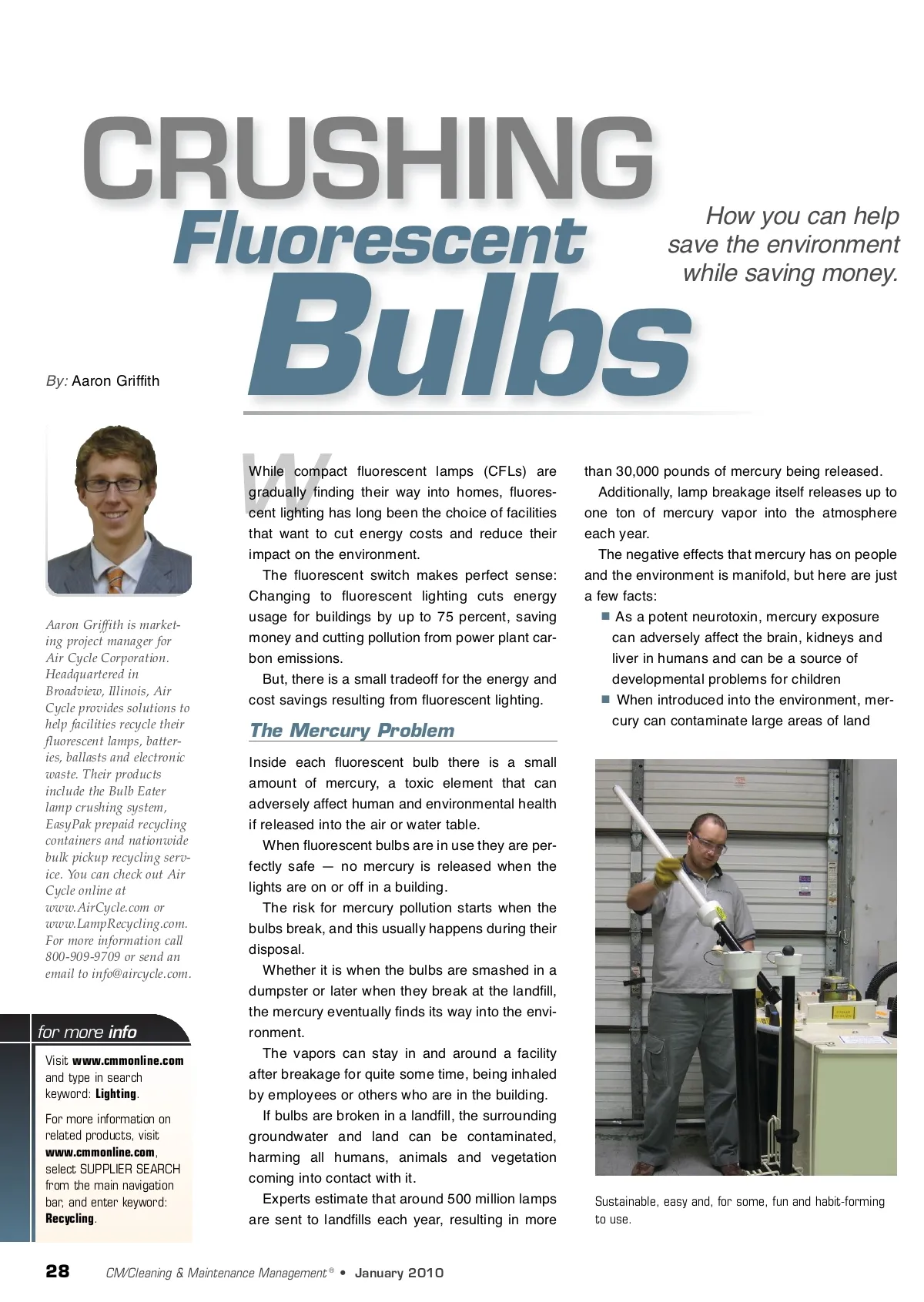
and water, accumulating in wildlife — usually fish — which in turn are eaten by humans and other animals Mercury is so potent that just one gram of it from the atmosphere can contaminate a 20-acre lake for one year. Frustrating Solutions The potential effect of millions of mercury-containing bulbs being improperly disposed of by thousands of facilities is a harrowing prospect. Fortunately, once facilities started learning about the hazards resulting from throwing lamps away in the trash, most started looking for a safer method of disposal. Facilities also discovered that it wasnʼt that expensive to recycle: Over the lifetime of a lamp, the cost of recycling is less than one percent of the total cost of ownership. Recycling lamps became the accepted disposal method as the mercury can be safely removed by machinery at special-ized recycling centers. Additionally, government regulations have been established in many states requiring facilities to dispose of their bulbs through certified recyclers. Employees collect bulbs and stack them in boxes, and once the pile gets big enough, they call to get them picked up. Boxing bulbs and ordering recycling pick-ups is commonplace, but facility staff can become frustrated as the process con-sumes valuable time and floor space. Mark Funkhouser, a facility manager in Santa Ynez, California, knows firsthand about the bulk bulb pickup hassle. His 120-person staff spent significant amounts of time collecting spent lamps in their building complex and boxing them for pickup. “We wasted a lot of time coordinating the pickup or drop-off of recyclables,” Funkhouser states. “It required a lot of atten-tion … it required labor because we had to pack the bulbs in different kinds of bins and place them wherever the pickup was going to be. We also were never sure of the outside contactorʼs schedule, so we really didnʼt know when he was going to come.” Funkhouser and his staff werenʼt alone in their frustration. Sheela Backen, integrated solid waste program manager at Colorado State University, oversaw a similarly complex and expensive method of bulb recycling. Backenʼs staff would pack lamps into their original cartons and load them onto a truck for transport back to a recycling facility. “That method presented a lot of prob-lems,” Backen says. “We couldnʼt get peo-ple to make sure the cartons were full, taped and marked with the date. When the truck was coming to pick them up, we would have anywhere from six to eight peo-ple filling boxes, taping them back up and then loading this truck. It was not cost-effective at all.” Lamp Crushing: A Smart Alternative Itʼs troubling that facilities trying to do the right thing by recycling their bulbs get stuck with inefficient and expensive pick-ups — not to mention piles of boxes filled with spent lamps sitting around their ware-houses. However, an alternative method of bulb disposal has emerged that rewards facili-ties and their staff with low costs, increased efficiency, space savings and environmen-tal benefits: Lamp crushing. This method is actually as simple as it sounds. Once they reach the end of their life, lamps are fed into a machine that breaks them down into tiny pieces. Many lamp crushers also have a filter that captures mercury vapors from the bro-ken tubes. After crushing, the material is picked up by a recycler for further processing. The savings from crushing lamps comes from the reduced cost in their pickup and transportation compared to an intact lamp pickup: Crushed lamps take up a smaller amount of space during transport and since they have already been processed, the cost of recycling the crushed material is much lower. Here are some specific details about ben-efits from using a lamp crushing system: Because the machine can crush a four-foot lamp in just one second, a facility can reduce labor by 20 hours per 1,000 lamps versus boxing up lamps for pickup Facilities can save up to 50 percent on recycling costs when they sched-ule a bulk recycling pickup for their crushed lamps Since hundreds of lamps fit into one 55-gallon drum, facilities can minimize their spent lamp storage space by using a crusher Crushing bulbs eliminates the fuss of dealing with piles of boxes filled with spent lamps. Backen describes her facilityʼs experi-ence with lamp crushing: “The bulbs are brought to a specific location. I send one person over there for a couple hours a week to crush the tubes. Itʼs very quick and efficient, and I donʼt have to waste so much time trying to load a truck.” Large facilities like hospitals are also seeing positive results by crushing their lamps. Vince Celtre of Vassar Brothers Medical Center in Poughkeepsie, New York, says, “[Crushing lamps] saved us a tremendous amount of storage space. We used to box our bulbs, place them on pallets and shrink wrap them, so it has saved us in labor as well.” Paul Lewis of UnumProvident Insurance says that crushing lamps “has cut my expenses by $15,000 a year and now Iʼm spending virtually nothing for recycling.” Crushing bulbs can even get a little addictive for some facility staff. Brian Weeks of Lakeland Regional Medical Center in Lakeland, Florida, saw his employees getting hooked on the whole idea: “We like it so much, my guys are run-ning around looking for spare tubes to crush. Weʼve already reorganized the warehouse and it couldnʼt have been neater or cleaner.” A Logical Solution Everyone that recycles their fluorescent bulbs is doing their part to reduce the bur-den of mercury on the environment. There are people crushing lamps all over the world that are helping the environment while simultaneously saving money, time and space for their facilities. Consider checking out lamp crushers if you are interested in keeping the environ-ment healthy while making life a little easi-er for your facility. CM www.cmmonline.com 29
CMM – Archives Jan 2010: 29