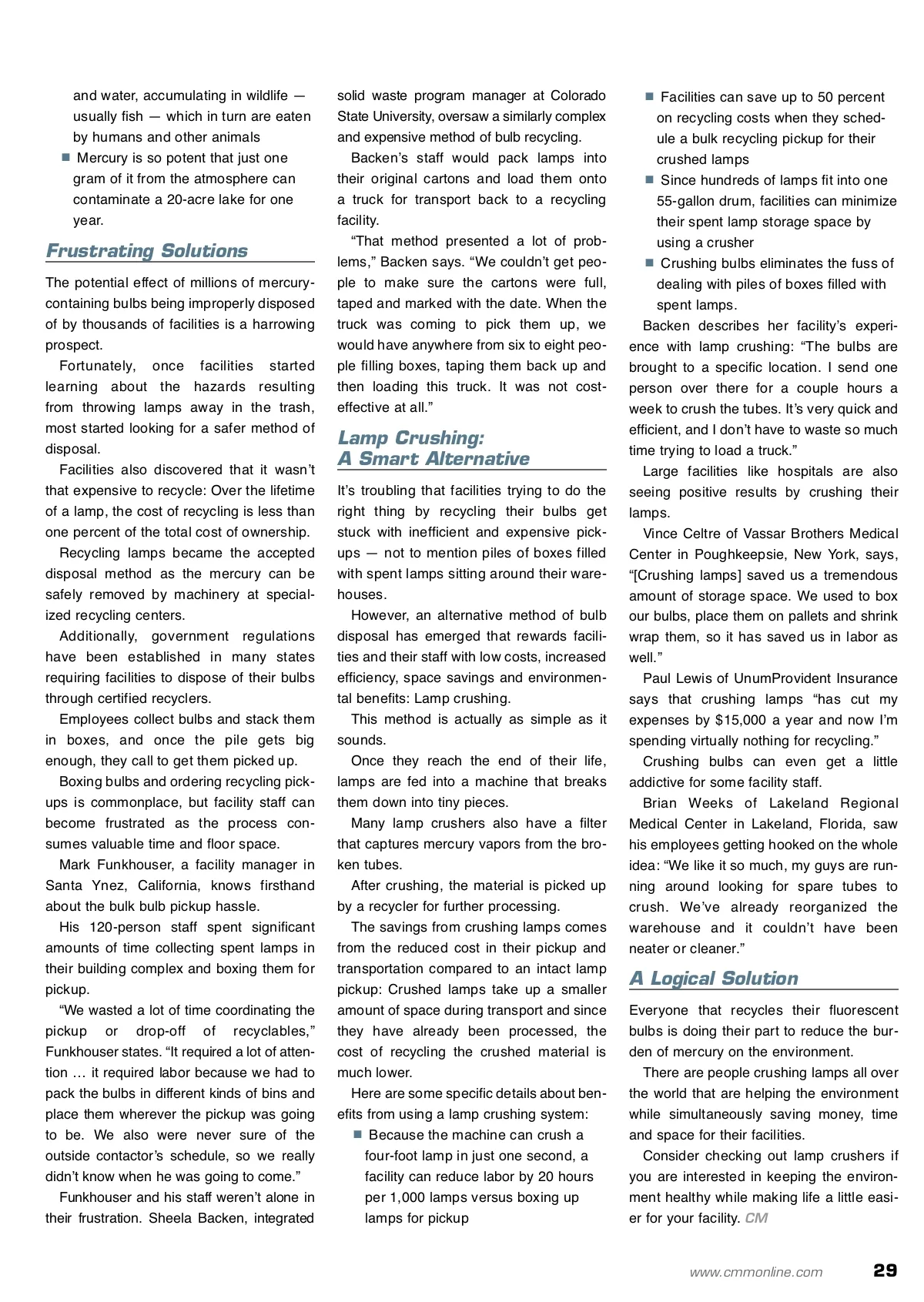
CRUSHING Fluorescent By: Aaron Griffith Bulbs While compact fluorescent lamps (CFLs) are gradually finding their way into homes, fluores-cent lighting has long been the choice of facilities that want to cut energy costs and reduce their impact on the environment. The fluorescent switch makes perfect sense: Changing to fluorescent lighting cuts energy usage for buildings by up to 75 percent, saving money and cutting pollution from power plant car-bon emissions. But, there is a small tradeoff for the energy and cost savings resulting from fluorescent lighting. How you can help save the environment while saving money. W Aaron Griffith is market-ing project manager for Air Cycle Corporation. Headquartered in Broadview, Illinois, Air Cycle provides solutions to help facilities recycle their fluorescent lamps, batter-ies, ballasts and electronic waste. Their products include the Bulb Eater lamp crushing system, EasyPak prepaid recycling containers and nationwide bulk pickup recycling serv-ice. You can check out Air Cycle online at www.AirCycle.com or www.LampRecycling.com. For more information call 800-909-9709 or send an email to [email protected]. The Mercury Problem Inside each fluorescent bulb there is a small amount of mercury, a toxic element that can adversely affect human and environmental health if released into the air or water table. When fluorescent bulbs are in use they are per-fectly safe — no mercury is released when the lights are on or off in a building. The risk for mercury pollution starts when the bulbs break, and this usually happens during their disposal. Whether it is when the bulbs are smashed in a dumpster or later when they break at the landfill, the mercury eventually finds its way into the envi-ronment. The vapors can stay in and around a facility after breakage for quite some time, being inhaled by employees or others who are in the building. If bulbs are broken in a landfill, the surrounding groundwater and land can be contaminated, harming all humans, animals and vegetation coming into contact with it. Experts estimate that around 500 million lamps are sent to landfills each year, resulting in more than 30,000 pounds of mercury being released. Additionally, lamp breakage itself releases up to one ton of mercury vapor into the atmosphere each year. The negative effects that mercury has on people and the environment is manifold, but here are just a few facts: As a potent neurotoxin, mercury exposure can adversely affect the brain, kidneys and liver in humans and can be a source of developmental problems for children When introduced into the environment, mer-cury can contaminate large areas of land for more info Visit www.cmmonline.com and type in search keyword: Lighting . For more information on related products, visit www.cmmonline.com , select SUPPLIER SEARCH from the main navigation bar, and enter keyword: Recycling . Sustainable, easy and, for some, fun and habit-forming to use. 28 CM/Cleaning & Maintenance Management ® • January 2010
CMM – Archives Jan 2010: 28