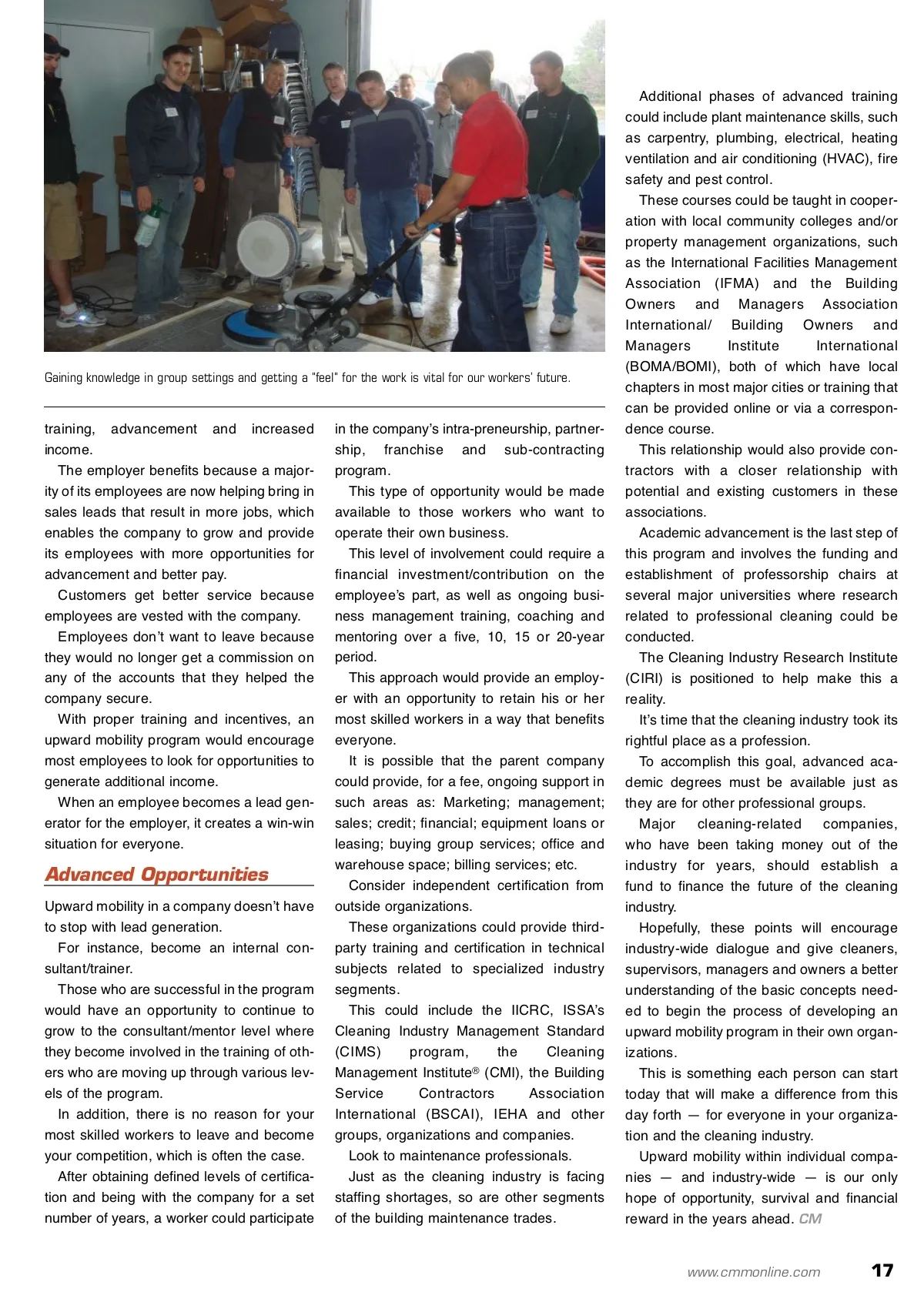
Gaining knowledge in group settings and getting a "feel" for the work is vital for our workers’ future. training, advancement and increased income. The employer benefits because a major-ity of its employees are now helping bring in sales leads that result in more jobs, which enables the company to grow and provide its employees with more opportunities for advancement and better pay. Customers get better service because employees are vested with the company. Employees donʼt want to leave because they would no longer get a commission on any of the accounts that they helped the company secure. With proper training and incentives, an upward mobility program would encourage most employees to look for opportunities to generate additional income. When an employee becomes a lead gen-erator for the employer, it creates a win-win situation for everyone. Advanced Opportunities Upward mobility in a company doesnʼt have to stop with lead generation. For instance, become an internal con-sultant/trainer. Those who are successful in the program would have an opportunity to continue to grow to the consultant/mentor level where they become involved in the training of oth-ers who are moving up through various lev-els of the program. In addition, there is no reason for your most skilled workers to leave and become your competition, which is often the case. After obtaining defined levels of certifica-tion and being with the company for a set number of years, a worker could participate in the companyʼs intra-preneurship, partner-ship, franchise and sub-contracting program. This type of opportunity would be made available to those workers who want to operate their own business. This level of involvement could require a financial investment/contribution on the employeeʼs part, as well as ongoing busi-ness management training, coaching and mentoring over a five, 10, 15 or 20-year period. This approach would provide an employ-er with an opportunity to retain his or her most skilled workers in a way that benefits everyone. It is possible that the parent company could provide, for a fee, ongoing support in such areas as: Marketing; management; sales; credit; financial; equipment loans or leasing; buying group services; office and warehouse space; billing services; etc. Consider independent certification from outside organizations. These organizations could provide third-party training and certification in technical subjects related to specialized industry segments. This could include the IICRC, ISSAʼs Cleaning Industry Management Standard (CIMS) program, the Cleaning Management Institute ® (CMI), the Building Service Contractors Association International (BSCAI), IEHA and other groups, organizations and companies. Look to maintenance professionals. Just as the cleaning industry is facing staffing shortages, so are other segments of the building maintenance trades. Additional phases of advanced training could include plant maintenance skills, such as carpentry, plumbing, electrical, heating ventilation and air conditioning (HVAC), fire safety and pest control. These courses could be taught in cooper-ation with local community colleges and/or property management organizations, such as the International Facilities Management Association (IFMA) and the Building Owners and Managers Association International/ Building Owners and Managers Institute International (BOMA/BOMI), both of which have local chapters in most major cities or training that can be provided online or via a correspon-dence course. This relationship would also provide con-tractors with a closer relationship with potential and existing customers in these associations. Academic advancement is the last step of this program and involves the funding and establishment of professorship chairs at several major universities where research related to professional cleaning could be conducted. The Cleaning Industry Research Institute (CIRI) is positioned to help make this a reality. Itʼs time that the cleaning industry took its rightful place as a profession. To accomplish this goal, advanced aca-demic degrees must be available just as they are for other professional groups. Major cleaning-related companies, who have been taking money out of the industry for years, should establish a fund to finance the future of the cleaning industry. Hopefully, these points will encourage industry-wide dialogue and give cleaners, supervisors, managers and owners a better understanding of the basic concepts need-ed to begin the process of developing an upward mobility program in their own organ-izations. This is something each person can start today that will make a difference from this day forth — for everyone in your organiza-tion and the cleaning industry. Upward mobility within individual compa-nies — and industry-wide — is our only hope of opportunity, survival and financial reward in the years ahead. CM www.cmmonline.com 17
CMM – Archives Jan 2010: 17