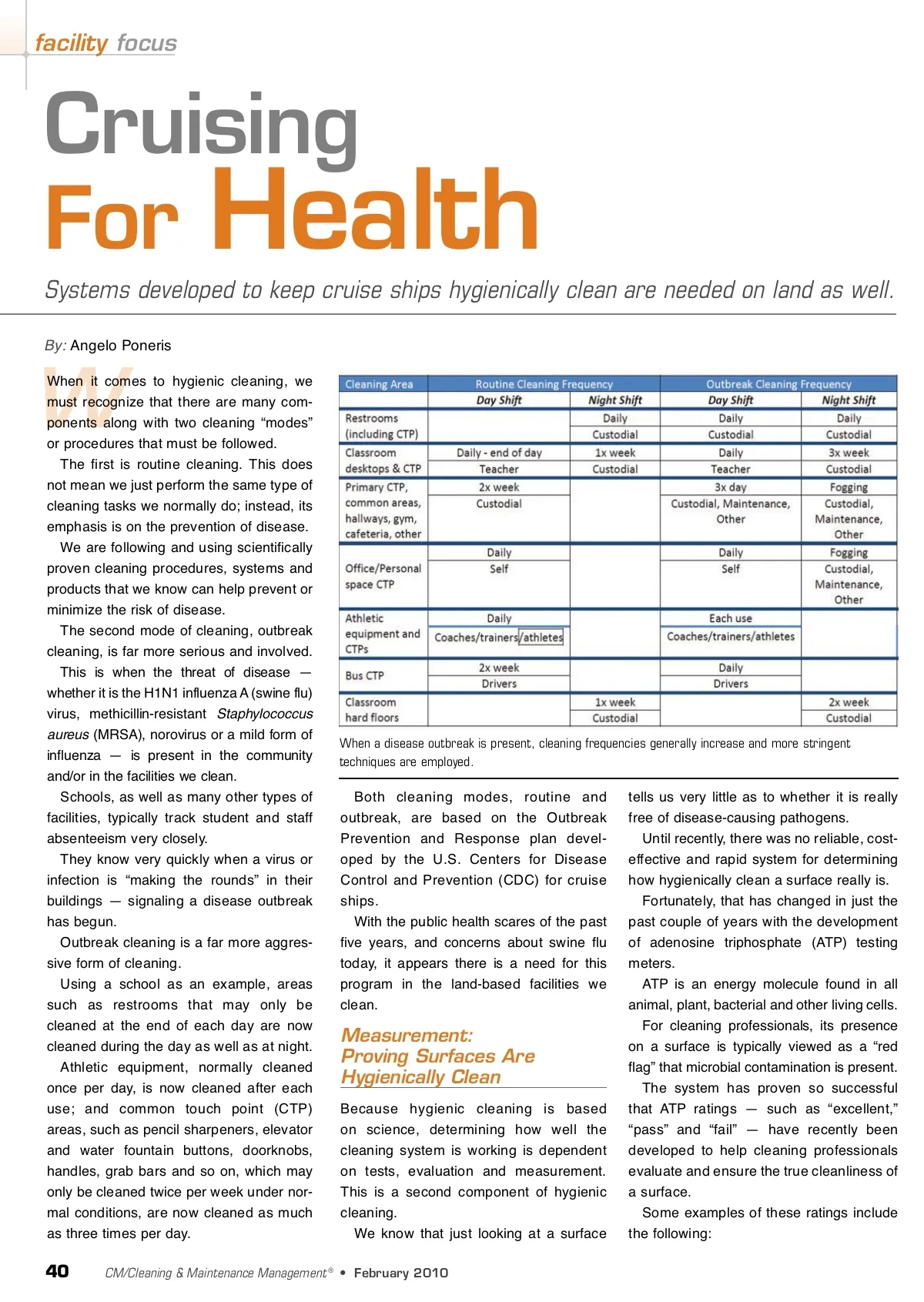
Area Tested Toilet seat Toilet floor Soap dispenser Excellent <15 <20 <20 Pass <30 <60 <60 Fail >30 >60 >60 Tools At Play A third component of hygienic cleaning focuses on the actual tools we use for cleaning. Dr. Charles Gerba, microbiologist at the University of Arizona, says that given the poor cleaning results from using some cleaning tools, there are times when it is best not to clean. This is because we now know, through the use of scientific measurements and ATP metering systems, that some com-monly used cleaning tools actually spread as many contaminants as they remove. For instance, a study was conducted using a disinfectant registered with the U.S. Environmental Protection Agency (EPA), a new, unused microfiber wiping cloth and a conventional spray-and-wipe cleaning method to clean 28 standard classroom desks. All desks were tested using an ATP metering system before cleaning and then again after cleaning. These were the results: The first few desktops cleaned had an improvement in cleanliness and a “pass” ATP rating Thereafter, the majority of desks actu-ally became dirtier, with ATP ratings becoming higher, nearing or surpass-ing the accepted “fail” rating The last desktop tested had a reading double its ATP reading before the cleaning. What occurred here is that the cleaning cloth reached its maximum “load” very quickly, and after the first few desks, it began redepositing soils and contaminants on desk surfaces. Although this study involved classroom desks, similar studies have been conducted on hard surface floors with congruent results. In one study, a floor was thoroughly cleaned and then tested for ATP. It had a “pass” rating of 25, which was used as a benchmark. A grape, which contains high levels of ATP, was spread over the tile floor, result-ing in a very high ATP reading of 7,267. The floor was mopped using a new microfiber mop head soaked in an EPA-registered disinfectant. After cleaning, the ATP levels dropped to 1,479, but surprisingly, the surrounding tile areas saw their ATP reading jump from 25 to nearly 700. In this case, what apparently was hap-pening was that the soils and contaminants on the floor and mop head were actually being spread to nearby floor surfaces. Because of this, Gerba, along with the Cleaning Industry Research Institute (CIRI), encourages the use of more hygien-ic cleaning technologies and practices. One such example is spray-and-vac cleaning systems, otherwise known as no-touch cleaning systems — a machine injects cleaning chemicals onto surfaces, which are then rinsed clean, similar to using a pressure washing system. The process removes soils, which are then vacuumed up using the machineʼs wet vacuum system. With this system, the ATP readings dropped to 27 after cleaning and contami-nants were not spread, but rather removed from the floor surface. The best way to deal with disease is not to treat it, but to prevent it. This is the goal of hygienic cleaning. Implementing different cleaning modes depends on situations and needs. Use ATP metering systems to determine if contaminants have been removed and employ scientifically proven cleaning sys-tems that thoroughly remove pathogens from surfaces. These are necessary parts of an effec-tive, hygienic cleaning system. CM Angelo Poneris is customer service manager for Valley Janitorial Supply Company, a more than 20-year-old janitorial distributorship in Hamilton, Ohio. Circle Product Information no. 214 on page 32 www.cmmonline.com 41
CMM – Archives Feb 2010: 41