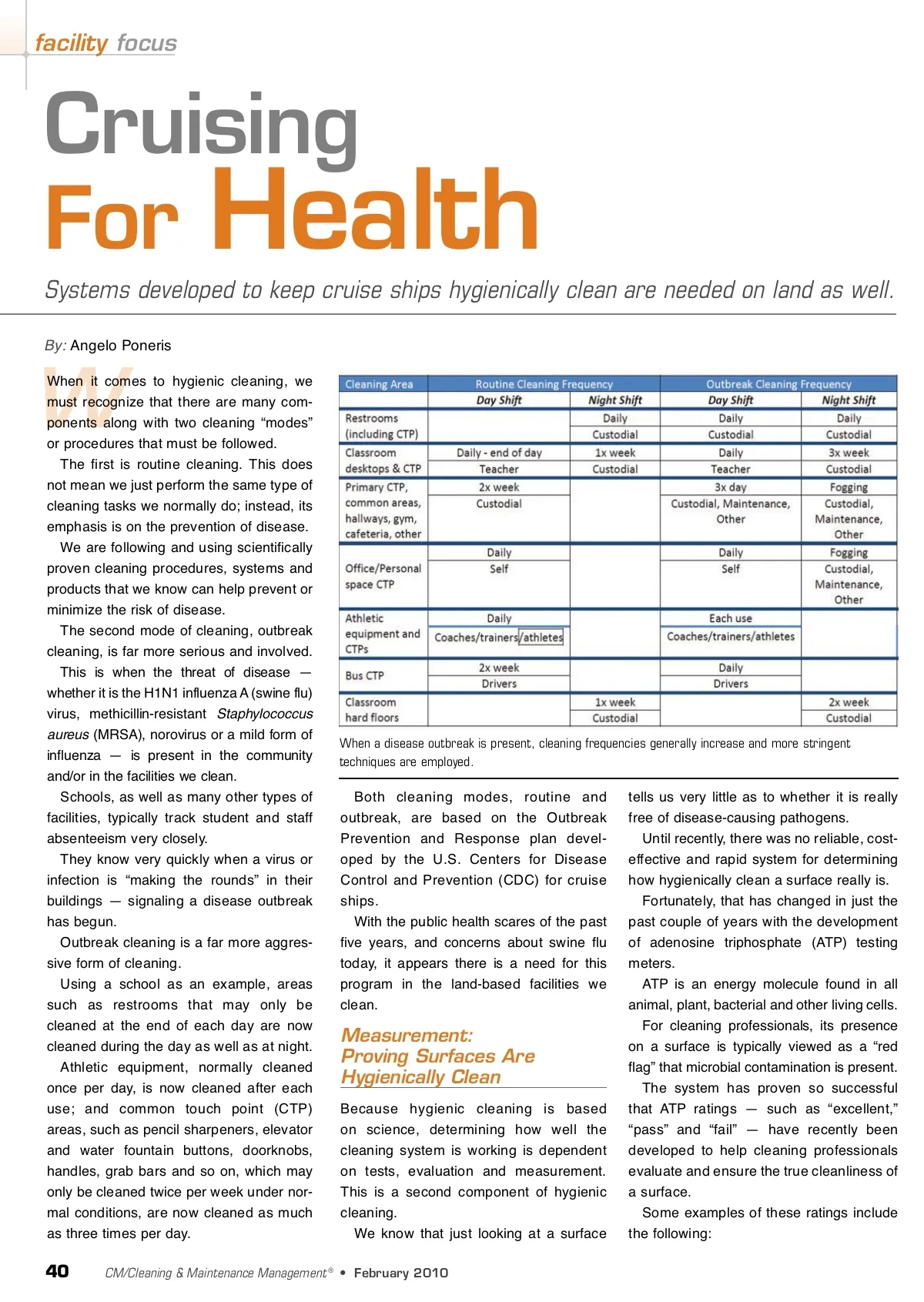
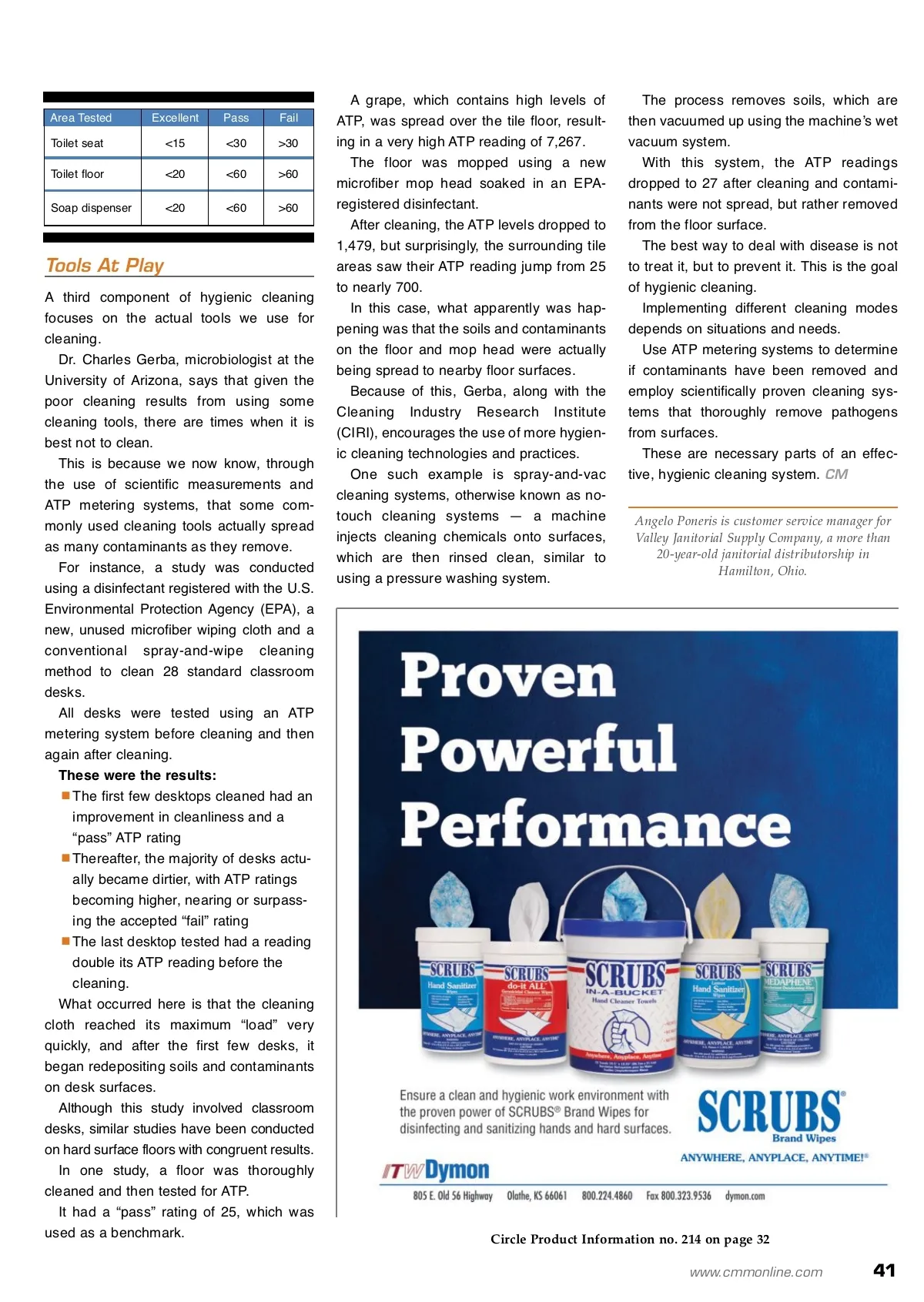
facility focus Cruising For Health Systems developed to keep cruise ships hygienically clean are needed on land as well. By: Angelo Poneris W When it comes to hygienic cleaning, we must recognize that there are many com-ponents along with two cleaning “modes” or procedures that must be followed. The first is routine cleaning. This does not mean we just perform the same type of cleaning tasks we normally do; instead, its emphasis is on the prevention of disease. We are following and using scientifically proven cleaning procedures, systems and products that we know can help prevent or minimize the risk of disease. The second mode of cleaning, outbreak cleaning, is far more serious and involved. This is when the threat of disease — whether it is the H1N1 influenza A (swine flu) virus, methicillin-resistant Staphylococcus aureus (MRSA), norovirus or a mild form of influenza — is present in the community and/or in the facilities we clean. Schools, as well as many other types of facilities, typically track student and staff absenteeism very closely. They know very quickly when a virus or infection is “making the rounds” in their buildings — signaling a disease outbreak has begun. Outbreak cleaning is a far more aggres-sive form of cleaning. Using a school as an example, areas such as restrooms that may only be cleaned at the end of each day are now cleaned during the day as well as at night. Athletic equipment, normally cleaned once per day, is now cleaned after each use; and common touch point (CTP) areas, such as pencil sharpeners, elevator and water fountain buttons, doorknobs, handles, grab bars and so on, which may only be cleaned twice per week under nor-mal conditions, are now cleaned as much as three times per day. When a disease outbreak is present, cleaning frequencies generally increase and more stringent techniques are employed. Both cleaning modes, routine and outbreak, are based on the Outbreak Prevention and Response plan devel-oped by the U.S. Centers for Disease Control and Prevention (CDC) for cruise ships. With the public health scares of the past five years, and concerns about swine flu today, it appears there is a need for this program in the land-based facilities we clean. Measurement: Proving Surfaces Are Hygienically Clean Because hygienic cleaning is based on science, determining how well the cleaning system is working is dependent on tests, evaluation and measurement. This is a second component of hygienic cleaning. We know that just looking at a surface tells us very little as to whether it is really free of disease-causing pathogens. Until recently, there was no reliable, cost-effective and rapid system for determining how hygienically clean a surface really is. Fortunately, that has changed in just the past couple of years with the development of adenosine triphosphate (ATP) testing meters. ATP is an energy molecule found in all animal, plant, bacterial and other living cells. For cleaning professionals, its presence on a surface is typically viewed as a “red flag” that microbial contamination is present. The system has proven so successful that ATP ratings — such as “excellent,” “pass” and “fail” — have recently been developed to help cleaning professionals evaluate and ensure the true cleanliness of a surface. Some examples of these ratings include the following: 40 CM/Cleaning & Maintenance Management ® • February 2010
CMM – Archives Feb 2010: 40