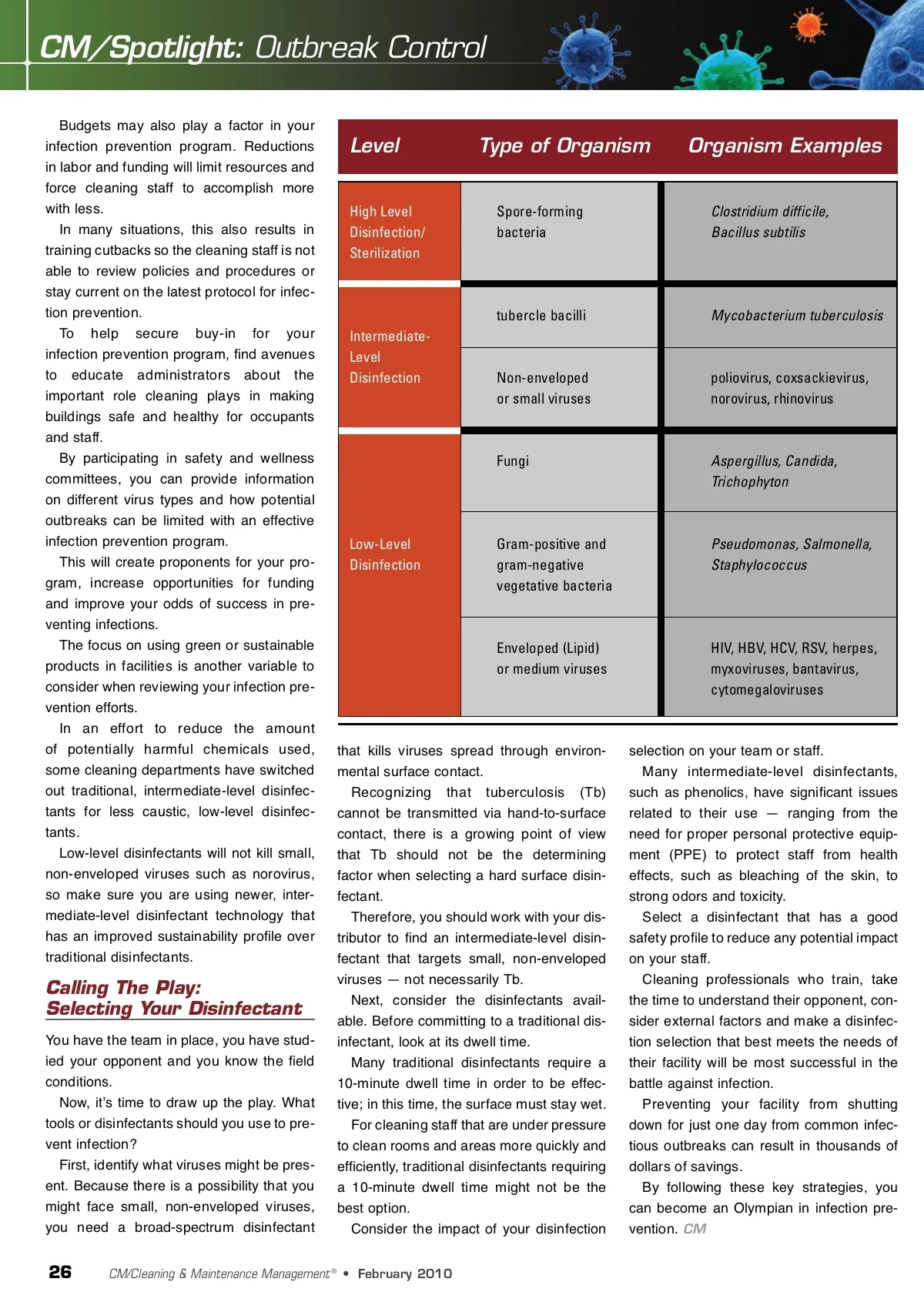
CM/Spotlight: Outbreak Control Budgets may also play a factor in your infection prevention program. Reductions in labor and funding will limit resources and force cleaning staff to accomplish more with less. In many situations, this also results in training cutbacks so the cleaning staff is not able to review policies and procedures or stay current on the latest protocol for infec-tion prevention. To help secure buy-in for your infection prevention program, find avenues to educate administrators about the important role cleaning plays in making buildings safe and healthy for occupants and staff. By participating in safety and wellness committees, you can provide information on different virus types and how potential outbreaks can be limited with an effective infection prevention program. This will create proponents for your pro-gram, increase opportunities for funding and improve your odds of success in pre-venting infections. The focus on using green or sustainable products in facilities is another variable to consider when reviewing your infection pre-vention efforts. In an effort to reduce the amount of potentially harmful chemicals used, some cleaning departments have switched out traditional, intermediate-level disinfec-tants for less caustic, low-level disinfec-tants. Low-level disinfectants will not kill small, non-enveloped viruses such as norovirus, so make sure you are using newer, inter-mediate-level disinfectant technology that has an improved sustainability profile over traditional disinfectants. Level High Level Disinfection/ Sterilization Type of Organism Spore-forming bacteria Organism Examples Clostridium difficile, Bacillus subtilis tubercle bacilli Intermediate-Level Disinfection Mycobacterium tuberculosis Non-enveloped or small viruses poliovirus, coxsackievirus, norovirus, rhinovirus Fungi Aspergillus, Candida, Trichophyton Low-Level Disinfection Gram-positive and gram-negative vegetative bacteria Pseudomonas, Salmonella, Staphylococcus Enveloped (Lipid) or medium viruses HIV, HBV, HCV, RSV, herpes, myxoviruses, bantavirus, cytomegaloviruses Calling The Play: Selecting Your Disinfectant You have the team in place, you have stud-ied your opponent and you know the field conditions. Now, itʼs time to draw up the play. What tools or disinfectants should you use to pre-vent infection? First, identify what viruses might be pres-ent. Because there is a possibility that you might face small, non-enveloped viruses, you need a broad-spectrum disinfectant that kills viruses spread through environ-mental surface contact. Recognizing that tuberculosis (Tb) cannot be transmitted via hand-to-surface contact, there is a growing point of view that Tb should not be the determining factor when selecting a hard surface disin-fectant. Therefore, you should work with your dis-tributor to find an intermediate-level disin-fectant that targets small, non-enveloped viruses — not necessarily Tb. Next, consider the disinfectants avail-able. Before committing to a traditional dis-infectant, look at its dwell time. Many traditional disinfectants require a 10-minute dwell time in order to be effec-tive; in this time, the surface must stay wet. For cleaning staff that are under pressure to clean rooms and areas more quickly and efficiently, traditional disinfectants requiring a 10-minute dwell time might not be the best option. Consider the impact of your disinfection selection on your team or staff. Many intermediate-level disinfectants, such as phenolics, have significant issues related to their use — ranging from the need for proper personal protective equip-ment (PPE) to protect staff from health effects, such as bleaching of the skin, to strong odors and toxicity. Select a disinfectant that has a good safety profile to reduce any potential impact on your staff. Cleaning professionals who train, take the time to understand their opponent, con-sider external factors and make a disinfec-tion selection that best meets the needs of their facility will be most successful in the battle against infection. Preventing your facility from shutting down for just one day from common infec-tious outbreaks can result in thousands of dollars of savings. By following these key strategies, you can become an Olympian in infection pre-vention. CM 26 CM/Cleaning & Maintenance Management ® • February 2010
CMM – Archives Feb 2010: 26