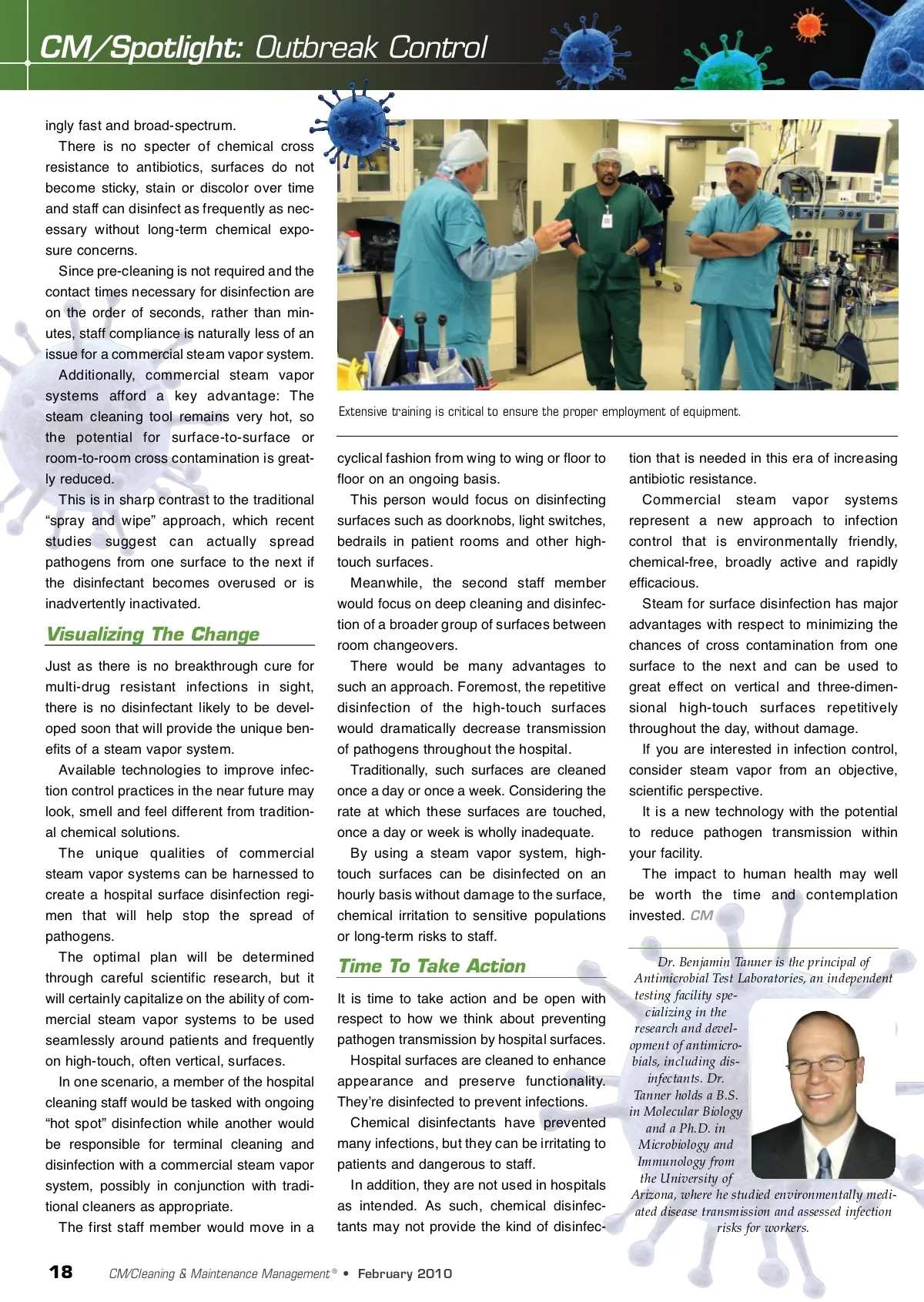
CM/Spotlight: Outbreak Control ingly fast and broad-spectrum. There is no specter of chemical cross resistance to antibiotics, surfaces do not become sticky, stain or discolor over time and staff can disinfect as frequently as nec-essary without long-term chemical expo-sure concerns. Since pre-cleaning is not required and the contact times necessary for disinfection are on the order of seconds, rather than min-utes, staff compliance is naturally less of an issue for a commercial steam vapor system. Additionally, commercial steam vapor systems afford a key advantage: The steam cleaning tool remains very hot, so the potential for surface-to-surface or room-to-room cross contamination is great-ly reduced. This is in sharp contrast to the traditional “spray and wipe” approach, which recent studies suggest can actually spread pathogens from one surface to the next if the disinfectant becomes overused or is inadvertently inactivated. Extensive training is critical to ensure the proper employment of equipment. Visualizing The Change Just as there is no breakthrough cure for multi-drug resistant infections in sight, there is no disinfectant likely to be devel-oped soon that will provide the unique ben-efits of a steam vapor system. Available technologies to improve infec-tion control practices in the near future may look, smell and feel different from tradition-al chemical solutions. The unique qualities of commercial steam vapor systems can be harnessed to create a hospital surface disinfection regi-men that will help stop the spread of pathogens. The optimal plan will be determined through careful scientific research, but it will certainly capitalize on the ability of com-mercial steam vapor systems to be used seamlessly around patients and frequently on high-touch, often vertical, surfaces. In one scenario, a member of the hospital cleaning staff would be tasked with ongoing “hot spot” disinfection while another would be responsible for terminal cleaning and disinfection with a commercial steam vapor system, possibly in conjunction with tradi-tional cleaners as appropriate. The first staff member would move in a cyclical fashion from wing to wing or floor to floor on an ongoing basis. This person would focus on disinfecting surfaces such as doorknobs, light switches, bedrails in patient rooms and other high-touch surfaces. Meanwhile, the second staff member would focus on deep cleaning and disinfec-tion of a broader group of surfaces between room changeovers. There would be many advantages to such an approach. Foremost, the repetitive disinfection of the high-touch surfaces would dramatically decrease transmission of pathogens throughout the hospital. Traditionally, such surfaces are cleaned once a day or once a week. Considering the rate at which these surfaces are touched, once a day or week is wholly inadequate. By using a steam vapor system, high-touch surfaces can be disinfected on an hourly basis without damage to the surface, chemical irritation to sensitive populations or long-term risks to staff. tion that is needed in this era of increasing antibiotic resistance. Commercial steam vapor systems represent a new approach to infection control that is environmentally friendly, chemical-free, broadly active and rapidly efficacious. Steam for surface disinfection has major advantages with respect to minimizing the chances of cross contamination from one surface to the next and can be used to great effect on vertical and three-dimen-sional high-touch surfaces repetitively throughout the day, without damage. If you are interested in infection control, consider steam vapor from an objective, scientific perspective. It is a new technology with the potential to reduce pathogen transmission within your facility. The impact to human health may well be worth the time and contemplation invested. CM Dr. Benjamin Tanner is the principal of Antimicrobial Test Laboratories, an independent testing facility spe-cializing in the research and devel-opment of antimicro-bials, including dis-infectants. Dr. Tanner holds a B.S. in Molecular Biology and a Ph.D. in Microbiology and Immunology from the University of Arizona, where he studied environmentally medi-ated disease transmission and assessed infection risks for workers. Time To Take Action It is time to take action and be open with respect to how we think about preventing pathogen transmission by hospital surfaces. Hospital surfaces are cleaned to enhance appearance and preserve functionality. Theyʼre disinfected to prevent infections. Chemical disinfectants have prevented many infections, but they can be irritating to patients and dangerous to staff. In addition, they are not used in hospitals as intended. As such, chemical disinfec-tants may not provide the kind of disinfec-18 CM/Cleaning & Maintenance Management ® • February 2010
CMM – Archives Feb 2010: 18