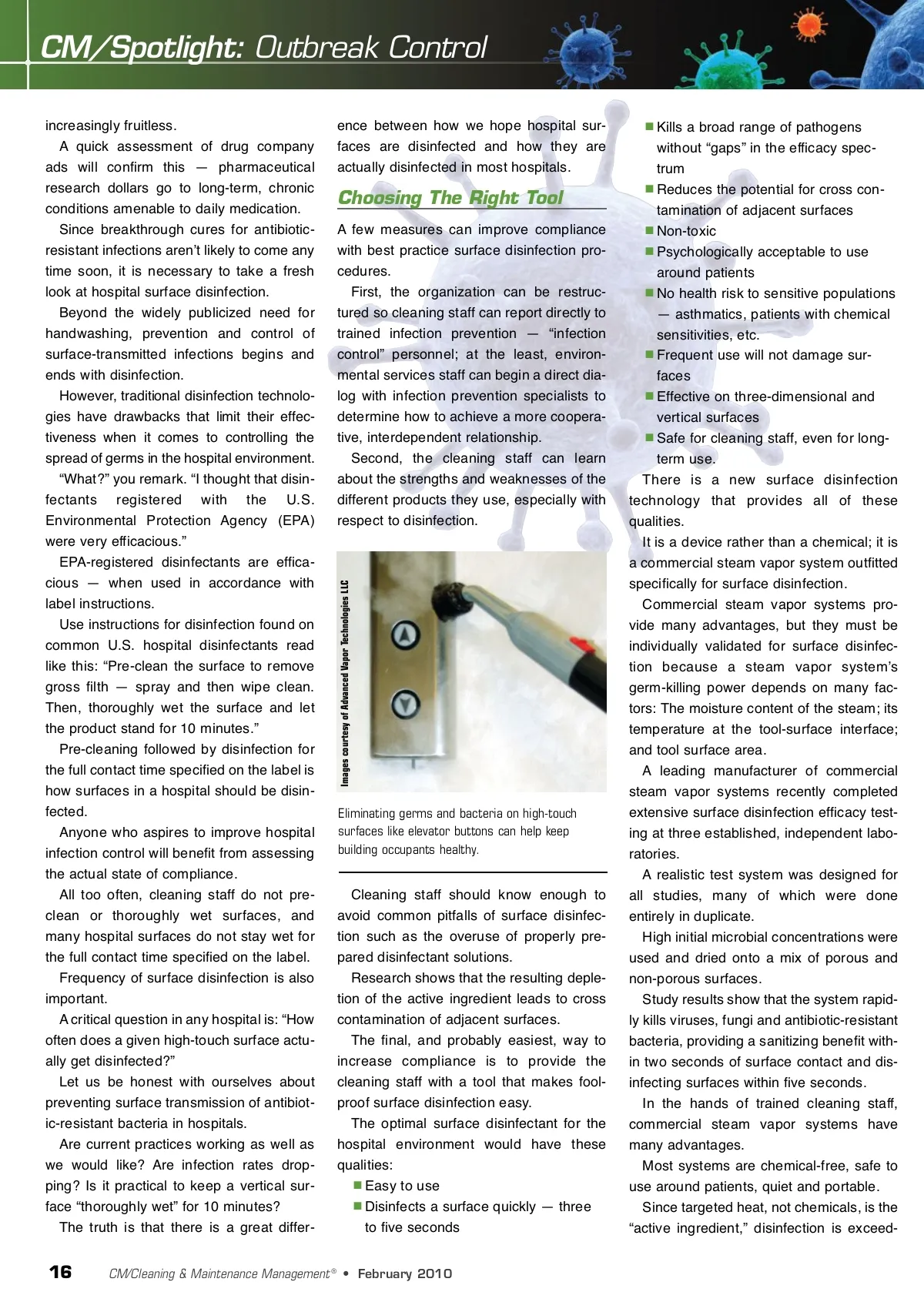
CM/Spotlight: Outbreak Control increasingly fruitless. A quick assessment of drug company ads will confirm this — pharmaceutical research dollars go to long-term, chronic conditions amenable to daily medication. Since breakthrough cures for antibiotic-resistant infections arenʼt likely to come any time soon, it is necessary to take a fresh look at hospital surface disinfection. Beyond the widely publicized need for handwashing, prevention and control of surface-transmitted infections begins and ends with disinfection. However, traditional disinfection technolo-gies have drawbacks that limit their effec-tiveness when it comes to controlling the spread of germs in the hospital environment. “What?” you remark. “I thought that disin-fectants registered with the U.S. Environmental Protection Agency (EPA) were very efficacious.” EPA-registered disinfectants are effica-cious — when used in accordance with label instructions. Use instructions for disinfection found on common U.S. hospital disinfectants read like this: “Pre-clean the surface to remove gross filth — spray and then wipe clean. Then, thoroughly wet the surface and let the product stand for 10 minutes.” Pre-cleaning followed by disinfection for the full contact time specified on the label is how surfaces in a hospital should be disin-fected. Anyone who aspires to improve hospital infection control will benefit from assessing the actual state of compliance. All too often, cleaning staff do not pre-clean or thoroughly wet surfaces, and many hospital surfaces do not stay wet for the full contact time specified on the label. Frequency of surface disinfection is also important. A critical question in any hospital is: “How often does a given high-touch surface actu-ally get disinfected?” Let us be honest with ourselves about preventing surface transmission of antibiot-ic-resistant bacteria in hospitals. Are current practices working as well as we would like? Are infection rates drop-ping? Is it practical to keep a vertical sur-face “thoroughly wet” for 10 minutes? The truth is that there is a great differ-ence between how we hope hospital sur-faces are disinfected and how they are actually disinfected in most hospitals. Kills a broad range of pathogens without “gaps” in the efficacy spec-trum Reduces the potential for cross con-tamination of adjacent surfaces Non-toxic Psychologically acceptable to use around patients No health risk to sensitive populations — asthmatics, patients with chemical sensitivities, etc. Frequent use will not damage sur-faces Effective on three-dimensional and vertical surfaces Safe for cleaning staff, even for long-term use. There is a new surface disinfection technology that provides all of these qualities. It is a device rather than a chemical; it is a commercial steam vapor system outfitted specifically for surface disinfection. Commercial steam vapor systems pro-vide many advantages, but they must be individually validated for surface disinfec-tion because a steam vapor systemʼs germ-killing power depends on many fac-tors: The moisture content of the steam; its temperature at the tool-surface interface; and tool surface area. A leading manufacturer of commercial steam vapor systems recently completed extensive surface disinfection efficacy test-ing at three established, independent labo-ratories. A realistic test system was designed for all studies, many of which were done entirely in duplicate. High initial microbial concentrations were used and dried onto a mix of porous and non-porous surfaces. Study results show that the system rapid-ly kills viruses, fungi and antibiotic-resistant bacteria, providing a sanitizing benefit with-in two seconds of surface contact and dis-infecting surfaces within five seconds. In the hands of trained cleaning staff, commercial steam vapor systems have many advantages. Most systems are chemical-free, safe to use around patients, quiet and portable. Since targeted heat, not chemicals, is the “active ingredient,” disinfection is exceed-Choosing The Right Tool A few measures can improve compliance with best practice surface disinfection pro-cedures. First, the organization can be restruc-tured so cleaning staff can report directly to trained infection prevention — “infection control” personnel; at the least, environ-mental services staff can begin a direct dia-log with infection prevention specialists to determine how to achieve a more coopera-tive, interdependent relationship. Second, the cleaning staff can learn about the strengths and weaknesses of the different products they use, especially with respect to disinfection. Eliminating germs and bacteria on high-touch surfaces like elevator buttons can help keep building occupants healthy. Cleaning staff should know enough to avoid common pitfalls of surface disinfec-tion such as the overuse of properly pre-pared disinfectant solutions. Research shows that the resulting deple-tion of the active ingredient leads to cross contamination of adjacent surfaces. The final, and probably easiest, way to increase compliance is to provide the cleaning staff with a tool that makes fool-proof surface disinfection easy. The optimal surface disinfectant for the hospital environment would have these qualities: Easy to use Disinfects a surface quickly — three to five seconds 16 CM/Cleaning & Maintenance Management ® • February 2010 Images courtesy of Advanced Vapor Technologies LLC
CMM – Archives Feb 2010: 16