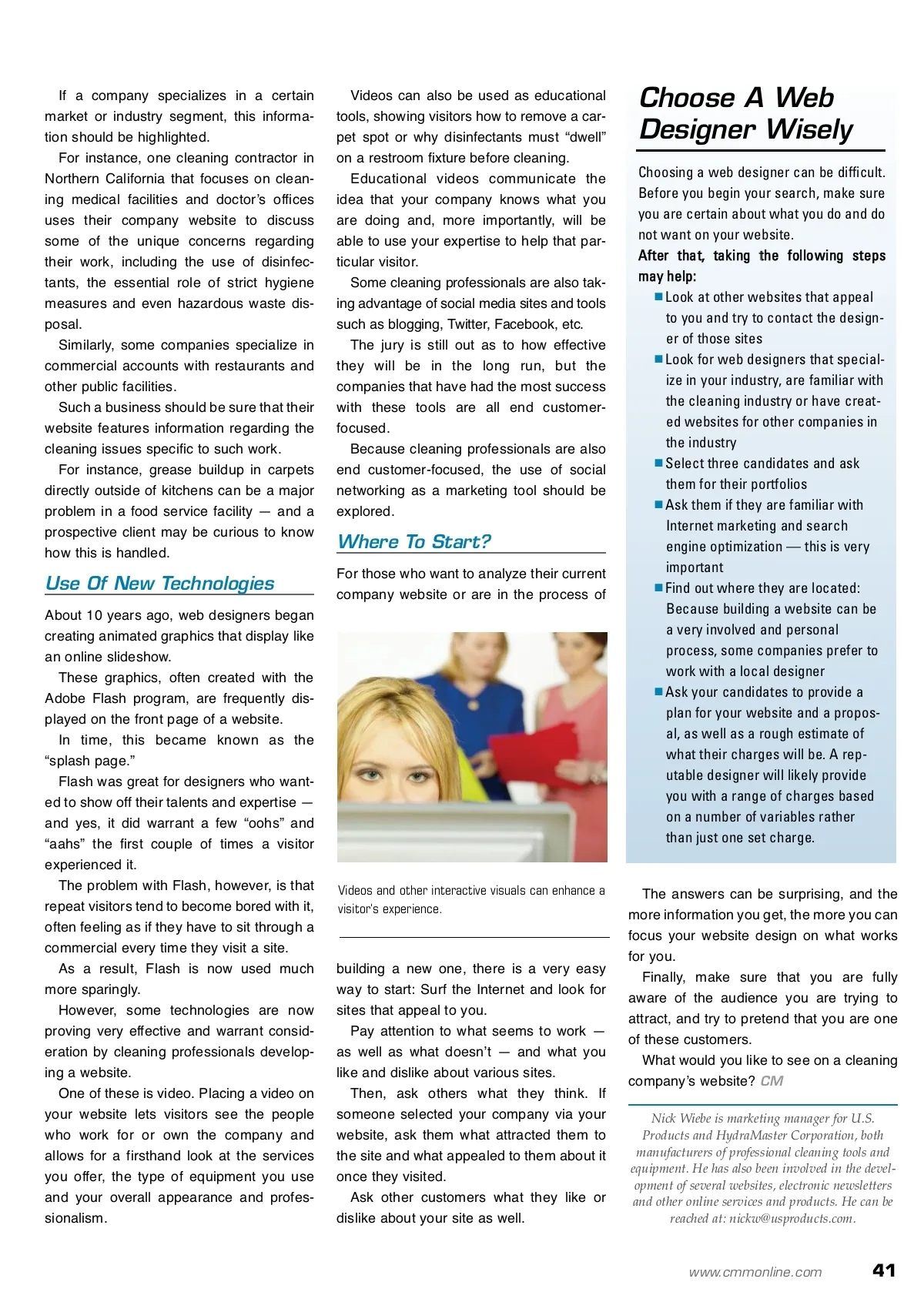
If a company specializes in a certain market or industry segment, this informa-tion should be highlighted. For instance, one cleaning contractor in Northern California that focuses on clean-ing medical facilities and doctorʼs offices uses their company website to discuss some of the unique concerns regarding their work, including the use of disinfec-tants, the essential role of strict hygiene measures and even hazardous waste dis-posal. Similarly, some companies specialize in commercial accounts with restaurants and other public facilities. Such a business should be sure that their website features information regarding the cleaning issues specific to such work. For instance, grease buildup in carpets directly outside of kitchens can be a major problem in a food service facility — and a prospective client may be curious to know how this is handled. Videos can also be used as educational tools, showing visitors how to remove a car-pet spot or why disinfectants must “dwell” on a restroom fixture before cleaning. Educational videos communicate the idea that your company knows what you are doing and, more importantly, will be able to use your expertise to help that par-ticular visitor. Some cleaning professionals are also tak-ing advantage of social media sites and tools such as blogging, Twitter, Facebook, etc. The jury is still out as to how effective they will be in the long run, but the companies that have had the most success with these tools are all end customer-focused. Because cleaning professionals are also end customer-focused, the use of social networking as a marketing tool should be explored. Choose A Web Designer Wisely Choosing a web designer can be difficult. Before you begin your search, make sure you are certain about what you do and do not want on your website. A f t e r th a t , ta k i n g th e fo l l o w i n g st e p s m a y h e l p : Look at other websites that appeal to you and try to contact the design-er of those sites Look for web designers that special-ize in your industry, are familiar with the cleaning industry or have creat-ed websites for other companies in the industry Select three candidates and ask them for their portfolios Ask them if they are familiar with Internet marketing and search engine optimization — this is very important Find out where they are located: Because building a website can be a very involved and personal process, some companies prefer to work with a local designer Ask your candidates to provide a plan for your website and a propos-al, as well as a rough estimate of what their charges will be. A rep-utable designer will likely provide you with a range of charges based on a number of variables rather than just one set charge. Where To Start? For those who want to analyze their current company website or are in the process of Use Of New Technologies About 10 years ago, web designers began creating animated graphics that display like an online slideshow. These graphics, often created with the Adobe Flash program, are frequently dis-played on the front page of a website. In time, this became known as the “splash page.” Flash was great for designers who want-ed to show off their talents and expertise — and yes, it did warrant a few “oohs” and “aahs” the first couple of times a visitor experienced it. The problem with Flash, however, is that repeat visitors tend to become bored with it, often feeling as if they have to sit through a commercial every time they visit a site. As a result, Flash is now used much more sparingly. However, some technologies are now proving very effective and warrant consid-eration by cleaning professionals develop-ing a website. One of these is video. Placing a video on your website lets visitors see the people who work for or own the company and allows for a firsthand look at the services you offer, the type of equipment you use and your overall appearance and profes-sionalism. Videos and other interactive visuals can enhance a visitor's experience. building a new one, there is a very easy way to start: Surf the Internet and look for sites that appeal to you. Pay attention to what seems to work — as well as what doesnʼt — and what you like and dislike about various sites. Then, ask others what they think. If someone selected your company via your website, ask them what attracted them to the site and what appealed to them about it once they visited. Ask other customers what they like or dislike about your site as well. The answers can be surprising, and the more information you get, the more you can focus your website design on what works for you. Finally, make sure that you are fully aware of the audience you are trying to attract, and try to pretend that you are one of these customers. What would you like to see on a cleaning companyʼs website? CM Nick Wiebe is marketing manager for U.S. Products and HydraMaster Corporation, both manufacturers of professional cleaning tools and equipment. He has also been involved in the devel-opment of several websites, electronic newsletters and other online services and products. He can be reached at: [email protected]. www.cmmonline.com 41
CMM – Archives Mar 2010: 41