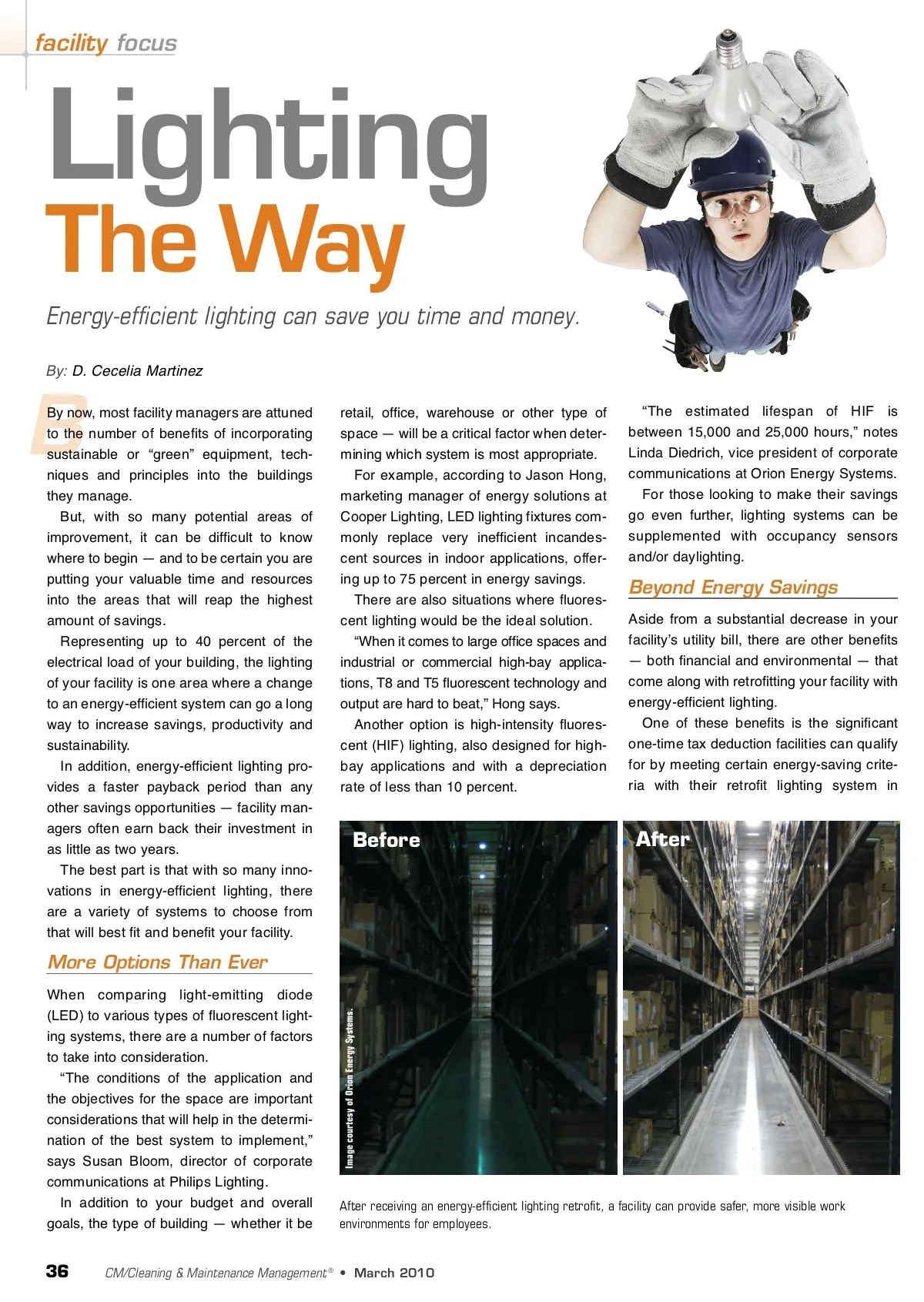
facility focus Lighting The Way By: D. Cecelia Martinez Energy-efficient lighting can save you time and money. B By now, most facility managers are attuned to the number of benefits of incorporating sustainable or “green” equipment, tech-niques and principles into the buildings they manage. But, with so many potential areas of improvement, it can be difficult to know where to begin — and to be certain you are putting your valuable time and resources into the areas that will reap the highest amount of savings. Representing up to 40 percent of the electrical load of your building, the lighting of your facility is one area where a change to an energy-efficient system can go a long way to increase savings, productivity and sustainability. In addition, energy-efficient lighting pro-vides a faster payback period than any other savings opportunities — facility man-agers often earn back their investment in as little as two years. The best part is that with so many inno-vations in energy-efficient lighting, there are a variety of systems to choose from that will best fit and benefit your facility. retail, office, warehouse or other type of space — will be a critical factor when deter-mining which system is most appropriate. For example, according to Jason Hong, marketing manager of energy solutions at Cooper Lighting, LED lighting fixtures com-monly replace very inefficient incandes-cent sources in indoor applications, offer-ing up to 75 percent in energy savings. There are also situations where fluores-cent lighting would be the ideal solution. “When it comes to large office spaces and industrial or commercial high-bay applica-tions, T8 and T5 fluorescent technology and output are hard to beat,” Hong says. Another option is high-intensity fluores-cent (HIF) lighting, also designed for high-bay applications and with a depreciation rate of less than 10 percent. “The estimated lifespan of HIF is between 15,000 and 25,000 hours,” notes Linda Diedrich, vice president of corporate communications at Orion Energy Systems. For those looking to make their savings go even further, lighting systems can be supplemented with occupancy sensors and/or daylighting. Beyond Energy Savings Aside from a substantial decrease in your facilityʼs utility bill, there are other benefits — both financial and environmental — that come along with retrofitting your facility with energy-efficient lighting. One of these benefits is the significant one-time tax deduction facilities can qualify for by meeting certain energy-saving crite-ria with their retrofit lighting system in Before After More Options Than Ever When comparing light-emitting diode (LED) to various types of fluorescent light-ing systems, there are a number of factors to take into consideration. “The conditions of the application and the objectives for the space are important considerations that will help in the determi-nation of the best system to implement,” says Susan Bloom, director of corporate communications at Philips Lighting. In addition to your budget and overall goals, the type of building — whether it be Image courtesy of Orion Energy Systems. After receiving an energy-efficient lighting retrofit, a facility can provide safer, more visible work environments for employees. 36 CM/Cleaning & Maintenance Management ® • March 2010
CMM – Archives Mar 2010: 36