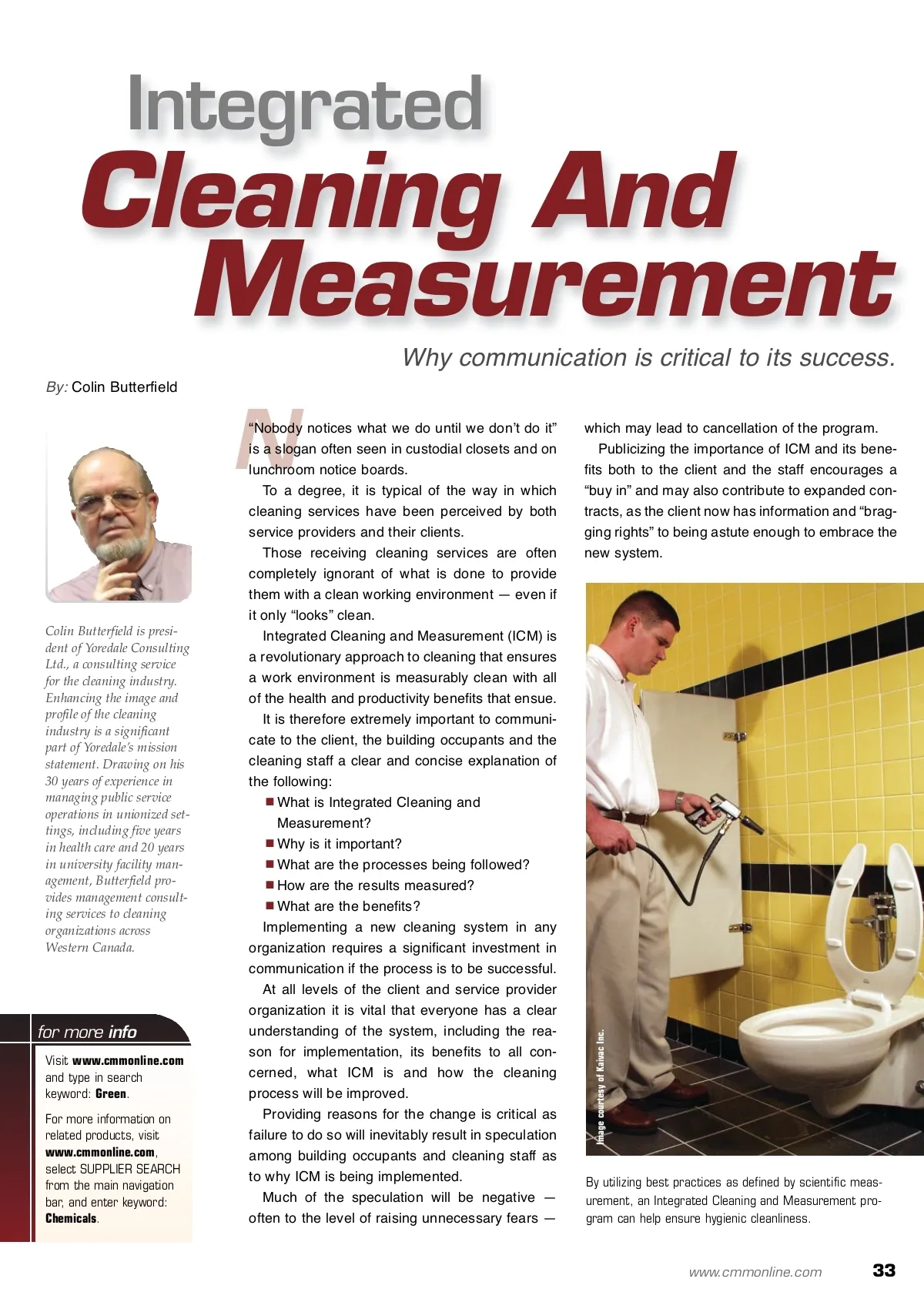
Integrated Cleaning And Measurement Why communication is critical to its success. By: Colin Butterfield N Colin Butterfield is presi-dent of Yoredale Consulting Ltd., a consulting service for the cleaning industry. Enhancing the image and profile of the cleaning industry is a significant part of Yoredale’s mission statement. Drawing on his 30 years of experience in managing public service operations in unionized set-tings, including five years in health care and 20 years in university facility man-agement, Butterfield pro-vides management consult-ing services to cleaning organizations across Western Canada. Visit www.cmmonline.com and type in search keyword: Green . For more information on related products, visit www.cmmonline.com , select SUPPLIER SEARCH from the main navigation bar, and enter keyword: Chemicals . By utilizing best practices as defined by scientific meas-urement, an Integrated Cleaning and Measurement pro-gram can help ensure hygienic cleanliness. Image courtesy of Kaivac Inc. for more info “Nobody notices what we do until we donʼt do it” is a slogan often seen in custodial closets and on lunchroom notice boards. To a degree, it is typical of the way in which cleaning services have been perceived by both service providers and their clients. Those receiving cleaning services are often completely ignorant of what is done to provide them with a clean working environment — even if it only “looks” clean. Integrated Cleaning and Measurement (ICM) is a revolutionary approach to cleaning that ensures a work environment is measurably clean with all of the health and productivity benefits that ensue. It is therefore extremely important to communi-cate to the client, the building occupants and the cleaning staff a clear and concise explanation of the following: What is Integrated Cleaning and Measurement? Why is it important? What are the processes being followed? How are the results measured? What are the benefits? Implementing a new cleaning system in any organization requires a significant investment in communication if the process is to be successful. At all levels of the client and service provider organization it is vital that everyone has a clear understanding of the system, including the rea-son for implementation, its benefits to all con-cerned, what ICM is and how the cleaning process will be improved. Providing reasons for the change is critical as failure to do so will inevitably result in speculation among building occupants and cleaning staff as to why ICM is being implemented. Much of the speculation will be negative — often to the level of raising unnecessary fears — which may lead to cancellation of the program. Publicizing the importance of ICM and its bene-fits both to the client and the staff encourages a “buy in” and may also contribute to expanded con-tracts, as the client now has information and “brag-ging rights” to being astute enough to embrace the new system. www.cmmonline.com 33
CMM – Archives Mar 2010: 33