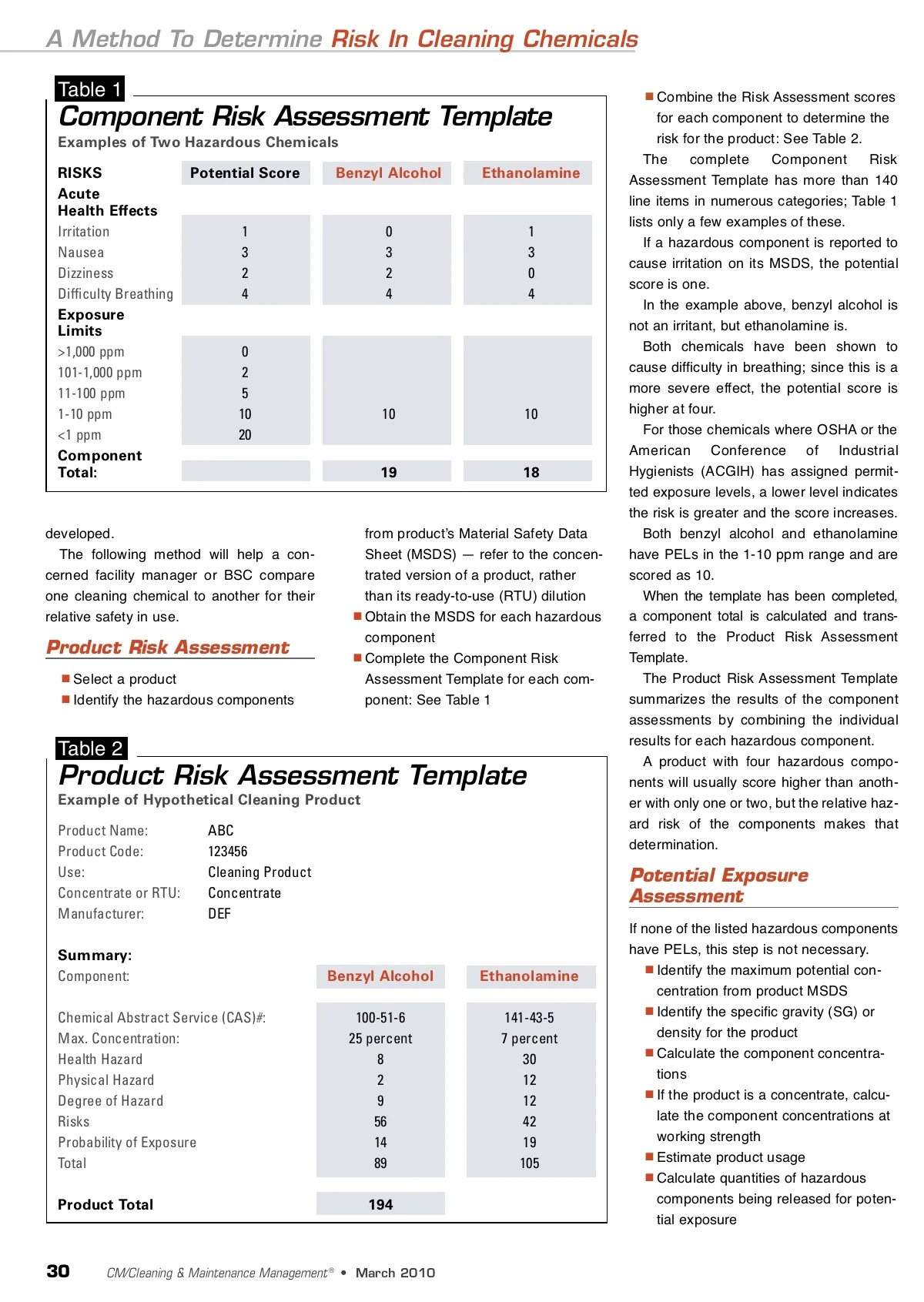
Table 3 Product Risk Assessment Template for Potential Exposure Example of Hypothetical Cleaning Product Exposure Risk: Concentration/ml: Product Dilution: Concentration/ml: Typical Usage: Potential Exposure: OSHA PEL: PE>PEL? Benzyl Alcohol 269 ppm 20 percent by volume 54 ppm 500 mls/15 minutes 1,800 ppm/minute 10 ppm Yes Ethanolamine 75 ppm 15 ppm 500 ppm/minute 3 ppm/time weighted average (TWA) Yes Compare to PELs. In addition to how and where it is used, the risk of potential exposure is as impor-tant as the hazard of a chemical. Table 3 demonstrates how two compo-nents of a hypothetical product can create hazardous exposure in the workplace. Multiplying the maximum concentration of benzyl alcohol — at a 25 percent con-centration — times the SG of the product (1.076) times 1,000 grams per liter estab-lishes 269 ppm per milliliter (ml) as the con-centration in the concentrate. Note: 1 gram per liter = 1 milligram (mg) per ml = 1 ppm. Since the product is used at 20 percent by volume, the benzyl alcohol concentra-tion in the working solution is 54 ppm. If a worker used approximately 1 pint — or 500 mls — in 15 minutes, the amount of benzyl alcohol released to the environment is 500 times 54, divided by 15 minutes — or 1,800 ppm per minute. With a maximum OSHA permitted expo-sure level of 10 ppm, this is going to be an unacceptable potential risk. That fact, coupled with laboratory studies by A. Bello, et al — published in Environmental Health in March of 2009 — showing that it takes approximately 1-2 hours for the quality of air in a bathroom or patientʼs room to return to background level after the use of chemicals for cleaning, amplifies the potential risk of exposure. A more complex method would introduce vapor pressure to the analysis to more closely approximate the expected chemical concentrations in the air. CM Circle Product Information no. 251 on page 32 www.cmmonline.com 31
CMM – Archives Mar 2010: 31