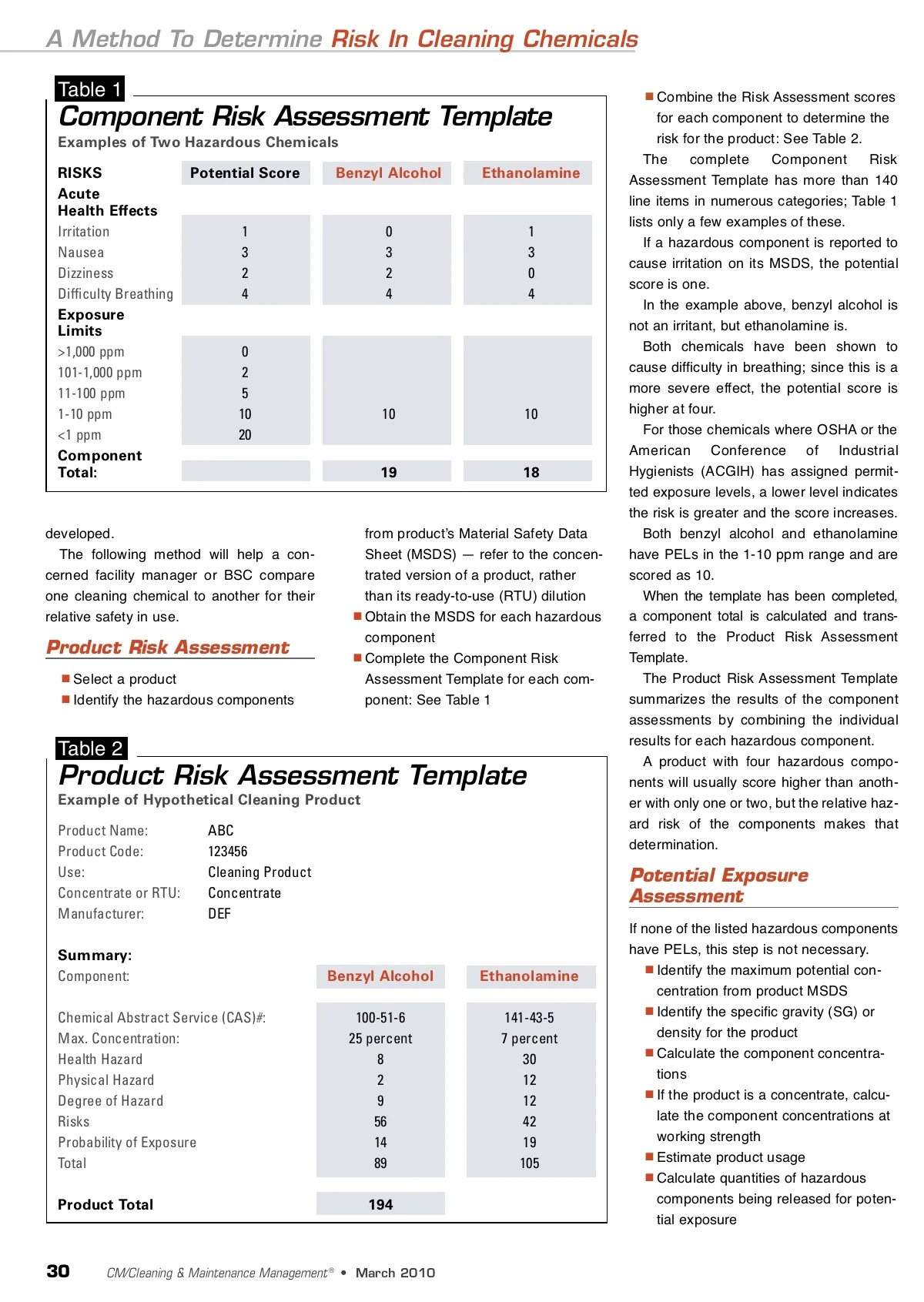
A Method To Determine Risk In Cleaning Chemicals Table 1 Component Risk Assessment Template Examples of Two Hazardous Chemicals RISKS Acute Health Effects Irritation Nausea Dizziness Difficulty Breathing Exposure Limits >1,000 ppm 101-1,000 ppm 11-100 ppm 1-10 ppm <1 ppm Component Total: Potential Score Benzyl Alcohol Ethanolamine 101 333 220 444 0 2 5 10 20 10 10 19 18 developed. The following method will help a con-cerned facility manager or BSC compare one cleaning chemical to another for their relative safety in use. Product Risk Assessment Select a product Identify the hazardous components from productʼs Material Safety Data Sheet (MSDS) — refer to the concen-trated version of a product, rather than its ready-to-use (RTU) dilution Obtain the MSDS for each hazardous component Complete the Component Risk Assessment Template for each com-ponent: See Table 1 Table 2 Product Risk Assessment Template Example of Hypothetical Cleaning Product Product Name: Product Code: Use: Concentrate or RTU: Manufacturer: Summary: Component: Chemical Abstract Service (CAS)#: Max. Concentration: Health Hazard Physical Hazard Degree of Hazard Risks Probability of Exposure Total Product Total ABC 123456 Cleaning Product Concentrate DEF Combine the Risk Assessment scores for each component to determine the risk for the product: See Table 2. The complete Component Risk Assessment Template has more than 140 line items in numerous categories; Table 1 lists only a few examples of these. If a hazardous component is reported to cause irritation on its MSDS, the potential score is one. In the example above, benzyl alcohol is not an irritant, but ethanolamine is. Both chemicals have been shown to cause difficulty in breathing; since this is a more severe effect, the potential score is higher at four. For those chemicals where OSHA or the American Conference of Industrial Hygienists (ACGIH) has assigned permit-ted exposure levels, a lower level indicates the risk is greater and the score increases. Both benzyl alcohol and ethanolamine have PELs in the 1-10 ppm range and are scored as 10. When the template has been completed, a component total is calculated and trans-ferred to the Product Risk Assessment Template. The Product Risk Assessment Template summarizes the results of the component assessments by combining the individual results for each hazardous component. A product with four hazardous compo-nents will usually score higher than anoth-er with only one or two, but the relative haz-ard risk of the components makes that determination. Potential Exposure Assessment If none of the listed hazardous components have PELs, this step is not necessary. Identify the maximum potential con-centration from product MSDS Identify the specific gravity (SG) or density for the product Calculate the component concentra-tions If the product is a concentrate, calcu-late the component concentrations at working strength Estimate product usage Calculate quantities of hazardous components being released for poten-tial exposure Benzyl Alcohol 100-51-6 25 percent 8 2 9 56 14 89 194 Ethanolamine 141-43-5 7 percent 30 12 12 42 19 105 30 CM/Cleaning & Maintenance Management ® • March 2010
CMM – Archives Mar 2010: 30