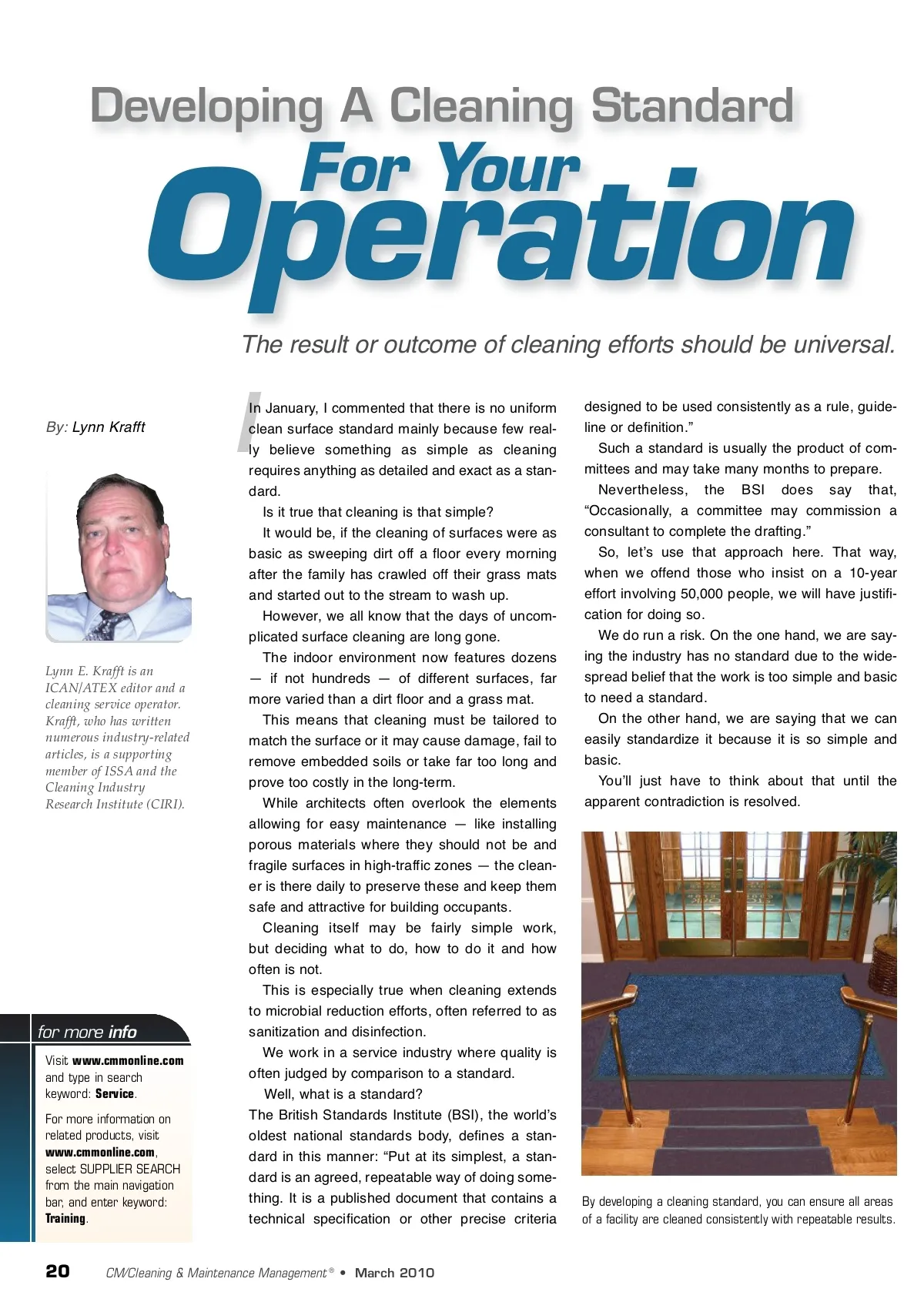
Developing A Cleaning Standard Operation The result or outcome of cleaning efforts should be universal. By: Lynn Krafft For Your I Lynn E. Krafft is an ICAN/ATEX editor and a cleaning service operator. Krafft, who has written numerous industry-related articles, is a supporting member of ISSA and the Cleaning Industry Research Institute (CIRI). for more info Visit www.cmmonline.com and type in search keyword: Service . For more information on related products, visit www.cmmonline.com , select SUPPLIER SEARCH from the main navigation bar, and enter keyword: Training . In January, I commented that there is no uniform clean surface standard mainly because few real-ly believe something as simple as cleaning requires anything as detailed and exact as a stan-dard. Is it true that cleaning is that simple? It would be, if the cleaning of surfaces were as basic as sweeping dirt off a floor every morning after the family has crawled off their grass mats and started out to the stream to wash up. However, we all know that the days of uncom-plicated surface cleaning are long gone. The indoor environment now features dozens — if not hundreds — of different surfaces, far more varied than a dirt floor and a grass mat. This means that cleaning must be tailored to match the surface or it may cause damage, fail to remove embedded soils or take far too long and prove too costly in the long-term. While architects often overlook the elements allowing for easy maintenance — like installing porous materials where they should not be and fragile surfaces in high-traffic zones — the clean-er is there daily to preserve these and keep them safe and attractive for building occupants. Cleaning itself may be fairly simple work, but deciding what to do, how to do it and how often is not. This is especially true when cleaning extends to microbial reduction efforts, often referred to as sanitization and disinfection. We work in a service industry where quality is often judged by comparison to a standard. Well, what is a standard? The British Standards Institute (BSI), the worldʼs oldest national standards body, defines a stan-dard in this manner: “Put at its simplest, a stan-dard is an agreed, repeatable way of doing some-thing. It is a published document that contains a technical specification or other precise criteria designed to be used consistently as a rule, guide-line or definition.” Such a standard is usually the product of com-mittees and may take many months to prepare. Nevertheless, the BSI does say that, “Occasionally, a committee may commission a consultant to complete the drafting.” So, letʼs use that approach here. That way, when we offend those who insist on a 10-year effort involving 50,000 people, we will have justifi-cation for doing so. We do run a risk. On the one hand, we are say-ing the industry has no standard due to the wide-spread belief that the work is too simple and basic to need a standard. On the other hand, we are saying that we can easily standardize it because it is so simple and basic. Youʼll just have to think about that until the apparent contradiction is resolved. By developing a cleaning standard, you can ensure all areas of a facility are cleaned consistently with repeatable results. 20 CM/Cleaning & Maintenance Management ® • March 2010
CMM – Archives Mar 2010: 20