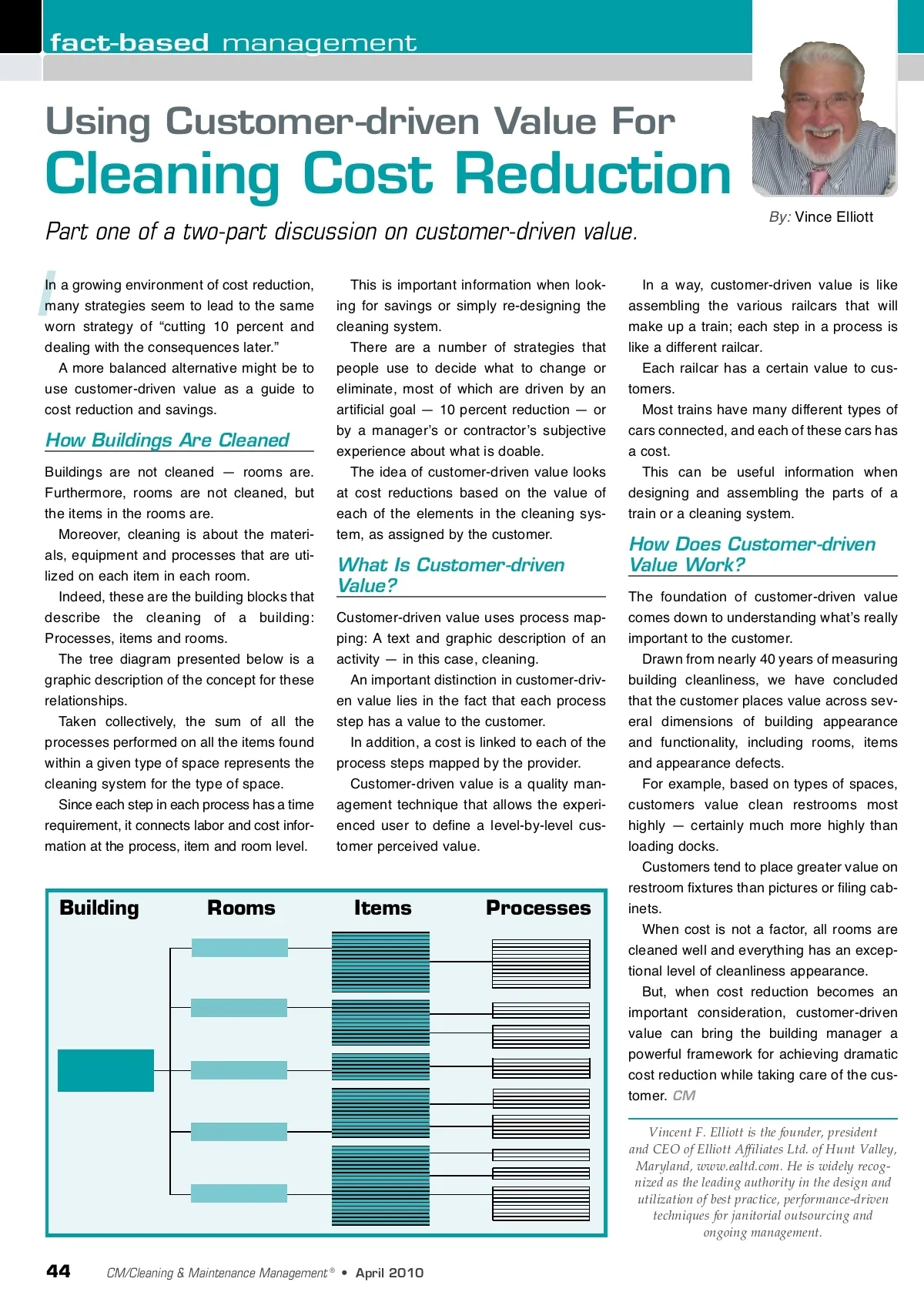
fact-based management Using Customer-driven Value For Cleaning Cost Reduction Part one of a two-part discussion on customer-driven value. By: Vince Elliott I In a growing environment of cost reduction, many strategies seem to lead to the same worn strategy of “cutting 10 percent and dealing with the consequences later.” A more balanced alternative might be to use customer-driven value as a guide to cost reduction and savings. How Buildings Are Cleaned Buildings are not cleaned — rooms are. Furthermore, rooms are not cleaned, but the items in the rooms are. Moreover, cleaning is about the materi-als, equipment and processes that are uti-lized on each item in each room. Indeed, these are the building blocks that describe the cleaning of a building: Processes, items and rooms. The tree diagram presented below is a graphic description of the concept for these relationships. Taken collectively, the sum of all the processes performed on all the items found within a given type of space represents the cleaning system for the type of space. Since each step in each process has a time requirement, it connects labor and cost infor-mation at the process, item and room level. This is important information when look-ing for savings or simply re-designing the cleaning system. There are a number of strategies that people use to decide what to change or eliminate, most of which are driven by an artificial goal — 10 percent reduction — or by a managerʼs or contractorʼs subjective experience about what is doable. The idea of customer-driven value looks at cost reductions based on the value of each of the elements in the cleaning sys-tem, as assigned by the customer. In a way, customer-driven value is like assembling the various railcars that will make up a train; each step in a process is like a different railcar. Each railcar has a certain value to cus-tomers. Most trains have many different types of cars connected, and each of these cars has a cost. This can be useful information when designing and assembling the parts of a train or a cleaning system. What Is Customer-driven Value? Customer-driven value uses process map-ping: A text and graphic description of an activity — in this case, cleaning. An important distinction in customer-driv-en value lies in the fact that each process step has a value to the customer. In addition, a cost is linked to each of the process steps mapped by the provider. Customer-driven value is a quality man-agement technique that allows the experi-enced user to define a level-by-level cus-tomer perceived value. How Does Customer-driven Value Work? The foundation of customer-driven value comes down to understanding whatʼs really important to the customer. Drawn from nearly 40 years of measuring building cleanliness, we have concluded that the customer places value across sev-eral dimensions of building appearance and functionality, including rooms, items and appearance defects. For example, based on types of spaces, customers value clean restrooms most highly — certainly much more highly than loading docks. Customers tend to place greater value on restroom fixtures than pictures or filing cab-inets. When cost is not a factor, all rooms are cleaned well and everything has an excep-tional level of cleanliness appearance. But, when cost reduction becomes an important consideration, customer-driven value can bring the building manager a powerful framework for achieving dramatic cost reduction while taking care of the cus-tomer. CM Vincent F. Elliott is the founder, president and CEO of Elliott Affiliates Ltd. of Hunt Valley, Maryland, www.ealtd.com. He is widely recog-nized as the leading authority in the design and utilization of best practice, performance-driven techniques for janitorial outsourcing and ongoing management. Building Rooms Items Processes 44 CM/Cleaning & Maintenance Management ® • April 2010
CMM – Archives Apr 2010: 44