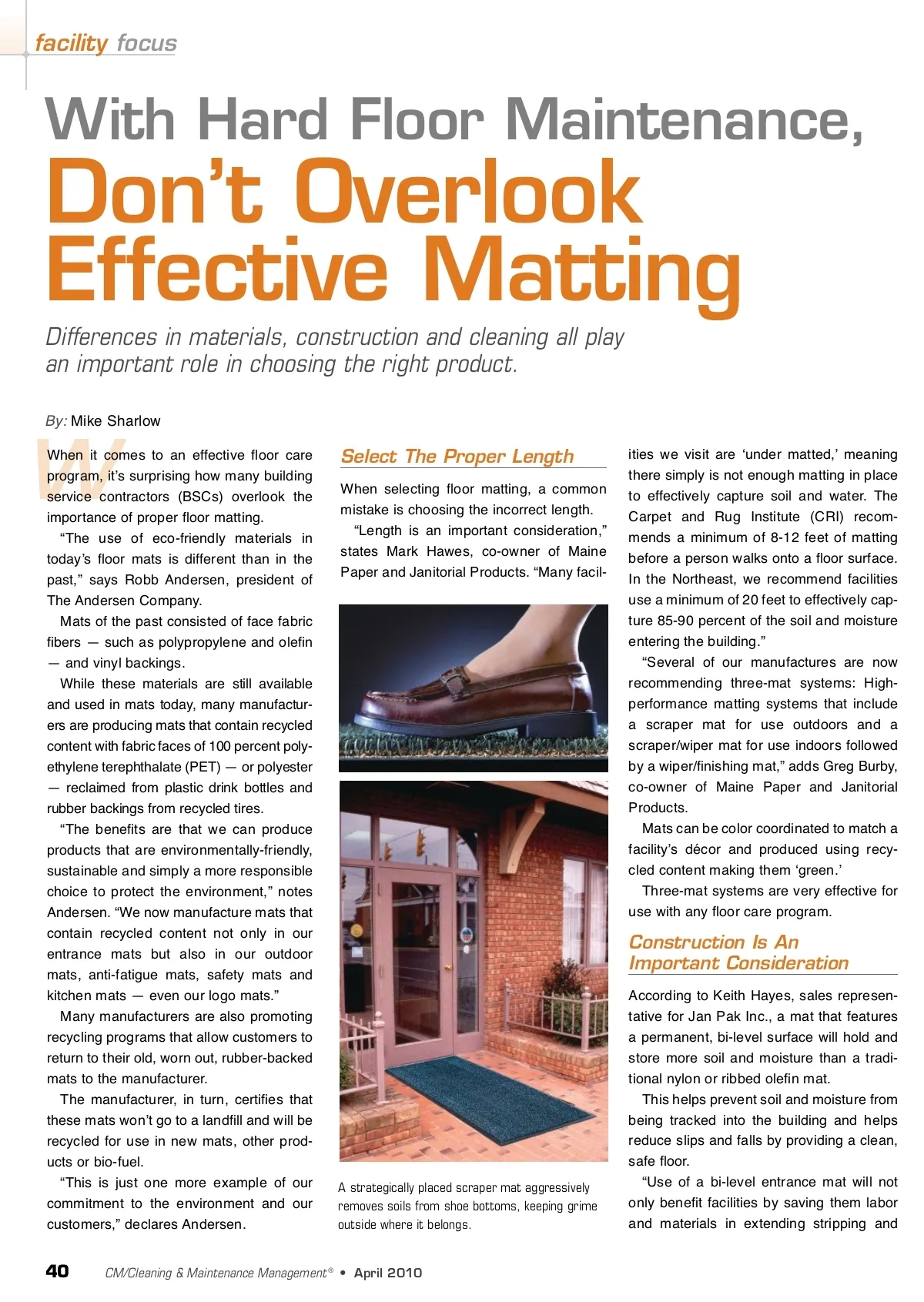
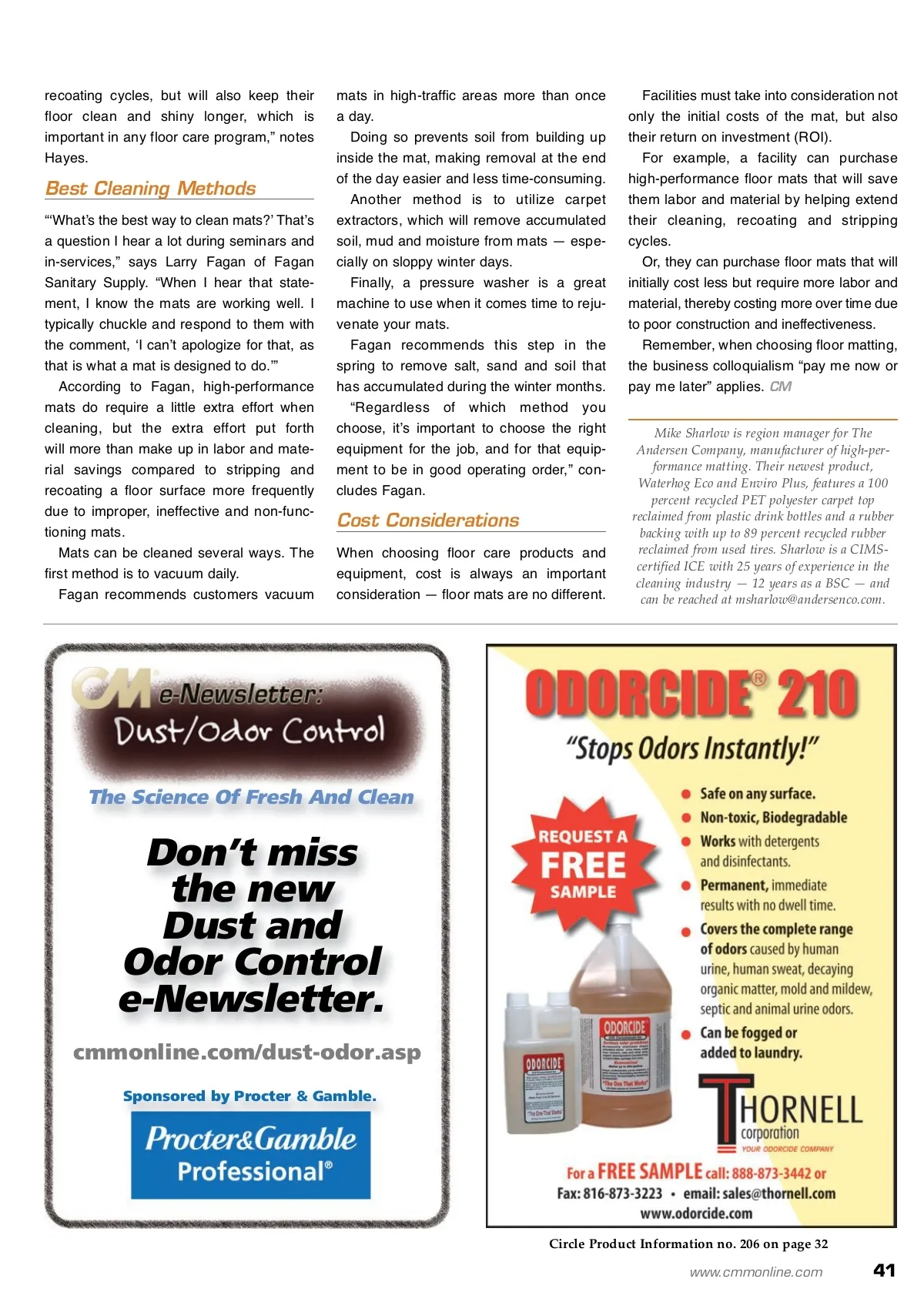
facility focus With Hard Floor Maintenance, Don’t Overlook Effective Matting Differences in materials, construction and cleaning all play an important role in choosing the right product. By: Mike Sharlow W When it comes to an effective floor care program, itʼs surprising how many building service contractors (BSCs) overlook the importance of proper floor matting. “The use of eco-friendly materials in todayʼs floor mats is different than in the past,” says Robb Andersen, president of The Andersen Company. Mats of the past consisted of face fabric fibers — such as polypropylene and olefin — and vinyl backings. While these materials are still available and used in mats today, many manufactur-ers are producing mats that contain recycled content with fabric faces of 100 percent poly-ethylene terephthalate (PET) — or polyester — reclaimed from plastic drink bottles and rubber backings from recycled tires. “The benefits are that we can produce products that are environmentally-friendly, sustainable and simply a more responsible choice to protect the environment,” notes Andersen. “We now manufacture mats that contain recycled content not only in our entrance mats but also in our outdoor mats, anti-fatigue mats, safety mats and kitchen mats — even our logo mats.” Many manufacturers are also promoting recycling programs that allow customers to return to their old, worn out, rubber-backed mats to the manufacturer. The manufacturer, in turn, certifies that these mats wonʼt go to a landfill and will be recycled for use in new mats, other prod-ucts or bio-fuel. “This is just one more example of our commitment to the environment and our customers,” declares Andersen. Select The Proper Length When selecting floor matting, a common mistake is choosing the incorrect length. “Length is an important consideration,” states Mark Hawes, co-owner of Maine Paper and Janitorial Products. “Many facil-ities we visit are ʻunder matted,ʼ meaning there simply is not enough matting in place to effectively capture soil and water. The Carpet and Rug Institute (CRI) recom-mends a minimum of 8-12 feet of matting before a person walks onto a floor surface. In the Northeast, we recommend facilities use a minimum of 20 feet to effectively cap-ture 85-90 percent of the soil and moisture entering the building.” “Several of our manufactures are now recommending three-mat systems: High-performance matting systems that include a scraper mat for use outdoors and a scraper/wiper mat for use indoors followed by a wiper/finishing mat,” adds Greg Burby, co-owner of Maine Paper and Janitorial Products. Mats can be color coordinated to match a facilityʼs décor and produced using recy-cled content making them ʻgreen.ʼ Three-mat systems are very effective for use with any floor care program. Construction Is An Important Consideration According to Keith Hayes, sales represen-tative for Jan Pak Inc., a mat that features a permanent, bi-level surface will hold and store more soil and moisture than a tradi-tional nylon or ribbed olefin mat. This helps prevent soil and moisture from being tracked into the building and helps reduce slips and falls by providing a clean, safe floor. “Use of a bi-level entrance mat will not only benefit facilities by saving them labor and materials in extending stripping and A strategically placed scraper mat aggressively removes soils from shoe bottoms, keeping grime outside where it belongs. 40 CM/Cleaning & Maintenance Management ® • April 2010
CMM – Archives Apr 2010: 40