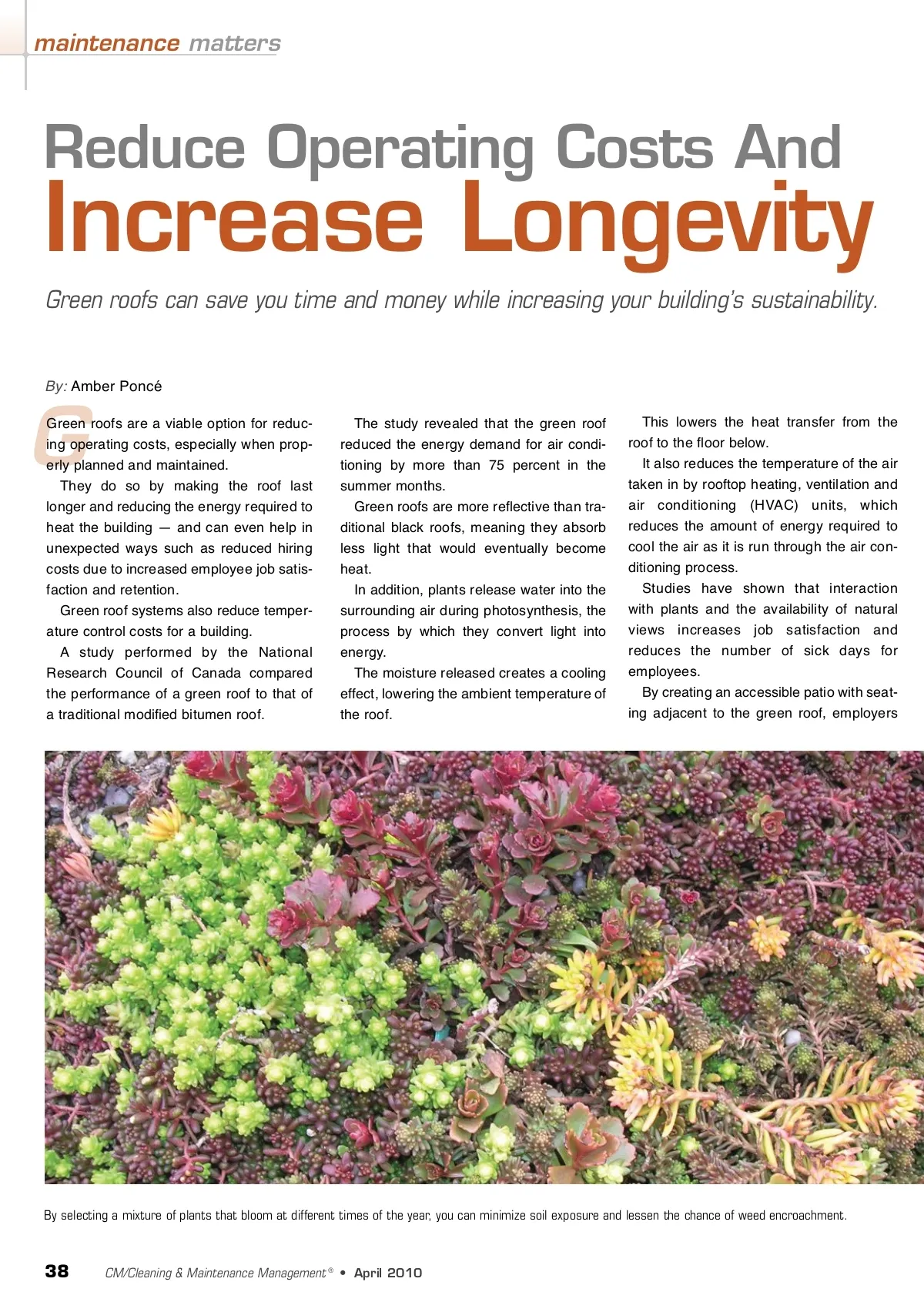
can create a relaxing environment for employee breaks. Employee interaction with rooftop vegetation can also help alleviate daily stresses. In hospital or clinical settings, patients can experience improved mental and phys-ical health through rooftop healing gardens. A Savings Over Time In order to maximize the financial benefits of greening a roof, building owners should place emphasis on the long-term value at the start of the project and avoid focusing solely on initial costs. All retrofit roofs should be inspected by a roofing contractor or a technical representative of the membrane manufac-turer to evaluate the condition of the membrane. Older membranes often require replace-ment or re-covering to ensure the system remains watertight for the life of the green roof. As with any roofing assembly, planners should minimize the number of membrane penetrations and transitions, as leaks are most common in these areas. A primary benefit green roofs offer is increased longevity of the membrane, which is achieved by protecting it from the elements and ultraviolet (UV) exposure. They reduce the heat flow transfer to the roof below, minimizing the expansion and contraction of the membrane. Planners should avoid leaving the mem-brane exposed at drain covers, at parapet walls, around rooftop equipment or any other vegetation-free zones. To maximize the life of the entire membrane, consider using stone ballast along drain covers, pavers near rooftop equipment or maintenance paths and metal flashing and coping caps on parapet walls. At the planning phase, purchasers should also consider the long-term per-formance of their green roof system. Although each project differs, green roof case studies typically calculate a break-even point of 17-20 years — around the time that a conventional roof would need replacing. The more money that must be spent maintaining the roof, the longer it will take to reach that payoff period. During the first two to four years, a sys-tem planted with plugs will require signifi-cantly more maintenance than one that arrives fully vegetated. Green Roofs for Healthy Cities estimates that green roofs may cost anywhere from 25 cents to $4.10 per square foot during the initial establishment period. The actual cost is primarily dependent on initial system design. In climates with freezing winters, decidu-ous plants will drop leaves, which replenish nutrients to the soil. When deciduous and semi-evergreens are planted using plugs, they will go dor-mant from late fall to early spring, leaving the soil surface exposed and susceptible to weed encroachment. When planted with a mixture of cuttings, the evergreens are intertwined with the deciduous varieties to provide year-round coverage and protection from weeds. Systems planted using this method — which do not have module edges exposed to the elements — have been shown to cost an average of 12 cents per square foot in maintenance labor costs. This cost will vary depending on the size of the roof and the irrigation system or method chosen for the roof. Caring For Green Roofs Instead of focusing on reducing the fre-quency of visits, maintenance personnel should strive to minimize the overall dura-tion of maintenance activities. By visiting the roof frequently during the growing season, maintenance staff can pull weeds when they are young and before they have become well-rooted or have been able to seed. Newly established weeds require less time to pull and displace less soil and neighboring plants when pulled. Also, any clogged drains, debris or other barriers to green roof plant health may be spotted early on and before they create costly problems. A clogged drain left untended could cre-ate pooling water — which can lead to root rot — causing plant damage or even death. Properly engineered soil is also crucial for long-term green roof success. Green roof soils need to shrink minimal-ly, hold fertility very well and drain properly. The recently approved American National Standards Institute/Single Ply Roofing Industry (ANSI/SPRI) VF-1 External Fire Design Standard for Vegetative Roofs defines a “generic fire-resistive vegetative system” as one planted in soil that is a minimum of 80 percent inor-ganic. Inorganic materials used in green roofs are typically non-combustible and provide fire protection. In addition, the inorganic materials wonʼt decompose over time. Generally, green roof system providers will recommend succulent plants to con-serve water and reduce required mainte-nance. Plants are living beings, and even the most drought-tolerant species require water to survive. Rainwater harvesting systems are sus-tainable alternatives to potable water sources in most climates. Some municipalities have permitted rain-water from limited sources for use in land-scape irrigation. This water, which otherwise would be wasted, can be recycled to improve the health of the green roof plants and reduce the energy demand for air conditioning. Although economic benefits of a green roof should not be overlooked, they alone are typically not enough to convince a building owner of the value. The social and environmental benefits of green roofs are great — though much more difficult to quantify. For companies seeking to convey their commitment to sustainable business practices while experiencing a long-term return on investment, a green roof is an ideal fit. CM Amber Poncé is the business development manager of LiveRoof LLC, manufacturer of a unique hybrid green roof system with patent-pending features that allow it to offer benefits of modular and built-in-place green roof systems. The LiveRoof ® brand green roof system is distributed throughout the United States and Canada by a network of licensed growers. LiveRoof LLC is a subsidiary of Hortech Inc., a Michigan-based nursery with over 25 years’ experience servicing the Midwest with premium perennial ground covers. Learn more about LiveRoof at www.liveroof.com or by calling 1-800-875-1392. www.cmmonline.com 39
CMM – Archives Apr 2010: 39