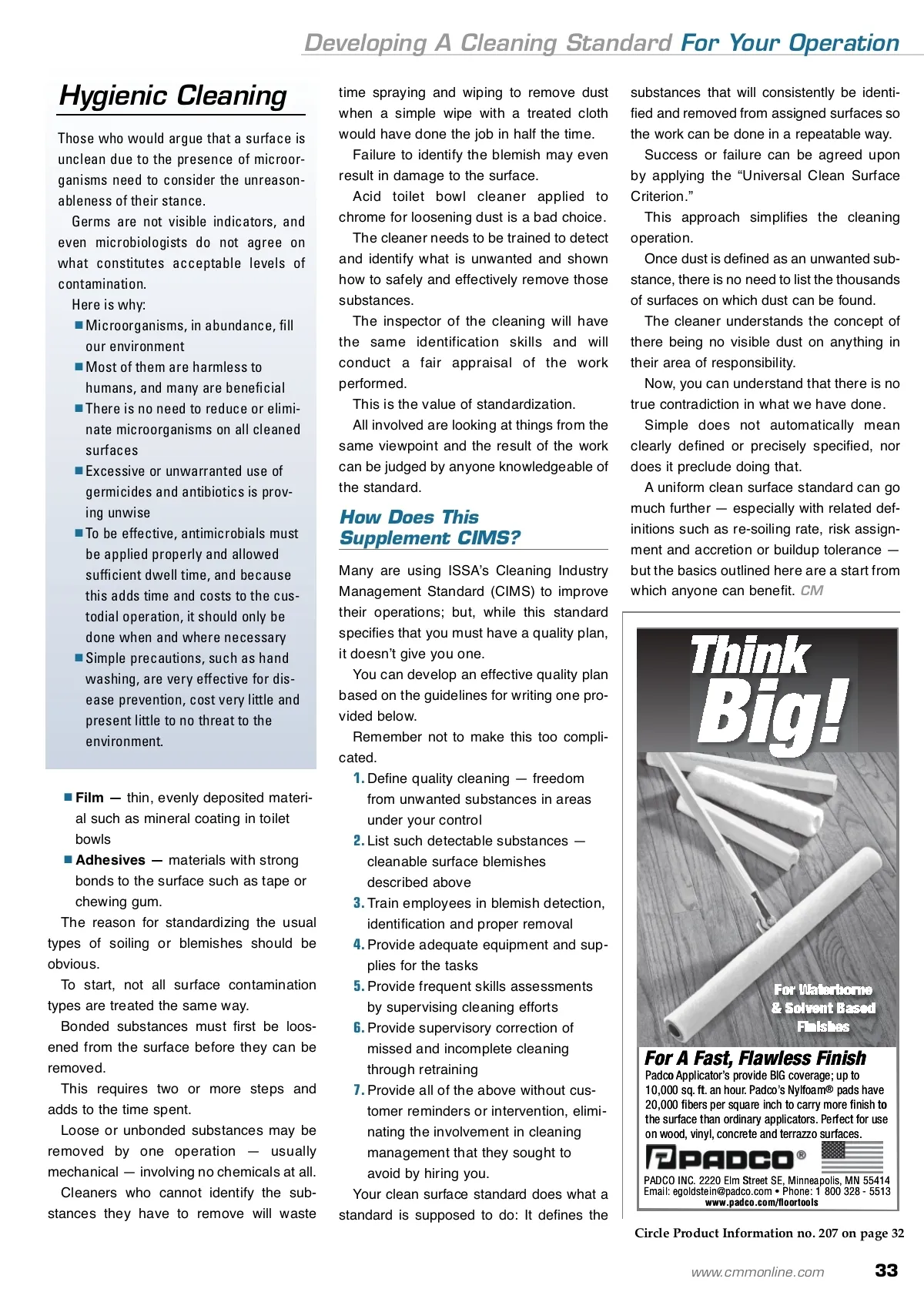
Developing A Cleaning Standard For Your Operation Hygienic Cleaning Those who would argue that a surface is unclean due to the presence of microor-ganisms need to consider the unreason-ableness of their stance. Germs are not visible indicators, and even microbiologists do not agree on what constitutes acceptable levels of contamination. Here is why: Microorganisms, in abundance, fill our environment Most of them are harmless to humans, and many are beneficial There is no need to reduce or elimi-nate microorganisms on all cleaned surfaces Excessive or unwarranted use of germicides and antibiotics is prov-ing unwise To be effective, antimicrobials must be applied properly and allowed sufficient dwell time, and because this adds time and costs to the cus-todial operation, it should only be done when and where necessary Simple precautions, such as hand washing, are very effective for dis-ease prevention, cost very little and present little to no threat to the environment. time spraying and wiping to remove dust when a simple wipe with a treated cloth would have done the job in half the time. Failure to identify the blemish may even result in damage to the surface. Acid toilet bowl cleaner applied to chrome for loosening dust is a bad choice. The cleaner needs to be trained to detect and identify what is unwanted and shown how to safely and effectively remove those substances. The inspector of the cleaning will have the same identification skills and will conduct a fair appraisal of the work performed. This is the value of standardization. All involved are looking at things from the same viewpoint and the result of the work can be judged by anyone knowledgeable of the standard. How Does This Supplement CIMS? Many are using ISSAʼs Cleaning Industry Management Standard (CIMS) to improve their operations; but, while this standard specifies that you must have a quality plan, it doesnʼt give you one. You can develop an effective quality plan based on the guidelines for writing one pro-vided below. Remember not to make this too compli-cated. 1. Define quality cleaning — freedom from unwanted substances in areas under your control 2. List such detectable substances — cleanable surface blemishes described above 3. Train employees in blemish detection, identification and proper removal 4. Provide adequate equipment and sup-plies for the tasks 5. Provide frequent skills assessments by supervising cleaning efforts 6. Provide supervisory correction of missed and incomplete cleaning through retraining 7. Provide all of the above without cus-tomer reminders or intervention, elimi-nating the involvement in cleaning management that they sought to avoid by hiring you. Your clean surface standard does what a standard is supposed to do: It defines the substances that will consistently be identi-fied and removed from assigned surfaces so the work can be done in a repeatable way. Success or failure can be agreed upon by applying the “Universal Clean Surface Criterion.” This approach simplifies the cleaning operation. Once dust is defined as an unwanted sub-stance, there is no need to list the thousands of surfaces on which dust can be found. The cleaner understands the concept of there being no visible dust on anything in their area of responsibility. Now, you can understand that there is no true contradiction in what we have done. Simple does not automatically mean clearly defined or precisely specified, nor does it preclude doing that. A uniform clean surface standard can go much further — especially with related def-initions such as re-soiling rate, risk assign-ment and accretion or buildup tolerance — but the basics outlined here are a start from which anyone can benefit. CM 4HINK "IG &OR 7ATERBORNE  3OLVENT "ASED &INISHES Film — thin, evenly deposited materi-al such as mineral coating in toilet bowls Adhesives — materials with strong bonds to the surface such as tape or chewing gum. The reason for standardizing the usual types of soiling or blemishes should be obvious. To start, not all surface contamination types are treated the same way. Bonded substances must first be loos-ened from the surface before they can be removed. This requires two or more steps and adds to the time spent. Loose or unbonded substances may be removed by one operation — usually mechanical — involving no chemicals at all. Cleaners who cannot identify the sub-stances they have to remove will waste &OR ! &AST�c; &LA &LAWLESS WLESS &INI &INISH ISH 0 ADCO !PPLICATORS 0ADCO ! PPLICA TOR S PROVIDE ")' COVERAGEb; COVERA GEb; UP U TO  �c; SQ�e; FT�e; AN HOUR�e; HOUR �e; 0ADCOS 0 ADCO S .YLFOAM PADS P HAVE HA VE  �c; lBERS PER SQUARE INCH TO CARR CARRY Y MORE MOR E lNISH TO THE SURFACE THAN ORDINAR ORDINARY Y APPLICATORS�e; A PPLICA TORS�e; 0ERFECT 0 ERFE ECT FOR USE ON WOOD�c; VINYL�c; VIN YL�c; CONCRETE AND TERRAZZO SURFACES�e; SURFA ACES �e; 0 !$#/ ).#�e;  %LM 3TREET 3%�c; -INNEAPOLIS�c; -.  0!$#/ %MAILa; EGOLDSTEIN PADCO�e;COM s 0HONEa;    �d;  WWW�e;PADCO�e;COM�f;FLOORTOOLS WWW �e;PADCO�e;COM�f;FLOORTOOLS Circle Product Information no. 207 on page 32 www.cmmonline.com 33
CMM – Archives Apr 2010: 33