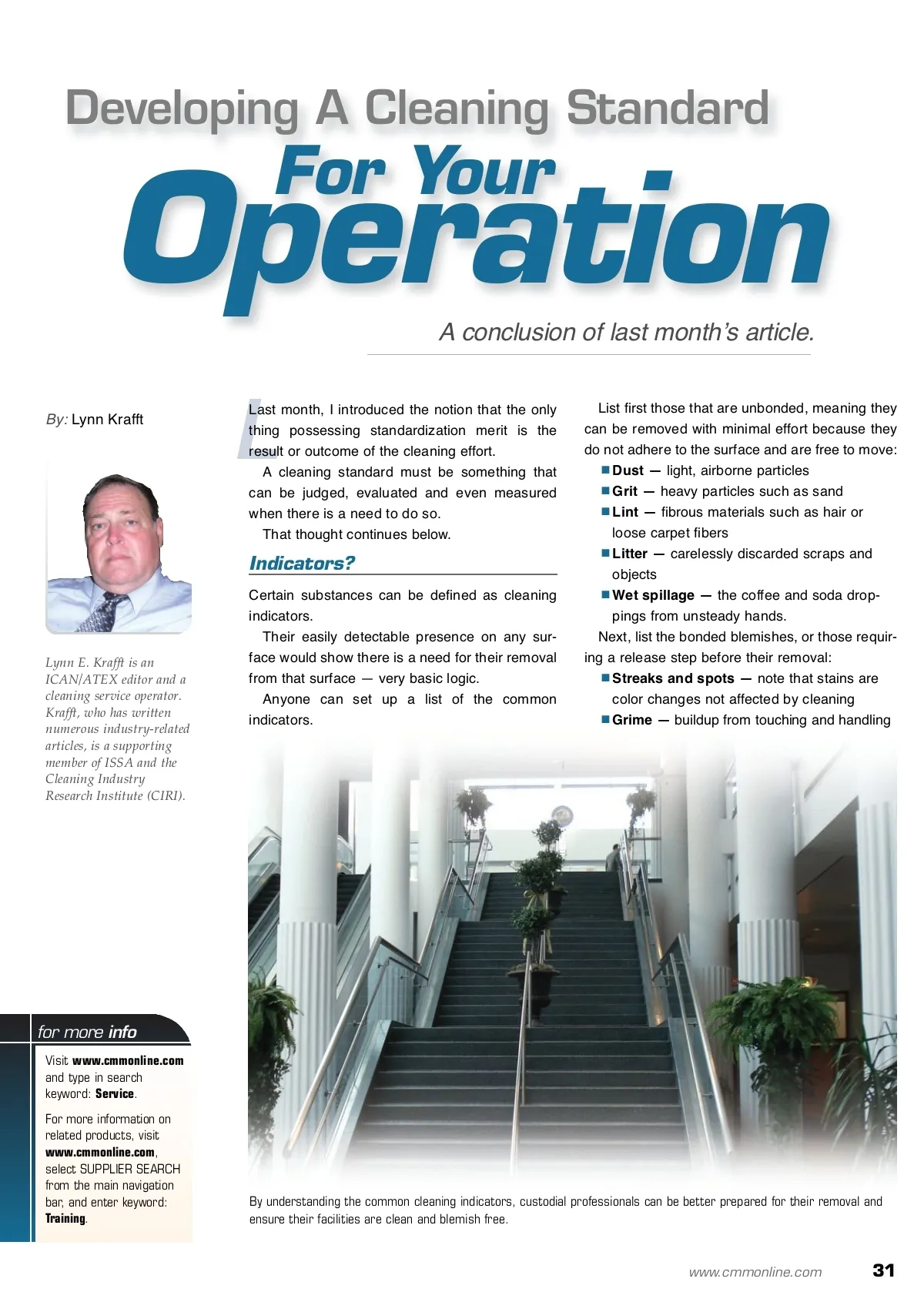
Developing A Cleaning Standard Operation A conclusion of last monthʼs article. By: Lynn Krafft For Your L Last month, I introduced the notion that the only thing possessing standardization merit is the result or outcome of the cleaning effort. A cleaning standard must be something that can be judged, evaluated and even measured when there is a need to do so. That thought continues below. Indicators? Certain substances can be defined as cleaning indicators. Their easily detectable presence on any sur-face would show there is a need for their removal from that surface — very basic logic. Anyone can set up a list of the common indicators. Lynn E. Krafft is an ICAN/ATEX editor and a cleaning service operator. Krafft, who has written numerous industry-related articles, is a supporting member of ISSA and the Cleaning Industry Research Institute (CIRI). List first those that are unbonded, meaning they can be removed with minimal effort because they do not adhere to the surface and are free to move: Dust — light, airborne particles Grit — heavy particles such as sand Lint — fibrous materials such as hair or loose carpet fibers Litter — carelessly discarded scraps and objects Wet spillage — the coffee and soda drop-pings from unsteady hands. Next, list the bonded blemishes, or those requir-ing a release step before their removal: Streaks and spots — note that stains are color changes not affected by cleaning Grime — buildup from touching and handling for more info Visit www.cmmonline.com and type in search keyword: Service . For more information on related products, visit www.cmmonline.com , select SUPPLIER SEARCH from the main navigation bar, and enter keyword: Training . By understanding the common cleaning indicators, custodial professionals can be better prepared for their removal and ensure their facilities are clean and blemish free. www.cmmonline.com 31
CMM – Archives Apr 2010: 31