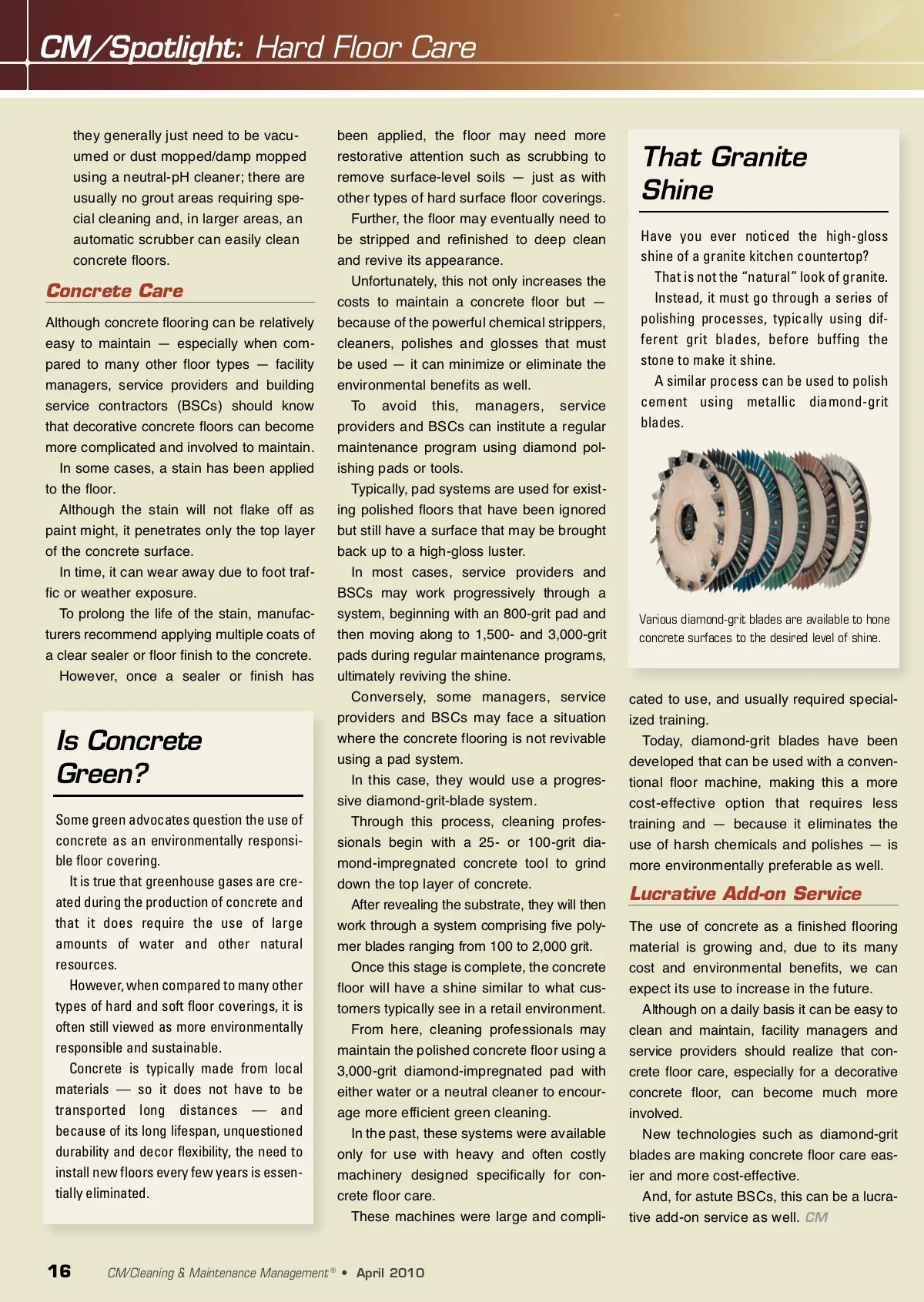
CM/Spotlight: Hard Floor Care they generally just need to be vacu-umed or dust mopped/damp mopped using a neutral-pH cleaner; there are usually no grout areas requiring spe-cial cleaning and, in larger areas, an automatic scrubber can easily clean concrete floors. been applied, the floor may need more restorative attention such as scrubbing to remove surface-level soils — just as with other types of hard surface floor coverings. Further, the floor may eventually need to be stripped and refinished to deep clean and revive its appearance. Unfortunately, this not only increases the costs to maintain a concrete floor but — because of the powerful chemical strippers, cleaners, polishes and glosses that must be used — it can minimize or eliminate the environmental benefits as well. To avoid this, managers, service providers and BSCs can institute a regular maintenance program using diamond pol-ishing pads or tools. Typically, pad systems are used for exist-ing polished floors that have been ignored but still have a surface that may be brought back up to a high-gloss luster. In most cases, service providers and BSCs may work progressively through a system, beginning with an 800-grit pad and then moving along to 1,500-and 3,000-grit pads during regular maintenance programs, ultimately reviving the shine. Conversely, some managers, service providers and BSCs may face a situation where the concrete flooring is not revivable using a pad system. In this case, they would use a progres-sive diamond-grit-blade system. Through this process, cleaning profes-sionals begin with a 25-or 100-grit dia-mond-impregnated concrete tool to grind down the top layer of concrete. After revealing the substrate, they will then work through a system comprising five poly-mer blades ranging from 100 to 2,000 grit. Once this stage is complete, the concrete floor will have a shine similar to what cus-tomers typically see in a retail environment. From here, cleaning professionals may maintain the polished concrete floor using a 3,000-grit diamond-impregnated pad with either water or a neutral cleaner to encour-age more efficient green cleaning. In the past, these systems were available only for use with heavy and often costly machinery designed specifically for con-crete floor care. These machines were large and compli-That Granite Shine Have you ever noticed the high-gloss shine of a granite kitchen countertop? That is not the “natural” look of granite. Instead, it must go through a series of polishing processes, typically using dif-ferent grit blades, before buffing the stone to make it shine. A similar process can be used to polish cement using metallic diamond-grit blades. Concrete Care Although concrete flooring can be relatively easy to maintain — especially when com-pared to many other floor types — facility managers, service providers and building service contractors (BSCs) should know that decorative concrete floors can become more complicated and involved to maintain. In some cases, a stain has been applied to the floor. Although the stain will not flake off as paint might, it penetrates only the top layer of the concrete surface. In time, it can wear away due to foot traf-fic or weather exposure. To prolong the life of the stain, manufac-turers recommend applying multiple coats of a clear sealer or floor finish to the concrete. However, once a sealer or finish has Various diamond-grit blades are available to hone concrete surfaces to the desired level of shine. Is Concrete Green? Some green advocates question the use of concrete as an environmentally responsi-ble floor covering. It is true that greenhouse gases are cre-ated during the production of concrete and that it does require the use of large amounts of water and other natural resources. However, when compared to many other types of hard and soft floor coverings, it is often still viewed as more environmentally responsible and sustainable. Concrete is typically made from local materials — so it does not have to be transported long distances — and because of its long lifespan, unquestioned durability and decor flexibility, the need to install new floors every few years is essen-tially eliminated. cated to use, and usually required special-ized training. Today, diamond-grit blades have been developed that can be used with a conven-tional floor machine, making this a more cost-effective option that requires less training and — because it eliminates the use of harsh chemicals and polishes — is more environmentally preferable as well. Lucrative Add-on Service The use of concrete as a finished flooring material is growing and, due to its many cost and environmental benefits, we can expect its use to increase in the future. Although on a daily basis it can be easy to clean and maintain, facility managers and service providers should realize that con-crete floor care, especially for a decorative concrete floor, can become much more involved. New technologies such as diamond-grit blades are making concrete floor care eas-ier and more cost-effective. And, for astute BSCs, this can be a lucra-tive add-on service as well. CM 16 CM/Cleaning & Maintenance Management ® • April 2010
CMM – Archives Apr 2010: 16