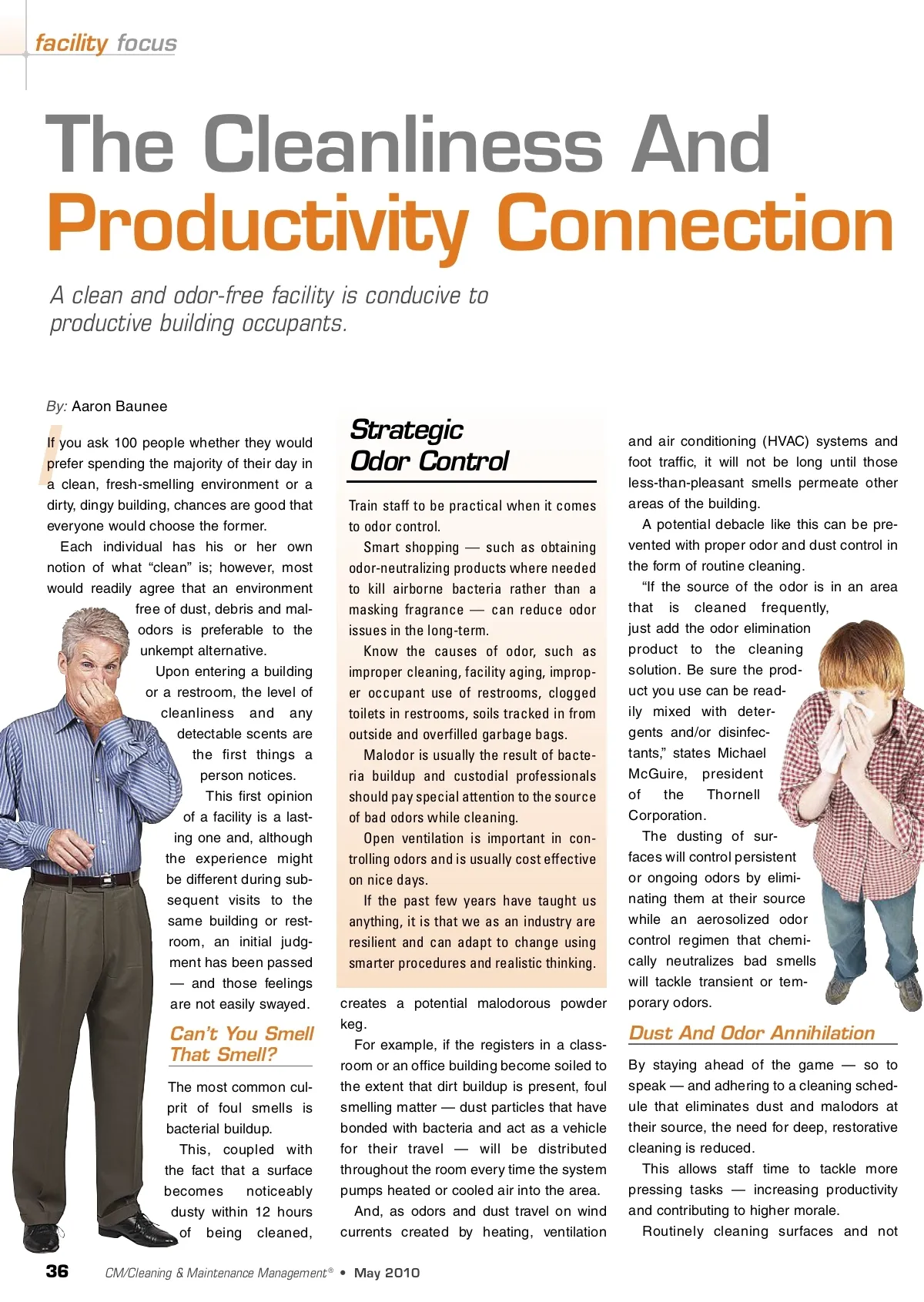
facility focus The Cleanliness And Productivity Connection A clean and odor-free facility is conducive to productive building occupants. By: Aaron Baunee I If you ask 100 people whether they would prefer spending the majority of their day in a clean, fresh-smelling environment or a dirty, dingy building, chances are good that everyone would choose the former. Each individual has his or her own notion of what “clean” is; however, most would readily agree that an environment free of dust, debris and mal-odors is preferable to the unkempt alternative. Upon entering a building or a restroom, the level of cleanliness and any detectable scents are the first things a person notices. This first opinion of a facility is a last-ing one and, although the experience might be different during sub-sequent visits to the same building or rest-room, an initial judg-ment has been passed — and those feelings are not easily swayed. Strategic Odor Control Train staff to be practical when it comes to odor control. Smart shopping — such as obtaining odor-neutralizing products where needed to kill airborne bacteria rather than a masking fragrance — can reduce odor issues in the long-term. Know the causes of odor, such as improper cleaning, facility aging, improp-er occupant use of restrooms, clogged toilets in restrooms, soils tracked in from outside and overfilled garbage bags. Malodor is usually the result of bacte-ria buildup and custodial professionals should pay special attention to the source of bad odors while cleaning. Open ventilation is important in con-trolling odors and is usually cost effective on nice days. If the past few years have taught us anything, it is that we as an industry are resilient and can adapt to change using smarter procedures and realistic thinking. creates a potential malodorous powder keg. For example, if the registers in a class-room or an office building become soiled to the extent that dirt buildup is present, foul smelling matter — dust particles that have bonded with bacteria and act as a vehicle for their travel — will be distributed throughout the room every time the system pumps heated or cooled air into the area. And, as odors and dust travel on wind currents created by heating, ventilation and air conditioning (HVAC) systems and foot traffic, it will not be long until those less-than-pleasant smells permeate other areas of the building. A potential debacle like this can be pre-vented with proper odor and dust control in the form of routine cleaning. “If the source of the odor is in an area that is cleaned frequently, just add the odor elimination product to the cleaning solution. Be sure the prod-uct you use can be read-ily mixed with deter-gents and/or disinfec-tants,” states Michael McGuire, president of the Thornell Corporation. The dusting of sur-faces will control persistent or ongoing odors by elimi-nating them at their source while an aerosolized odor control regimen that chemi-cally neutralizes bad smells will tackle transient or tem-porary odors. Can’t You Smell That Smell? The most common cul-prit of foul smells is bacterial buildup. This, coupled with the fact that a surface becomes noticeably dusty within 12 hours of being cleaned, Dust And Odor Annihilation By staying ahead of the game — so to speak — and adhering to a cleaning sched-ule that eliminates dust and malodors at their source, the need for deep, restorative cleaning is reduced. This allows staff time to tackle more pressing tasks — increasing productivity and contributing to higher morale. Routinely cleaning surfaces and not 36 CM/Cleaning & Maintenance Management ® • May 2010
CMM – Archives May 2010: 36