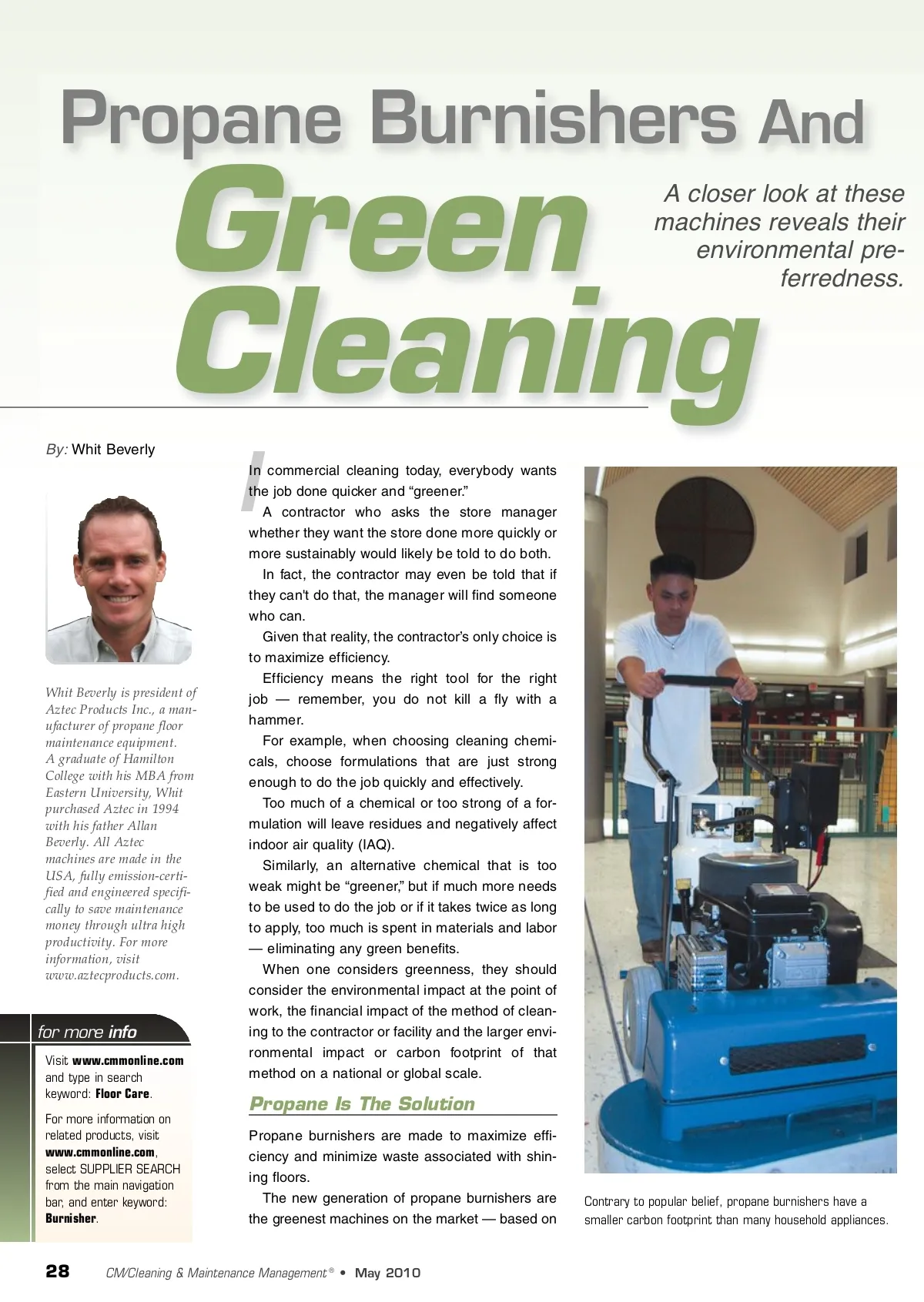
emissions, labor requirements and purchase price. According to the Official ISSA 540 Cleaning Times, a propane burnisher will shine a floor at 19,355 square feet per hour. The production rate of a 2,000 revolution per minute (RPM) corded electric machine is 8,333 square feet per hour, which is less than one-half the speed of the propane machine — assuming that you do not have to continually stop, unplug the machine and find another plug while you are working. Practically speaking, a propane burnish-er is usually considered to be at least three times the speed of a corded electric bur-nisher. A battery-powered machine will do 9,677 square feet per hour — exactly one-half the speed of the propane burnisher. Because there is no need to worry about cords, this work rate is accurate. Based on the above, it would take two battery-powered machines or three corded electric machines to do the same job. Ideally, you would be able to stretch the useable life of any of these machines to about six years. But, there is a hidden charge with bat-tery-powered machines because over six years it is normal to go through three sets of acid lead batteries, which end up in land-fills and cost thousands of dollars. A propane burnisher only requires one man to shine a floor at 20,000 square feet per hour. For a 60,000-square-foot store, three man-hours at a $15 per hour labor rate would cost you $45. A battery-powered burnisher would require six man-hours or $90 while a cord-ed electric burnisher would require nine man-hours or $135. Buffing with propane versus other meth-ods can be compared to the speed of trav-eling by car verses traveling by horse. If you have never operated a propane burnisher and are used to corded or bat-tery-powered machines, you need to see it to believe it. The Environmental Toll Obviously, there are no emissions from corded electric machines. However, as previously mentioned, more than 50 percent of the electricity in the United States is generated from coal-burning plants. Burning coal for electricity is a major con-tributor to greenhouse gasses, global warming and acid rain. Using electricity is creating the demand to burn more. Contrary to widespread notions, there are emissions from battery-powered machines — not when they are being used, but when they are charging. Lead acid batteries vent fumes when they charge and, given what the batteries are made of, you can guess what is in the fumes. Propane machines also create emis-sions. In their case, it is very low levels of car-bon monoxide. The vast majority of propane burnishers made by responsible companies use cat-alytic converters to mitigate the chance of problems occurring from carbon monoxide. As in an automobile, these catalytic con-verters change carbon monoxide to carbon dioxide — what we exhale as a byproduct of respiration. The U.S. Environmental Protection Agency (EPA) and the California Air Resources Board (CARB) very carefully regulate the use of propane indoors. It Is A Numbers Game Suppose you have a three-year contract for burnishing a 60,000-square-foot store three times a week or 468 times throughout the life of the contract. Here is how the costs break down: Type Machine Expense Corded electric: $ 4,500 Battery-powered: $12,000 Propane: $ 2,000 Labor Expense $63,180 $42,120 $21,060 Total Expense $67,680 $54,120 $23,060 Each manufacturer of propane equip-ment is required to submit their propane engine to be tested and approved. Once it is approved, the manufacturer is required to make every future engine the same way and to test the emissions on each new machine before it leaves the building. Spot tests of well-maintained propane machines in grocery stores usually find that the bread machine in the store bakery has significantly higher emissions than the propane burnisher. In addition to these standard features, most manufacturers offer some enhanced safety features. An overfill protection tank is an option to make sure that your propane tank does not get overfilled, resulting in liquid — rather than gaseous — propane entering the reg-ulator and freezing the diaphragm. An emergency cutoff switch can be installed that works much like those found on jet skis, which breaks the electric circuit if the operator loses contact with the machine. An electric clutch can be installed, which does much the same thing, but cuts power to the pad — not electricity — when the user releases the handle. An oxygen sensor can also be installed to actively monitor emission levels and cut power to the machine if something happens causing emissions to rise to unsafe levels. Just like in so many other areas of life, the people who talk the loudest are usually trying to sell you something. Green cleaning is very important, and the technological advances that have been made with chemicals and ionization processes are truly amazing. Equipment salespeople — much like politicians and special interest groups — tend to only give you the facts that strength-en their own case. After all, they are paid to convince you to change to their products or adopt their way of thinking. Do your own homework and make sure to take into account labor requirements, new parts replacement cost and old parts disposal expense — both to you and to the environment. You may find that the “best, newest and greenest” way to take care of your floors is the way that you have been doing it all along. CM www.cmmonline.com 29
CMM – Archives May 2010: 29