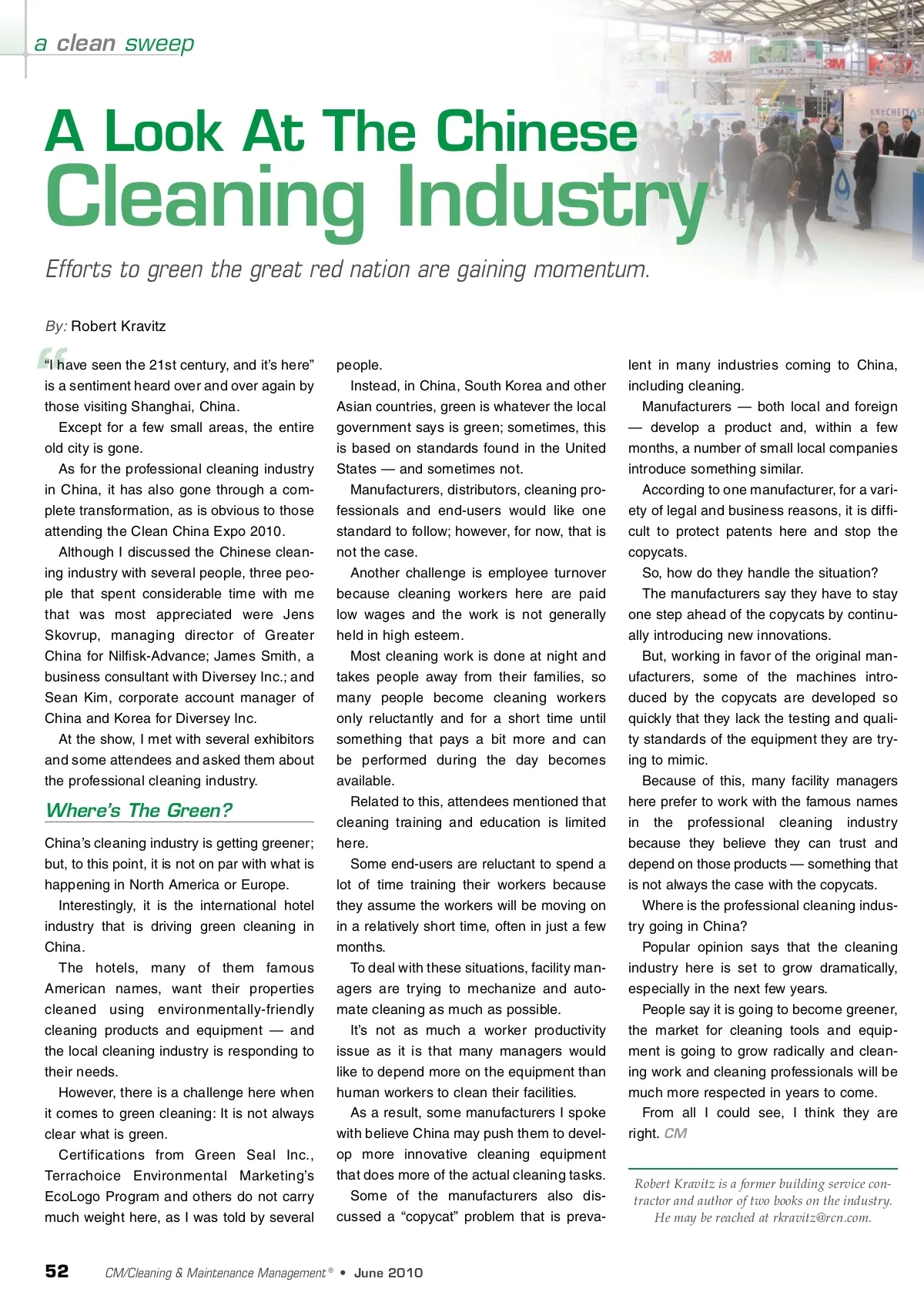
a clean sweep A Look At The Chinese Cleaning Industry Efforts to green the great red nation are gaining momentum. By: Robert Kravitz “ “I have seen the 21st century, and it’s here” is a sentiment heard over and over again by those visiting Shanghai, China. Except for a few small areas, the entire old city is gone. As for the professional cleaning industry in China, it has also gone through a com-plete transformation, as is obvious to those attending the Clean China Expo 2010. Although I discussed the Chinese clean-ing industry with several people, three peo-ple that spent considerable time with me that was most appreciated were Jens Skovrup, managing director of Greater China for Nilfisk-Advance; James Smith, a business consultant with Diversey Inc.; and Sean Kim, corporate account manager of China and Korea for Diversey Inc. At the show, I met with several exhibitors and some attendees and asked them about the professional cleaning industry. Where’s The Green? China’s cleaning industry is getting greener; but, to this point, it is not on par with what is happening in North America or Europe. Interestingly, it is the international hotel industry that is driving green cleaning in China. The hotels, many of them famous American names, want their properties cleaned using environmentally-friendly cleaning products and equipment — and the local cleaning industry is responding to their needs. However, there is a challenge here when it comes to green cleaning: It is not always clear what is green. Certifications from Green Seal Inc., Terrachoice Environmental Marketing’s EcoLogo Program and others do not carry much weight here, as I was told by several people. Instead, in China, South Korea and other Asian countries, green is whatever the local government says is green; sometimes, this is based on standards found in the United States — and sometimes not. Manufacturers, distributors, cleaning pro-fessionals and end-users would like one standard to follow; however, for now, that is not the case. Another challenge is employee turnover because cleaning workers here are paid low wages and the work is not generally held in high esteem. Most cleaning work is done at night and takes people away from their families, so many people become cleaning workers only reluctantly and for a short time until something that pays a bit more and can be performed during the day becomes available. Related to this, attendees mentioned that cleaning training and education is limited here. Some end-users are reluctant to spend a lot of time training their workers because they assume the workers will be moving on in a relatively short time, often in just a few months. To deal with these situations, facility man-agers are trying to mechanize and auto-mate cleaning as much as possible. It’s not as much a worker productivity issue as it is that many managers would like to depend more on the equipment than human workers to clean their facilities. As a result, some manufacturers I spoke with believe China may push them to devel-op more innovative cleaning equipment that does more of the actual cleaning tasks. Some of the manufacturers also dis-cussed a “copycat” problem that is preva-lent in many industries coming to China, including cleaning. Manufacturers — both local and foreign — develop a product and, within a few months, a number of small local companies introduce something similar. According to one manufacturer, for a vari-ety of legal and business reasons, it is diffi-cult to protect patents here and stop the copycats. So, how do they handle the situation? The manufacturers say they have to stay one step ahead of the copycats by continu-ally introducing new innovations. But, working in favor of the original man-ufacturers, some of the machines intro-duced by the copycats are developed so quickly that they lack the testing and quali-ty standards of the equipment they are try-ing to mimic. Because of this, many facility managers here prefer to work with the famous names in the professional cleaning industry because they believe they can trust and depend on those products — something that is not always the case with the copycats. Where is the professional cleaning indus-try going in China? Popular opinion says that the cleaning industry here is set to grow dramatically, especially in the next few years. People say it is going to become greener, the market for cleaning tools and equip-ment is going to grow radically and clean-ing work and cleaning professionals will be much more respected in years to come. From all I could see, I think they are right. CM Robert Kravitz is a former building service con-tractor and author of two books on the industry. He may be reached at [email protected]. 52 CM/Cleaning & Maintenance Management ® • June 2010
CMM – Archives Jun 2010: 52