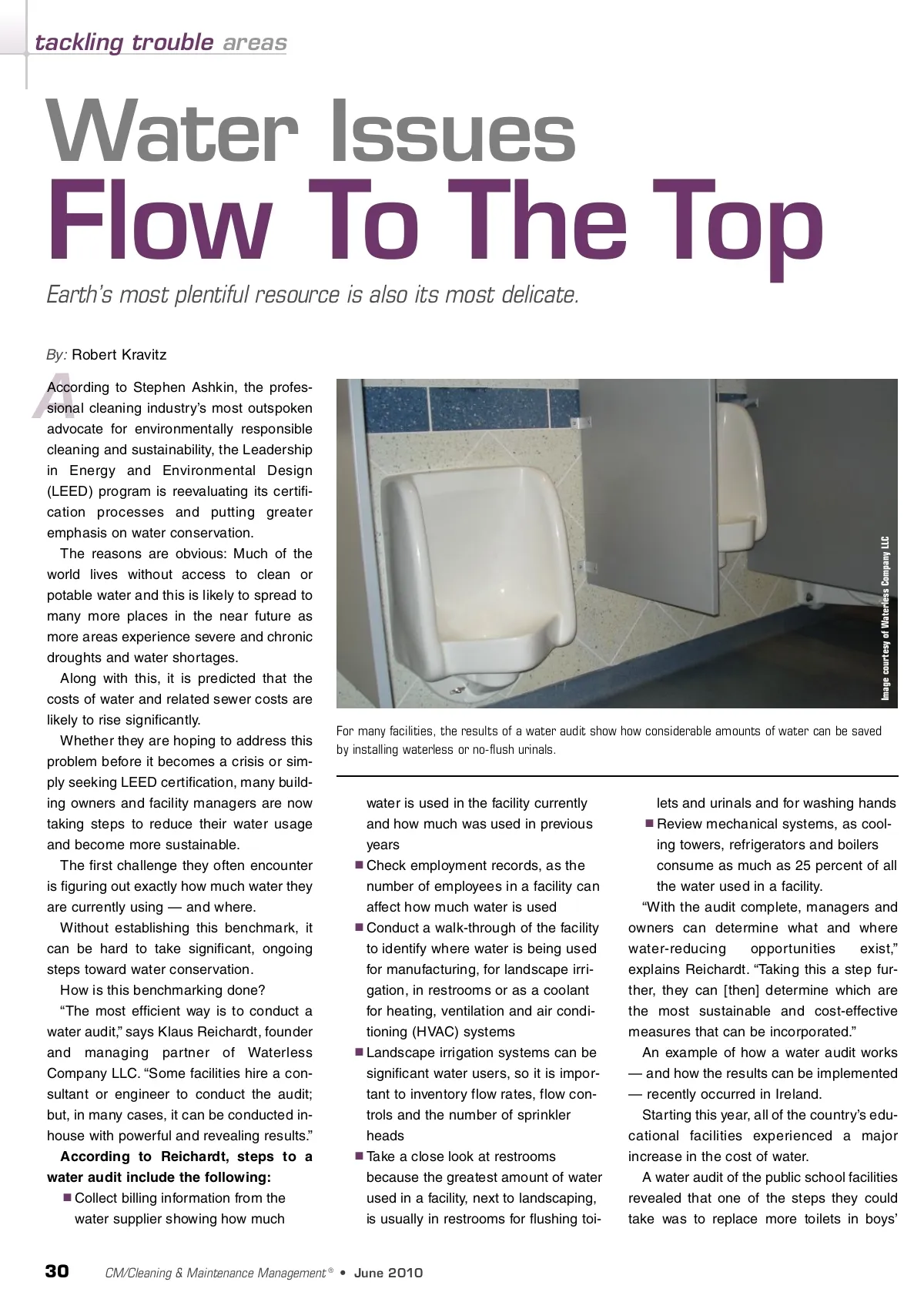
restrooms with urinals, which typically use about half the water of a standard toilet. However, the school system decided to take this a step further. Again referencing their water audit, they realized the most dramatic step they could take would be to install waterless urinal systems, essentially eliminating the need for water altogether. These are now being installed in all of the country’s educational facilities. Cleaning And Water Water is used in many cleaning proce-dures, and the two cleaning tasks that use more water than any other are carpet cleaning and floor care. JanSan manufacturers are addressing both of these areas to reduce the amount of water used. For instance, according to Nick Wiebe, marketing manager for U.S. Products, older carpet extractors typically use 1 to 1.5 gal-lons of water per minute. Conversely, newer, low-moisture machines use about two-thirds of a gallon of water per minute. “Translating this into actual water usage, a 30-minute carpet cleaning would require about 45 gallons of water with an older machine,” Wiebe says, “whereas less than 20 [gallons] would be necessary when a low-moisture machine is employed.” Wiebe adds that the carpets also dry faster with a low-moisture system — and the chances that mold or mildew will devel-op are minimized considerably. Similar developments are occurring with floor care equipment. According to David Frank, president of the American Institute for Cleaning Sciences (AICS), among the reasons we can expect more “low-moisture floor care” is that “the less water used, the better. You don’t want to use more chemical and water than you have to.You want to be [cost-effec-tive and] efficient and decrease dry times.” Frank believes that to minimize water use, cylindrical brush agitation, also known as cylindrical brush technology machines, available in Europe for almost two decades but introduced in the United States only about six or seven years ago, will become increasingly popular. “They use less water because they use rotating brushes instead of pads, and that’s a good thing,” notes Frank. There are many more ways facilities can reduce water usage. With the help of the water audit, high-water-use areas other than those men-tioned here — specifically landscaping — will likely pop up for evaluation. In some facilities, more water is used for landscaping than for anything else. “However, you really won’t know until the [water] audit is conducted,” concludes Reichardt. “Once you have that accom-plished, scores of water-conserving sys-tems can be implemented with positive, cost-effective results.” CM Robert Kravitz is a former building service contractor and author of two books on the indus-try. He may be reached at [email protected]. Circle Product Information no. 201 on page 32 www.cmmonline.com 31
CMM – Archives Jun 2010: 31