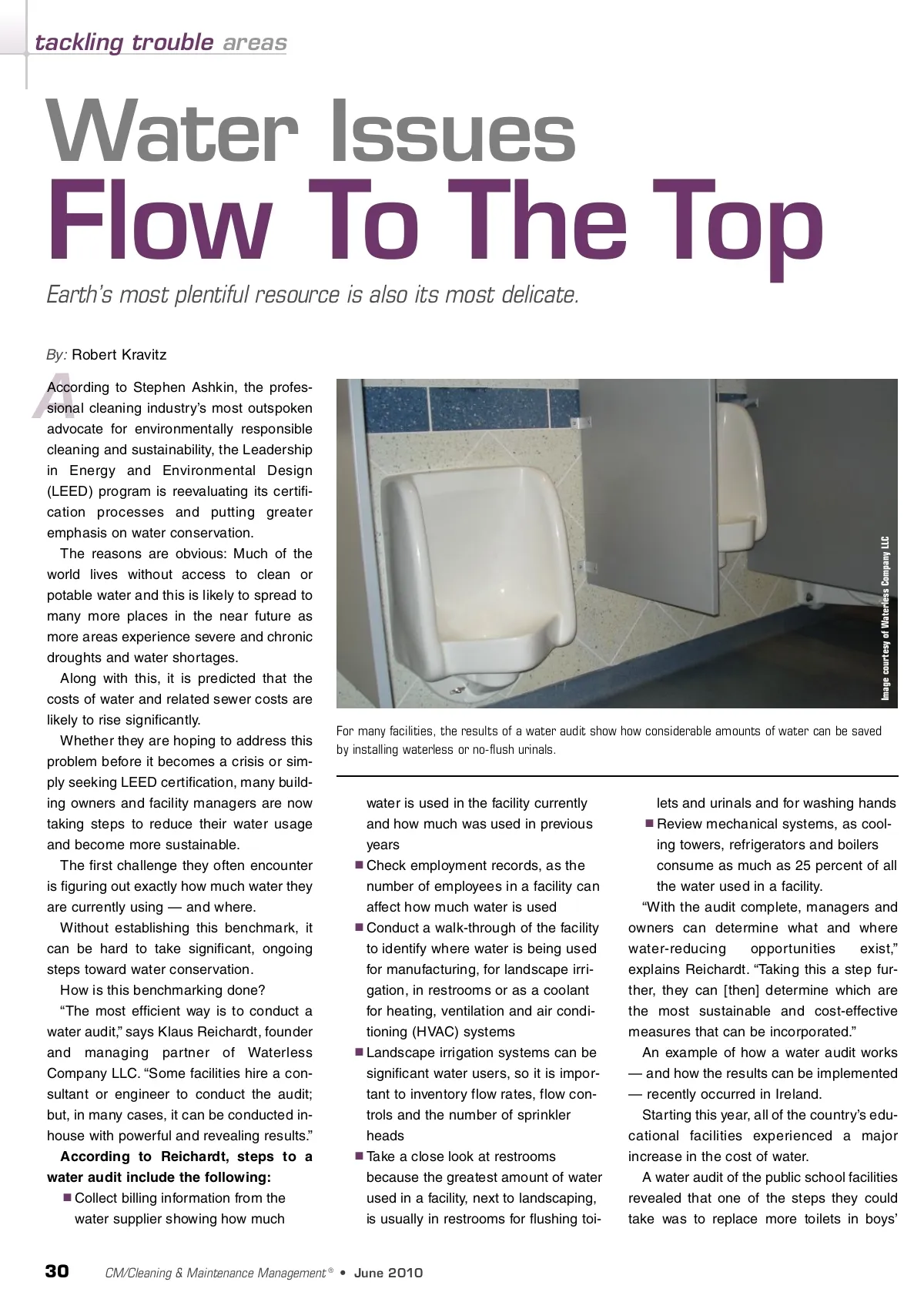
tackling trouble areas Water Issues By: Robert Kravitz Flow To The Top Earth’s most plentiful resource is also its most delicate. A According to Stephen Ashkin, the profes-sional cleaning industry’s most outspoken advocate for environmentally responsible cleaning and sustainability, the Leadership in Energy and Environmental Design (LEED) program is reevaluating its certifi-cation processes and putting greater emphasis on water conservation. The reasons are obvious: Much of the world lives without access to clean or potable water and this is likely to spread to many more places in the near future as more areas experience severe and chronic droughts and water shortages. Along with this, it is predicted that the costs of water and related sewer costs are likely to rise significantly. Whether they are hoping to address this problem before it becomes a crisis or sim-ply seeking LEED certification, many build-ing owners and facility managers are now taking steps to reduce their water usage and become more sustainable. The first challenge they often encounter is figuring out exactly how much water they are currently using — and where. Without establishing this benchmark, it can be hard to take significant, ongoing steps toward water conservation. How is this benchmarking done? “The most efficient way is to conduct a water audit,” says Klaus Reichardt, founder and managing partner of Waterless Company LLC. “Some facilities hire a con-sultant or engineer to conduct the audit; but, in many cases, it can be conducted in-house with powerful and revealing results.” According to Reichardt, steps to a water audit include the following: Collect billing information from the water supplier showing how much For many facilities, the results of a water audit show how considerable amounts of water can be saved by installing waterless or no-flush urinals. water is used in the facility currently and how much was used in previous years Check employment records, as the number of employees in a facility can affect how much water is used Conduct a walk-through of the facility to identify where water is being used for manufacturing, for landscape irri-gation, in restrooms or as a coolant for heating, ventilation and air condi-tioning (HVAC) systems Landscape irrigation systems can be significant water users, so it is impor-tant to inventory flow rates, flow con-trols and the number of sprinkler heads Take a close look at restrooms because the greatest amount of water used in a facility, next to landscaping, is usually in restrooms for flushing toi-lets and urinals and for washing hands Review mechanical systems, as cool-ing towers, refrigerators and boilers consume as much as 25 percent of all the water used in a facility. “With the audit complete, managers and owners can determine what and where water-reducing opportunities exist,” explains Reichardt. “Taking this a step fur-ther, they can [then] determine which are the most sustainable and cost-effective measures that can be incorporated.” An example of how a water audit works — and how the results can be implemented — recently occurred in Ireland. Starting this year, all of the country’s edu-cational facilities experienced a major increase in the cost of water. A water audit of the public school facilities revealed that one of the steps they could take was to replace more toilets in boys’ 30 CM/Cleaning & Maintenance Management ® • June 2010 Image courtesy of Waterless Company LLC
CMM – Archives Jun 2010: 30