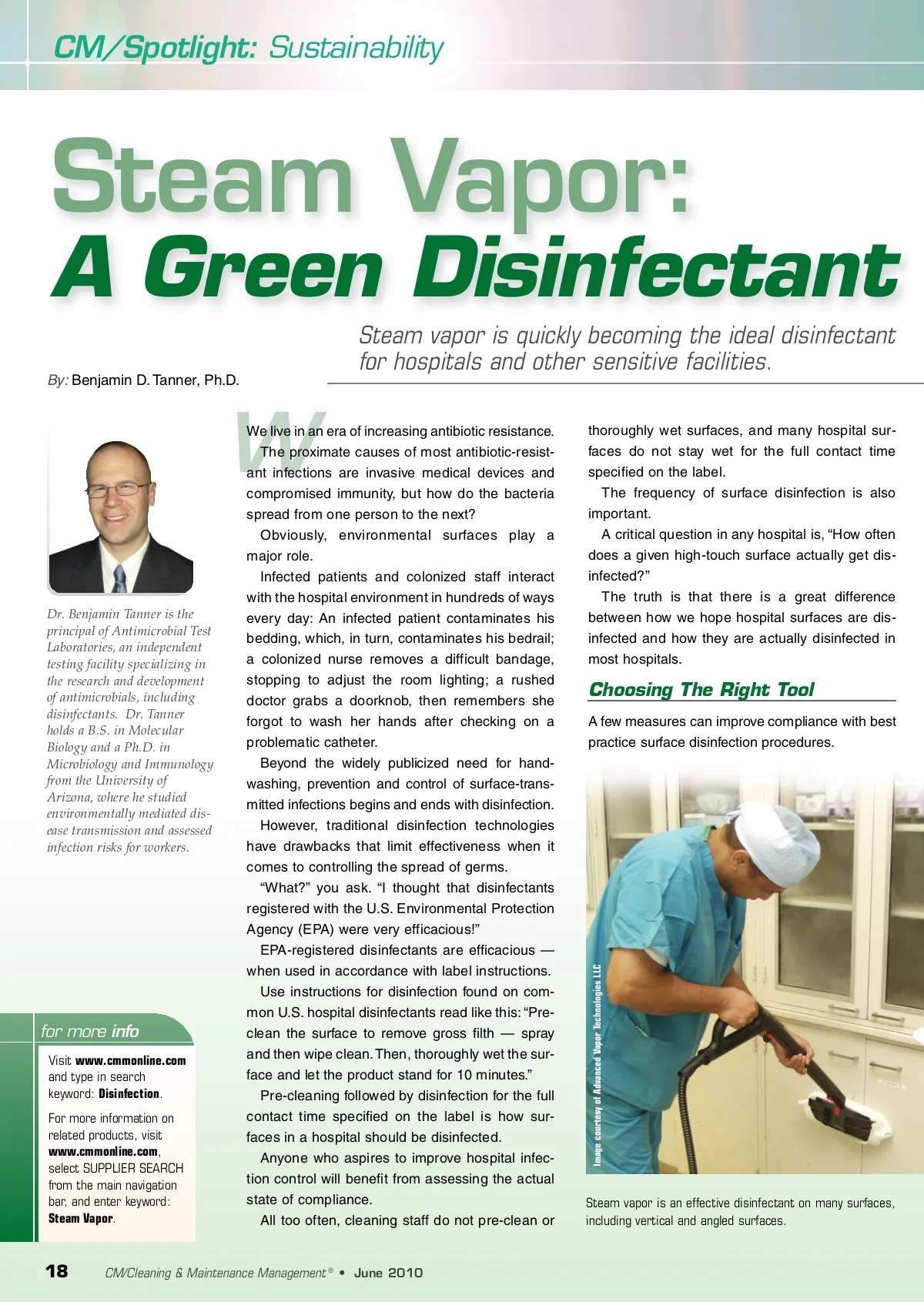
Steam Vapor: A Green Disinfectant By: Benjamin D. Tanner, Ph.D. Steam vapor is quickly becoming the ideal disinfectant for hospitals and other sensitive facilities. We live in an era of increasing antibiotic resistance. The proximate causes of most antibiotic-resist-ant infections are invasive medical devices and compromised immunity, but how do the bacteria spread from one person to the next? Obviously, environmental surfaces play a major role. Infected patients and colonized staff interact with the hospital environment in hundreds of ways every day: An infected patient contaminates his bedding, which, in turn, contaminates his bedrail; a colonized nurse removes a difficult bandage, stopping to adjust the room lighting; a rushed doctor grabs a doorknob, then remembers she forgot to wash her hands after checking on a problematic catheter. Beyond the widely publicized need for hand-washing, prevention and control of surface-trans-mitted infections begins and ends with disinfection. However, traditional disinfection technologies have drawbacks that limit effectiveness when it comes to controlling the spread of germs. “What?” you ask. “I thought that disinfectants registered with the U.S. Environmental Protection Agency (EPA) were very efficacious!” EPA-registered disinfectants are efficacious — when used in accordance with label instructions. Use instructions for disinfection found on com-mon U.S. hospital disinfectants read like this: “Pre-clean the surface to remove gross filth — spray and then wipe clean. Then, thoroughly wet the sur-face and let the product stand for 10 minutes.” Pre-cleaning followed by disinfection for the full contact time specified on the label is how sur-faces in a hospital should be disinfected. Anyone who aspires to improve hospital infec-tion control will benefit from assessing the actual state of compliance. All too often, cleaning staff do not pre-clean or thoroughly wet surfaces, and many hospital sur-faces do not stay wet for the full contact time specified on the label. The frequency of surface disinfection is also important. A critical question in any hospital is, “How often does a given high-touch surface actually get dis-infected?” The truth is that there is a great difference between how we hope hospital surfaces are dis-infected and how they are actually disinfected in most hospitals. W Dr. Benjamin Tanner is the principal of Antimicrobial Test Laboratories, an independent testing facility specializing in the research and development of antimicrobials, including disinfectants. Dr. Tanner holds a B.S. in Molecular Biology and a Ph.D. in Microbiology and Immunology from the University of Arizona, where he studied environmentally mediated dis-ease transmission and assessed infection risks for workers. Choosing The Right Tool A few measures can improve compliance with best practice surface disinfection procedures. for more info Visit www.cmmonline.com and type in search keyword: Disinfection . For more information on related products, visit www.cmmonline.com , select SUPPLIER SEARCH from the main navigation bar, and enter keyword: Steam Vapor . Steam vapor is an effective disinfectant on many surfaces, including vertical and angled surfaces. 18 CM/Cleaning & Maintenance Management ® • June 2010
CMM – Archives Jun 2010: 18