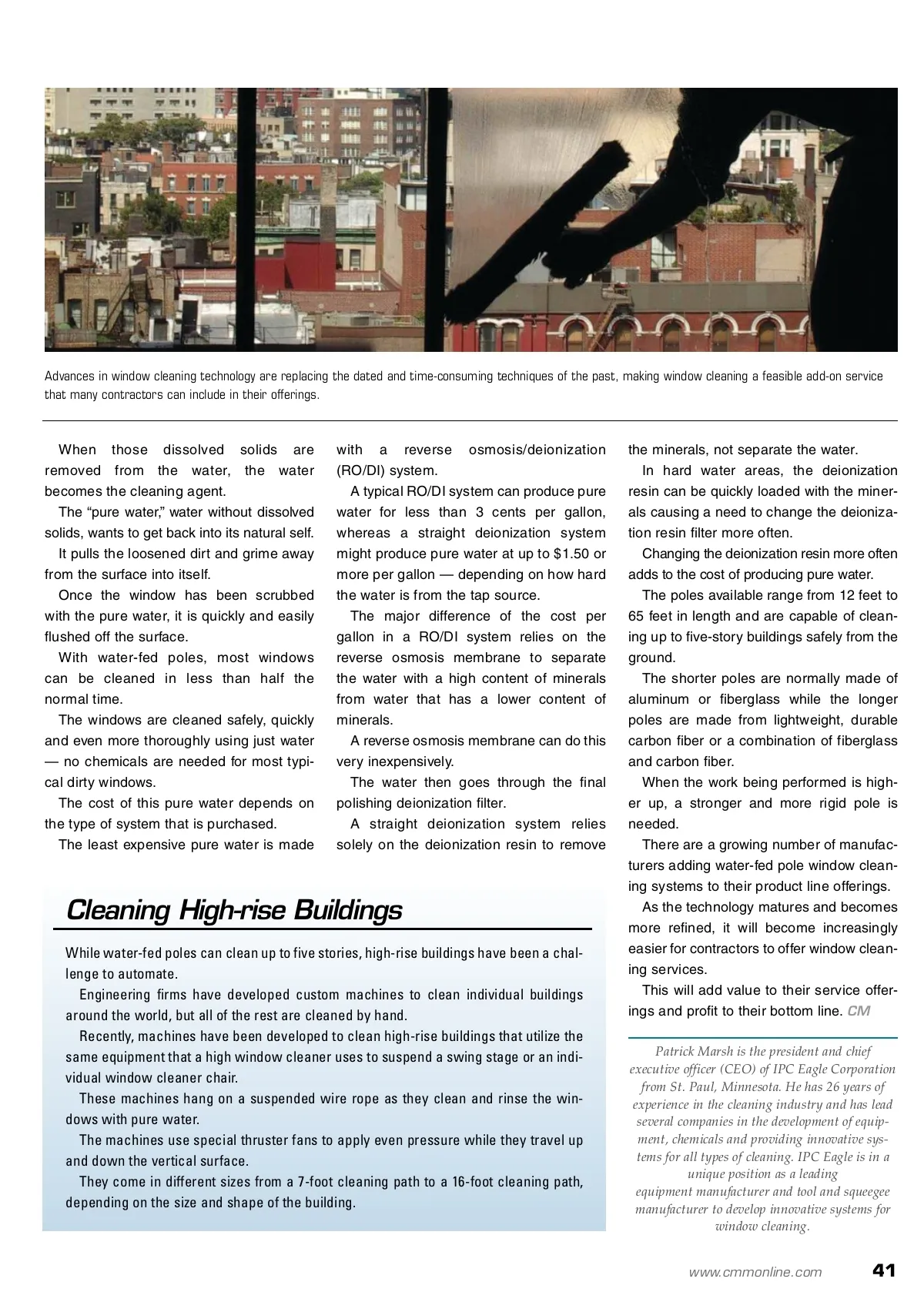
Advances in window cleaning technology are replacing the dated and time-consuming techniques of the past, making window cleaning a feasible add-on service that many contractors can include in their offerings. When those dissolved solids are removed from the water, the water becomes the cleaning agent. The “pure water,” water without dissolved solids, wants to get back into its natural self. It pulls the loosened dirt and grime away from the surface into itself. Once the window has been scrubbed with the pure water, it is quickly and easily flushed off the surface. With water-fed poles, most windows can be cleaned in less than half the normal time. The windows are cleaned safely, quickly and even more thoroughly using just water — no chemicals are needed for most typi-cal dirty windows. The cost of this pure water depends on the type of system that is purchased. The least expensive pure water is made with a reverse osmosis/deionization (RO/DI) system. A typical RO/DI system can produce pure water for less than 3 cents per gallon, whereas a straight deionization system might produce pure water at up to $1.50 or more per gallon — depending on how hard the water is from the tap source. The major difference of the cost per gallon in a RO/DI system relies on the reverse osmosis membrane to separate the water with a high content of minerals from water that has a lower content of minerals. A reverse osmosis membrane can do this very inexpensively. The water then goes through the final polishing deionization filter. A straight deionization system relies solely on the deionization resin to remove Cleaning High-rise Buildings While water-fed poles can clean up to five stories, high-rise buildings have been a chal-lenge to automate. Engineering firms have developed custom machines to clean individual buildings around the world, but all of the rest are cleaned by hand. Recently, machines have been developed to clean high-rise buildings that utilize the same equipment that a high window cleaner uses to suspend a swing stage or an indi-vidual window cleaner chair. These machines hang on a suspended wire rope as they clean and rinse the win-dows with pure water. The machines use special thruster fans to apply even pressure while they travel up and down the vertical surface. They come in different sizes from a 7-foot cleaning path to a 16-foot cleaning path, depending on the size and shape of the building. the minerals, not separate the water. In hard water areas, the deionization resin can be quickly loaded with the miner-als causing a need to change the deioniza-tion resin filter more often. Changing the deionization resin more often adds to the cost of producing pure water. The poles available range from 12 feet to 65 feet in length and are capable of clean-ing up to five-story buildings safely from the ground. The shorter poles are normally made of aluminum or fiberglass while the longer poles are made from lightweight, durable carbon fiber or a combination of fiberglass and carbon fiber. When the work being performed is high-er up, a stronger and more rigid pole is needed. There are a growing number of manufac-turers adding water-fed pole window clean-ing systems to their product line offerings. As the technology matures and becomes more refined, it will become increasingly easier for contractors to offer window clean-ing services. This will add value to their service offer-ings and profit to their bottom line. CM Patrick Marsh is the president and chief executive officer (CEO) of IPC Eagle Corporation from St. Paul, Minnesota. He has 26 years of experience in the cleaning industry and has lead several companies in the development of equip-ment, chemicals and providing innovative sys-tems for all types of cleaning. IPC Eagle is in a unique position as a leading equipment manufacturer and tool and squeegee manufacturer to develop innovative systems for window cleaning. www.cmmonline.com 41
CMM – Archives July 2010: 41