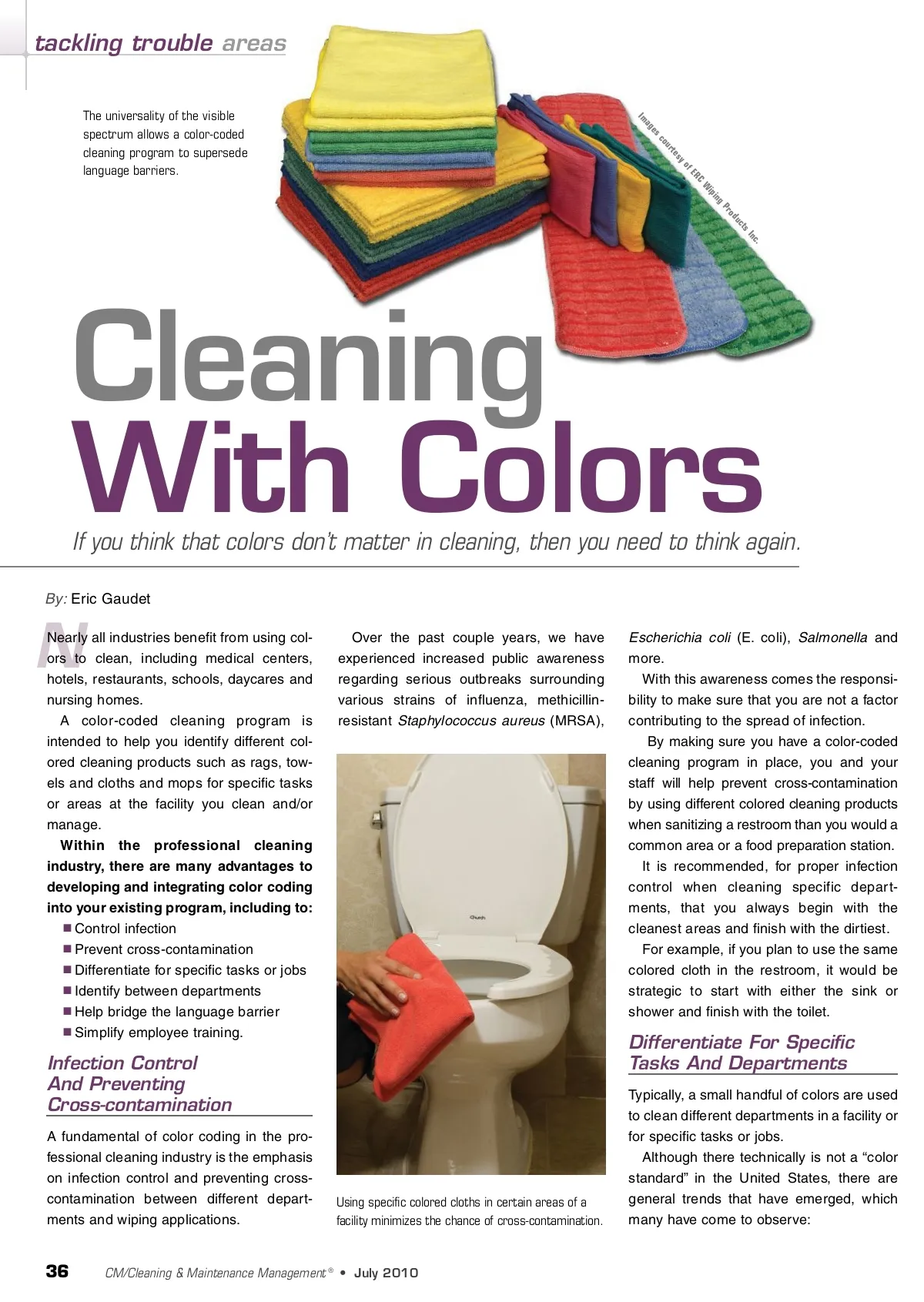
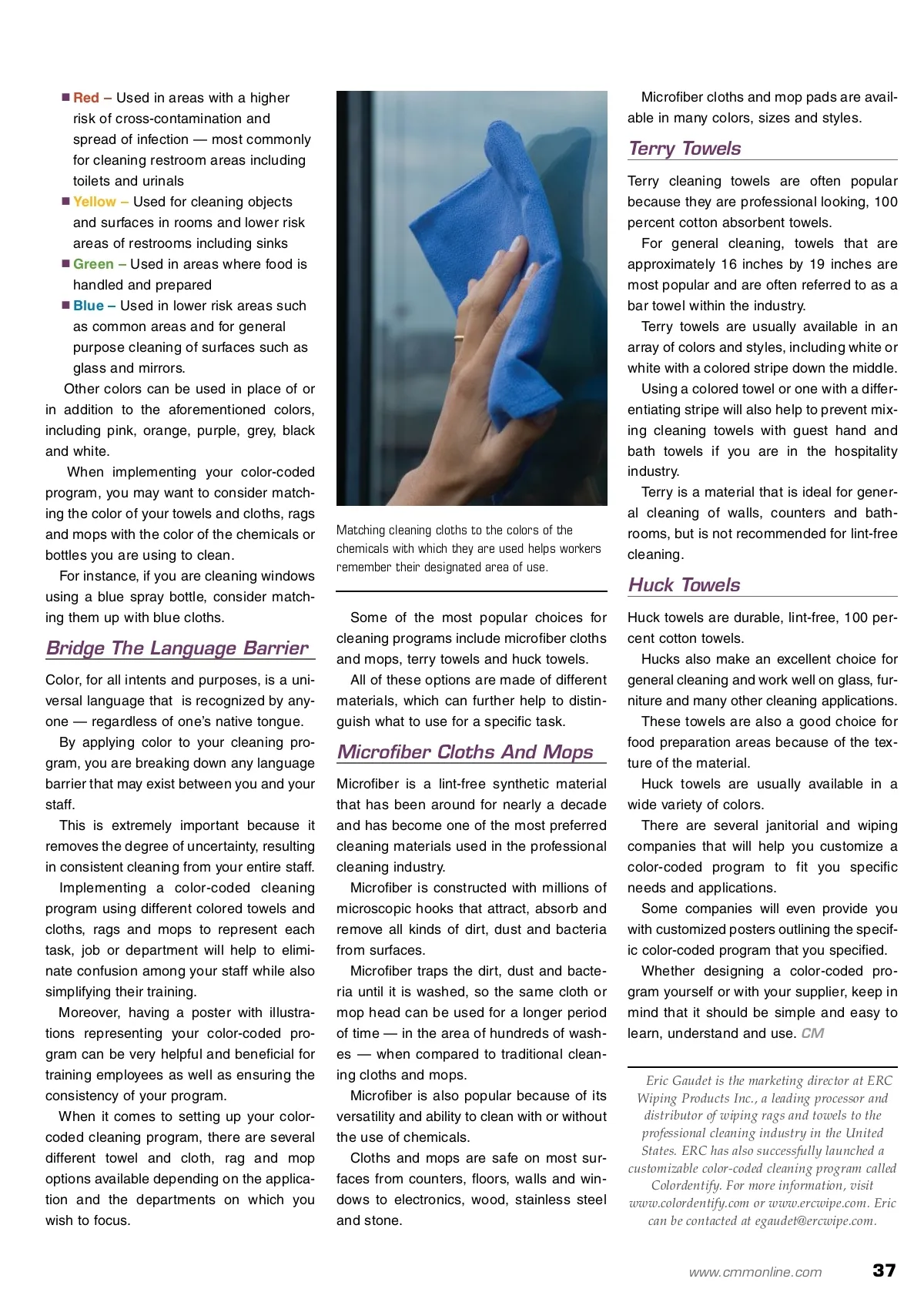
Red – Used in areas with a higher risk of cross-contamination and spread of infection — most commonly for cleaning restroom areas including toilets and urinals Yellow – Used for cleaning objects and surfaces in rooms and lower risk areas of restrooms including sinks Green – Used in areas where food is handled and prepared Blue – Used in lower risk areas such as common areas and for general purpose cleaning of surfaces such as glass and mirrors. Other colors can be used in place of or in addition to the aforementioned colors, including pink, orange, purple, grey, black and white. When implementing your color-coded program, you may want to consider match-ing the color of your towels and cloths, rags and mops with the color of the chemicals or bottles you are using to clean. For instance, if you are cleaning windows using a blue spray bottle, consider match-ing them up with blue cloths. Microfiber cloths and mop pads are avail-able in many colors, sizes and styles. Terry Towels Terry cleaning towels are often popular because they are professional looking, 100 percent cotton absorbent towels. For general cleaning, towels that are approximately 16 inches by 19 inches are most popular and are often referred to as a bar towel within the industry. Terry towels are usually available in an array of colors and styles, including white or white with a colored stripe down the middle. Using a colored towel or one with a differ-entiating stripe will also help to prevent mix-ing cleaning towels with guest hand and bath towels if you are in the hospitality industry. Terry is a material that is ideal for gener-al cleaning of walls, counters and bath-rooms, but is not recommended for lint-free cleaning. Matching cleaning cloths to the colors of the chemicals with which they are used helps workers remember their designated area of use. Huck Towels Some of the most popular choices for cleaning programs include microfiber cloths and mops, terry towels and huck towels. All of these options are made of different materials, which can further help to distin-guish what to use for a specific task. Huck towels are durable, lint-free, 100 per-cent cotton towels. Hucks also make an excellent choice for general cleaning and work well on glass, fur-niture and many other cleaning applications. These towels are also a good choice for food preparation areas because of the tex-ture of the material. Huck towels are usually available in a wide variety of colors. There are several janitorial and wiping companies that will help you customize a color-coded program to fit you specific needs and applications. Some companies will even provide you with customized posters outlining the specif-ic color-coded program that you specified. Whether designing a color-coded pro-gram yourself or with your supplier, keep in mind that it should be simple and easy to learn, understand and use. CM Eric Gaudet is the marketing director at ERC Wiping Products Inc., a leading processor and distributor of wiping rags and towels to the professional cleaning industry in the United States. ERC has also successfully launched a customizable color-coded cleaning program called Colordentify. For more information, visit www.colordentify.com or www.ercwipe.com. Eric can be contacted at [email protected]. Bridge The Language Barrier Color, for all intents and purposes, is a uni-versal language that is recognized by any-one — regardless of one’s native tongue. By applying color to your cleaning pro-gram, you are breaking down any language barrier that may exist between you and your staff. This is extremely important because it removes the degree of uncertainty, resulting in consistent cleaning from your entire staff. Implementing a color-coded cleaning program using different colored towels and cloths, rags and mops to represent each task, job or department will help to elimi-nate confusion among your staff while also simplifying their training. Moreover, having a poster with illustra-tions representing your color-coded pro-gram can be very helpful and beneficial for training employees as well as ensuring the consistency of your program. When it comes to setting up your color-coded cleaning program, there are several different towel and cloth, rag and mop options available depending on the applica-tion and the departments on which you wish to focus. Microfiber Cloths And Mops Microfiber is a lint-free synthetic material that has been around for nearly a decade and has become one of the most preferred cleaning materials used in the professional cleaning industry. Microfiber is constructed with millions of microscopic hooks that attract, absorb and remove all kinds of dirt, dust and bacteria from surfaces. Microfiber traps the dirt, dust and bacte-ria until it is washed, so the same cloth or mop head can be used for a longer period of time — in the area of hundreds of wash-es — when compared to traditional clean-ing cloths and mops. Microfiber is also popular because of its versatility and ability to clean with or without the use of chemicals. Cloths and mops are safe on most sur-faces from counters, floors, walls and win-dows to electronics, wood, stainless steel and stone. www.cmmonline.com 37
CMM – Archives July 2010: 37