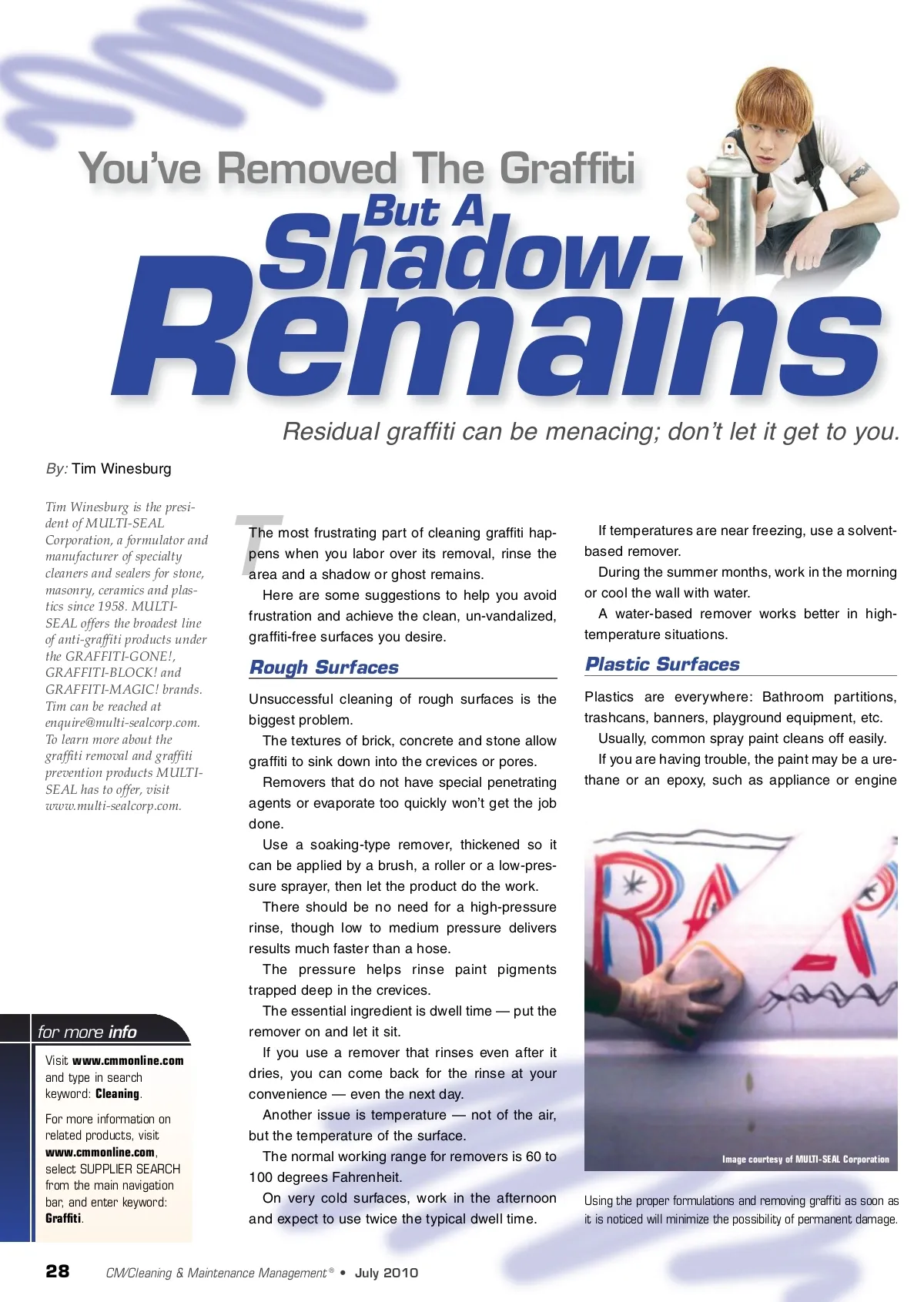
block spray paint. Shift up to a stronger remover that can handle those types of paints. The bigger problem is permanent mark-er; you can easily clean off the surface, but a stubborn ghost remains. The essential difference between paints and markers is that markers are made of permanent dyes. These dyes are microscopic colors dis-solved in solvent that can penetrate into the surface. You may well have cleaned a ceramic bathroom tile, only to see that there was a shadow left in the grout joints — this is the dye that entered into the grout itself. You must approach it as a stain and use a graffiti remover that is designed for stain lifting. Just like textured surfaces, there will be a dwell time for the stain remover to work. Another word of advice: Like any stain, repeated failures to remove it may make the stain permanent. Because of this possibility, you want to succeed the first time. Therefore, test your product in a small, inconspicuous spot before attempting the entire mark. Image courtesy of MULTI-SEAL Corporation Failing to immediately remove unsightly graffiti will encourage subsequent acts of vandalism. Third, in areas where you do not want to use any chemical remover, perhaps in a school or a nature setting, a pressurized water rinse is used alone. Coatings come in two basic types: Sacrificial and permanent. The sacrificial barriers are popular, less expensive, safe and fast, but will be partly removed during cleaning; hence, they are sacrificed and must be re-applied. The permanent barriers are usually very expensive, tough coatings, such as ure-thanes or nanoparticle paints. They survive repeated cleanings and can be convenient. The main drawback is that they are not breathable and have a tendency to delami-nate from masonry and other porous sur-faces. If you consider the surface and its tem-perature, along with the type of graffiti, you increase your chances of being successful in its removal. Improve your odds even more by addressing the graffiti as soon as possible. After a few days of hardening and pene-trating porous surfaces, the marks are much harder to remove, could cause per-manent damage and will undoubtedly cost you more money. CM Uncleanable Surfaces Some surfaces are actually damaged by the graffiti. The solvents in spray paint can dull some traffic signs. Signs made with ink are permanently dis-figured by markers. Latex house paint is so porous and frag-ile that any graffiti soaks into it and, as a result, any sort of cleaning removes the latex along with the graffiti. The obvious solution for fragile surfaces is an anti-graffiti coating. These invisible coatings stop potential damage by creating a cleanable membrane that conceals the pristine surface underneath. Preventing Graffiti There are three main reasons for using anti-graffiti coatings. First, very delicate surfaces, those that cannot hold up to graffiti or its removal, should be protected. Second, if the area receives repeated attacks, a coating allows for faster removal. Circle Product Information no. 211 on page 32 www.cmmonline.com 29
CMM – Archives July 2010: 29