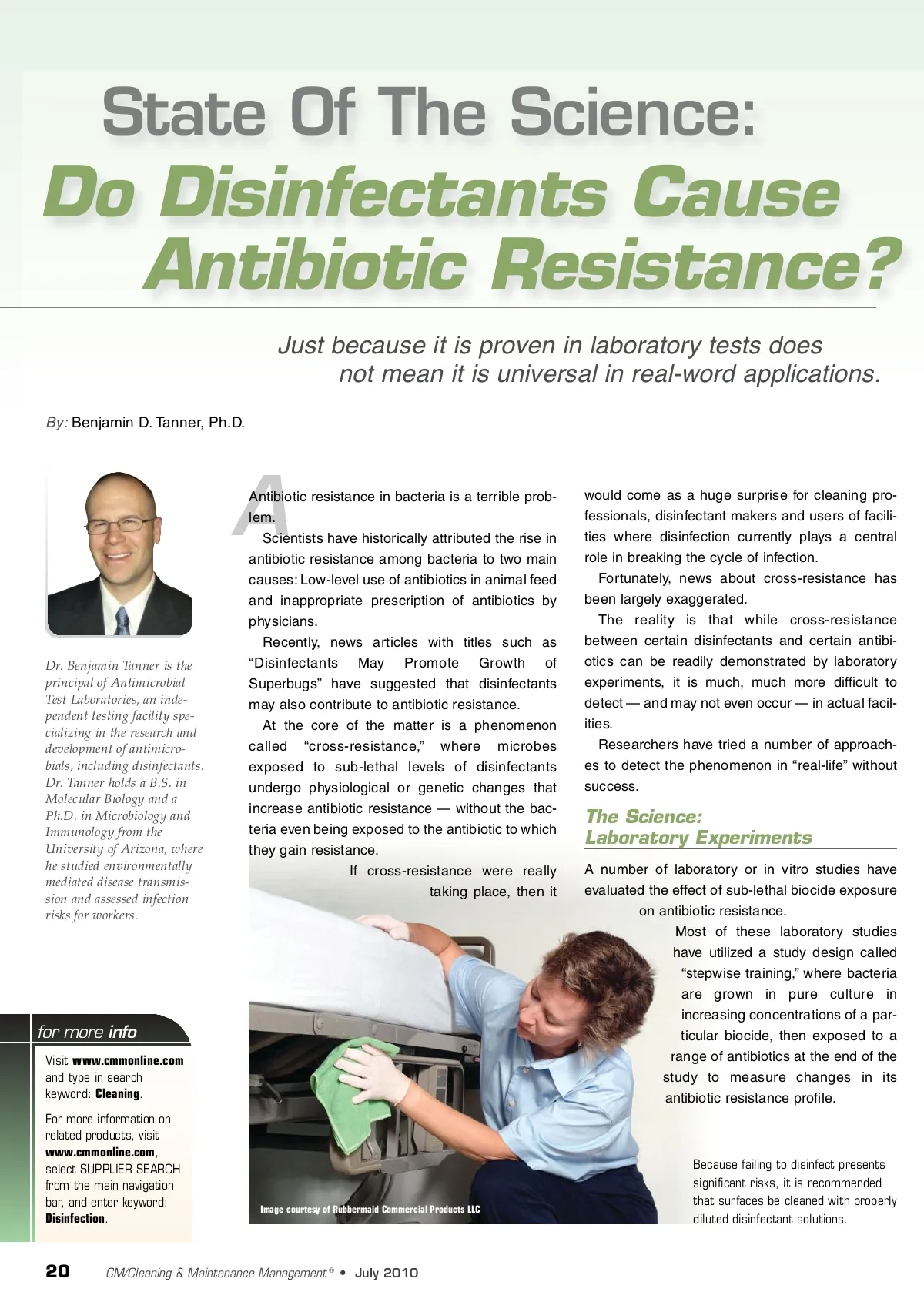
State Of The Science: Do Disinfectants Cause Antibiotic Resistance? Just because it is proven in laboratory tests does not mean it is universal in real-word applications. By: Benjamin D. Tanner, Ph.D. A Dr. Benjamin Tanner is the principal of Antimicrobial Test Laboratories, an inde-pendent testing facility spe-cializing in the research and development of antimicro-bials, including disinfectants. Dr. Tanner holds a B.S. in Molecular Biology and a Ph.D. in Microbiology and Immunology from the University of Arizona, where he studied environmentally mediated disease transmis-sion and assessed infection risks for workers. Antibiotic resistance in bacteria is a terrible prob-lem. Scientists have historically attributed the rise in antibiotic resistance among bacteria to two main causes: Low-level use of antibiotics in animal feed and inappropriate prescription of antibiotics by physicians. Recently, news articles with titles such as “Disinfectants May Promote Growth of Superbugs” have suggested that disinfectants may also contribute to antibiotic resistance. At the core of the matter is a phenomenon called “cross-resistance,” where microbes exposed to sub-lethal levels of disinfectants undergo physiological or genetic changes that increase antibiotic resistance — without the bac-teria even being exposed to the antibiotic to which they gain resistance. If cross-resistance were really taking place, then it would come as a huge surprise for cleaning pro-fessionals, disinfectant makers and users of facili-ties where disinfection currently plays a central role in breaking the cycle of infection. Fortunately, news about cross-resistance has been largely exaggerated. The reality is that while cross-resistance between certain disinfectants and certain antibi-otics can be readily demonstrated by laboratory experiments, it is much, much more difficult to detect — and may not even occur — in actual facil-ities. Researchers have tried a number of approach-es to detect the phenomenon in “real-life” without success. The Science: Laboratory Experiments A number of laboratory or in vitro studies have evaluated the effect of sub-lethal biocide exposure on antibiotic resistance. Most of these laboratory studies have utilized a study design called “stepwise training,” where bacteria are grown in pure culture in increasing concentrations of a par-ticular biocide, then exposed to a range of antibiotics at the end of the study to measure changes in its antibiotic resistance profile. for more info Visit www.cmmonline.com and type in search keyword: Cleaning . For more information on related products, visit www.cmmonline.com , select SUPPLIER SEARCH from the main navigation bar, and enter keyword: Disinfection . Image courtesy of Rubbermaid Commercial Products LLC Because failing to disinfect presents significant risks, it is recommended that surfaces be cleaned with properly diluted disinfectant solutions. 20 CM/Cleaning & Maintenance Management ® • July 2010
CMM – Archives July 2010: 20