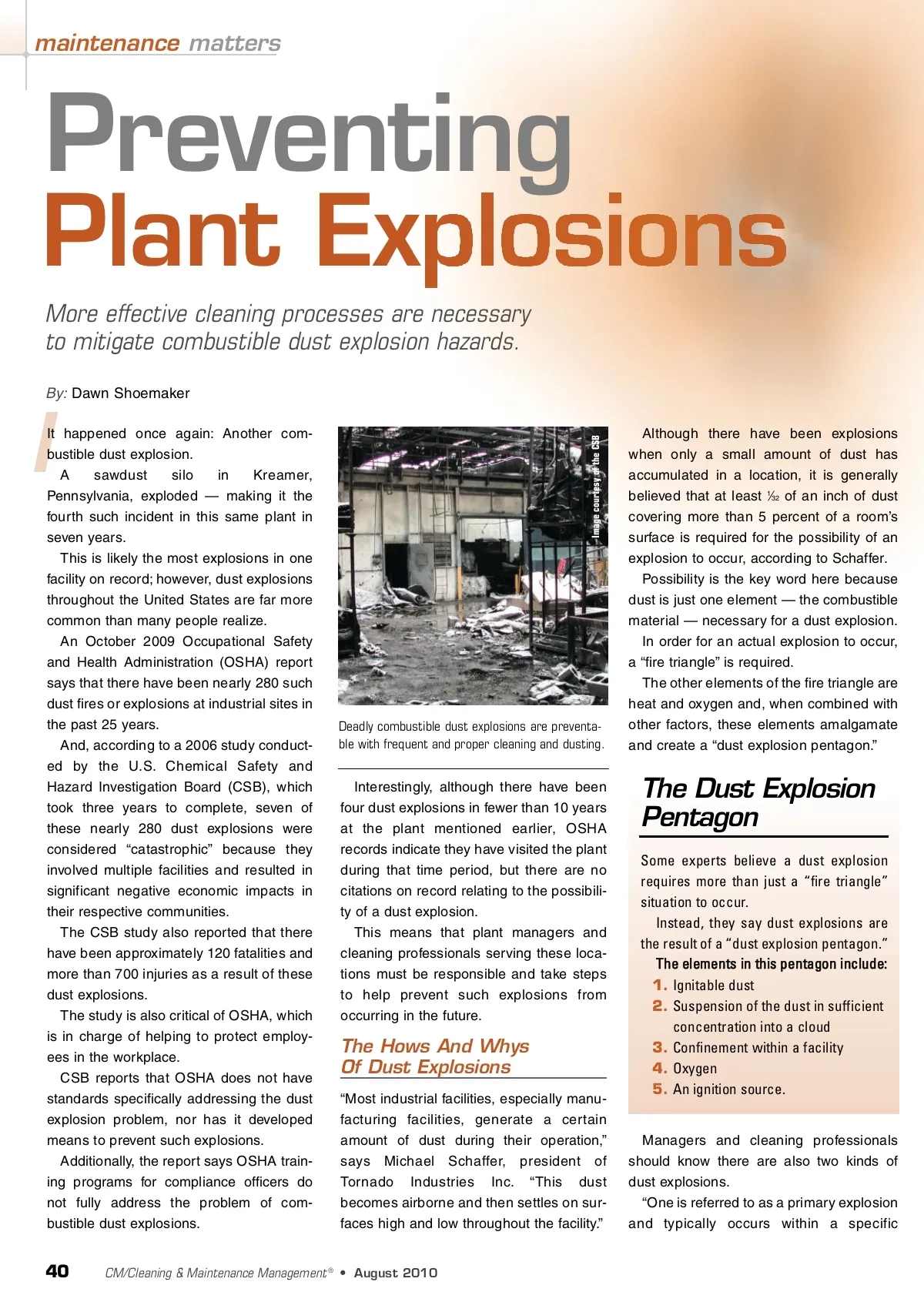
maintenance matters Plant Explosions More effective cleaning processes are necessary to mitigate combustible dust explosion hazards. By: Dawn Shoemaker Image courtesy of the CSB Preventing It happened once again: Another com-bustible dust explosion. A sawdust silo in Kreamer, Pennsylvania, exploded — making it the fourth such incident in this same plant in seven years. This is likely the most explosions in one facility on record; however, dust explosions throughout the United States are far more common than many people realize. An October 2009 Occupational Safety and Health Administration (OSHA) report says that there have been nearly 280 such dust fires or explosions at industrial sites in the past 25 years. And, according to a 2006 study conduct-ed by the U.S. Chemical Safety and Hazard Investigation Board (CSB), which took three years to complete, seven of these nearly 280 dust explosions were considered “catastrophic” because they involved multiple facilities and resulted in significant negative economic impacts in their respective communities. The CSB study also reported that there have been approximately 120 fatalities and more than 700 injuries as a result of these dust explosions. The study is also critical of OSHA, which is in charge of helping to protect employ-ees in the workplace. CSB reports that OSHA does not have standards specifically addressing the dust explosion problem, nor has it developed means to prevent such explosions. Additionally, the report says OSHA train-ing programs for compliance officers do not fully address the problem of com-bustible dust explosions. I Deadly combustible dust explosions are preventa-ble with frequent and proper cleaning and dusting. Although there have been explosions when only a small amount of dust has accumulated in a location, it is generally believed that at least 1 ⁄ 32 of an inch of dust covering more than 5 percent of a room’s surface is required for the possibility of an explosion to occur, according to Schaffer. Possibility is the key word here because dust is just one element — the combustible material — necessary for a dust explosion. In order for an actual explosion to occur, a “fire triangle” is required. The other elements of the fire triangle are heat and oxygen and, when combined with other factors, these elements amalgamate and create a “dust explosion pentagon.” Interestingly, although there have been four dust explosions in fewer than 10 years at the plant mentioned earlier, OSHA records indicate they have visited the plant during that time period, but there are no citations on record relating to the possibili-ty of a dust explosion. This means that plant managers and cleaning professionals serving these loca-tions must be responsible and take steps to help prevent such explosions from occurring in the future. The Dust Explosion Pentagon Some experts believe a dust explosion requires more than just a “fire triangle” situation to occur. Instead, they say dust explosions are the result of a “dust explosion pentagon.” T h e e l e m e n t s i n t h i s p e n t a g o n i n c l u d e : 1. Ignitable dust 2. Suspension of the dust in sufficient concentration into a cloud 3. Confinement within a facility 4. Oxygen 5. An ignition source. Managers and cleaning professionals should know there are also two kinds of dust explosions. “One is referred to as a primary explosion and typically occurs within a specific The Hows And Whys Of Dust Explosions “Most industrial facilities, especially manu-facturing facilities, generate a certain amount of dust during their operation,” says Michael Schaffer, president of Tornado Industries Inc. “This dust becomes airborne and then settles on sur-faces high and low throughout the facility.” 40 CM/Cleaning & Maintenance Management ® • August 2010
CMM – Archives Aug 2010: 40