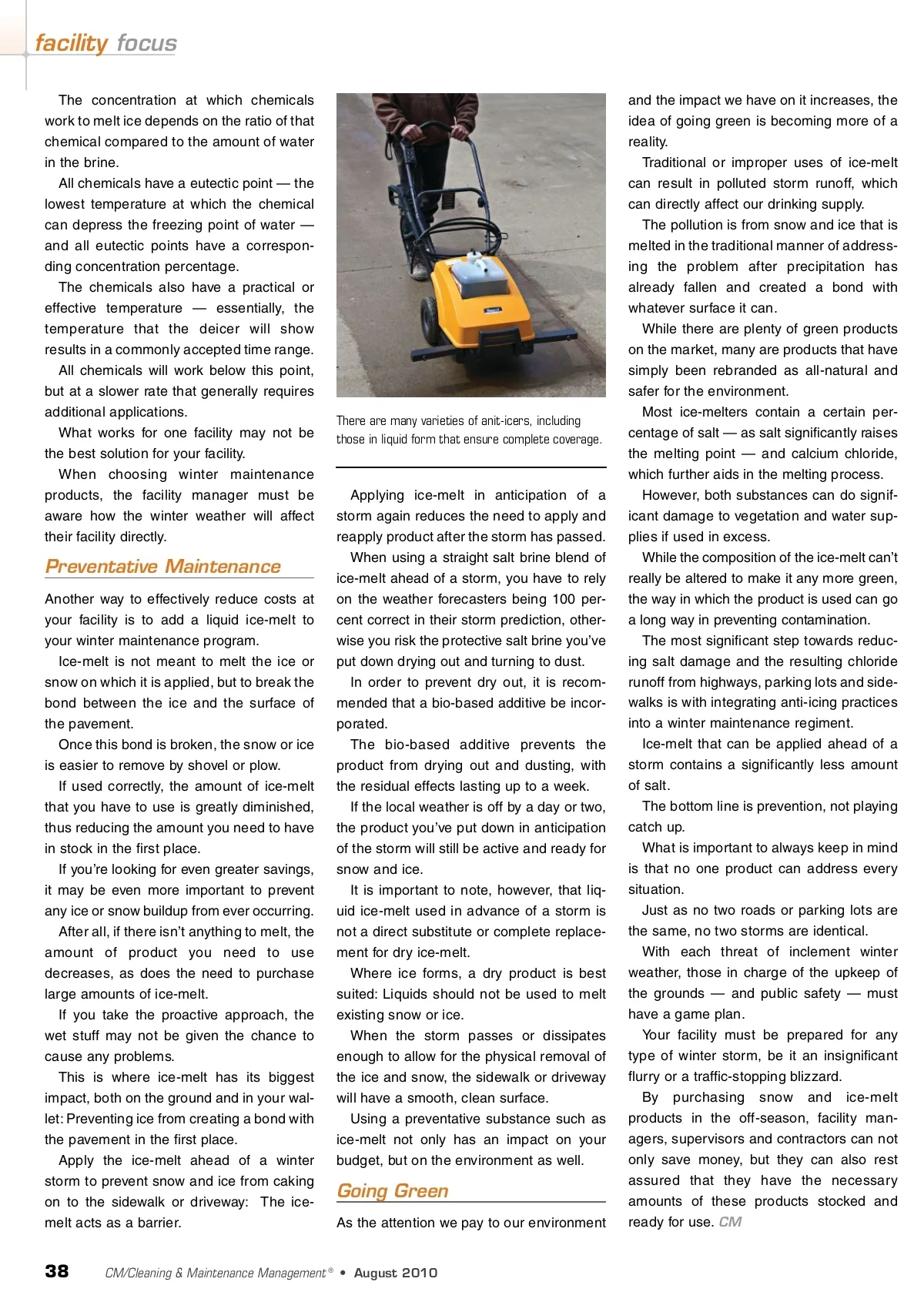
facility focus The concentration at which chemicals work to melt ice depends on the ratio of that chemical compared to the amount of water in the brine. All chemicals have a eutectic point — the lowest temperature at which the chemical can depress the freezing point of water — and all eutectic points have a correspon-ding concentration percentage. The chemicals also have a practical or effective temperature — essentially, the temperature that the deicer will show results in a commonly accepted time range. All chemicals will work below this point, but at a slower rate that generally requires additional applications. What works for one facility may not be the best solution for your facility. When choosing winter maintenance products, the facility manager must be aware how the winter weather will affect their facility directly. and the impact we have on it increases, the idea of going green is becoming more of a reality. Traditional or improper uses of ice-melt can result in polluted storm runoff, which can directly affect our drinking supply. The pollution is from snow and ice that is melted in the traditional manner of address-ing the problem after precipitation has already fallen and created a bond with whatever surface it can. While there are plenty of green products on the market, many are products that have simply been rebranded as all-natural and safer for the environment. Most ice-melters contain a certain per-centage of salt — as salt significantly raises the melting point — and calcium chloride, which further aids in the melting process. However, both substances can do signif-icant damage to vegetation and water sup-plies if used in excess. While the composition of the ice-melt can’t really be altered to make it any more green, the way in which the product is used can go a long way in preventing contamination. The most significant step towards reduc-ing salt damage and the resulting chloride runoff from highways, parking lots and side-walks is with integrating anti-icing practices into a winter maintenance regiment. Ice-melt that can be applied ahead of a storm contains a significantly less amount of salt. The bottom line is prevention, not playing catch up. What is important to always keep in mind is that no one product can address every situation. Just as no two roads or parking lots are the same, no two storms are identical. With each threat of inclement winter weather, those in charge of the upkeep of the grounds — and public safety — must have a game plan. Your facility must be prepared for any type of winter storm, be it an insignificant flurry or a traffic-stopping blizzard. By purchasing snow and ice-melt products in the off-season, facility man-agers, supervisors and contractors can not only save money, but they can also rest assured that they have the necessary amounts of these products stocked and ready for use. CM There are many varieties of anit-icers, including those in liquid form that ensure complete coverage. Preventative Maintenance Another way to effectively reduce costs at your facility is to add a liquid ice-melt to your winter maintenance program. Ice-melt is not meant to melt the ice or snow on which it is applied, but to break the bond between the ice and the surface of the pavement. Once this bond is broken, the snow or ice is easier to remove by shovel or plow. If used correctly, the amount of ice-melt that you have to use is greatly diminished, thus reducing the amount you need to have in stock in the first place. If you’re looking for even greater savings, it may be even more important to prevent any ice or snow buildup from ever occurring. After all, if there isn’t anything to melt, the amount of product you need to use decreases, as does the need to purchase large amounts of ice-melt. If you take the proactive approach, the wet stuff may not be given the chance to cause any problems. This is where ice-melt has its biggest impact, both on the ground and in your wal-let: Preventing ice from creating a bond with the pavement in the first place. Apply the ice-melt ahead of a winter storm to prevent snow and ice from caking on to the sidewalk or driveway: The ice-melt acts as a barrier. Applying ice-melt in anticipation of a storm again reduces the need to apply and reapply product after the storm has passed. When using a straight salt brine blend of ice-melt ahead of a storm, you have to rely on the weather forecasters being 100 per-cent correct in their storm prediction, other-wise you risk the protective salt brine you’ve put down drying out and turning to dust. In order to prevent dry out, it is recom-mended that a bio-based additive be incor-porated. The bio-based additive prevents the product from drying out and dusting, with the residual effects lasting up to a week. If the local weather is off by a day or two, the product you’ve put down in anticipation of the storm will still be active and ready for snow and ice. It is important to note, however, that liq-uid ice-melt used in advance of a storm is not a direct substitute or complete replace-ment for dry ice-melt. Where ice forms, a dry product is best suited: Liquids should not be used to melt existing snow or ice. When the storm passes or dissipates enough to allow for the physical removal of the ice and snow, the sidewalk or driveway will have a smooth, clean surface. Using a preventative substance such as ice-melt not only has an impact on your budget, but on the environment as well. Going Green As the attention we pay to our environment 38 CM/Cleaning & Maintenance Management ® • August 2010
CMM – Archives Aug 2010: 38