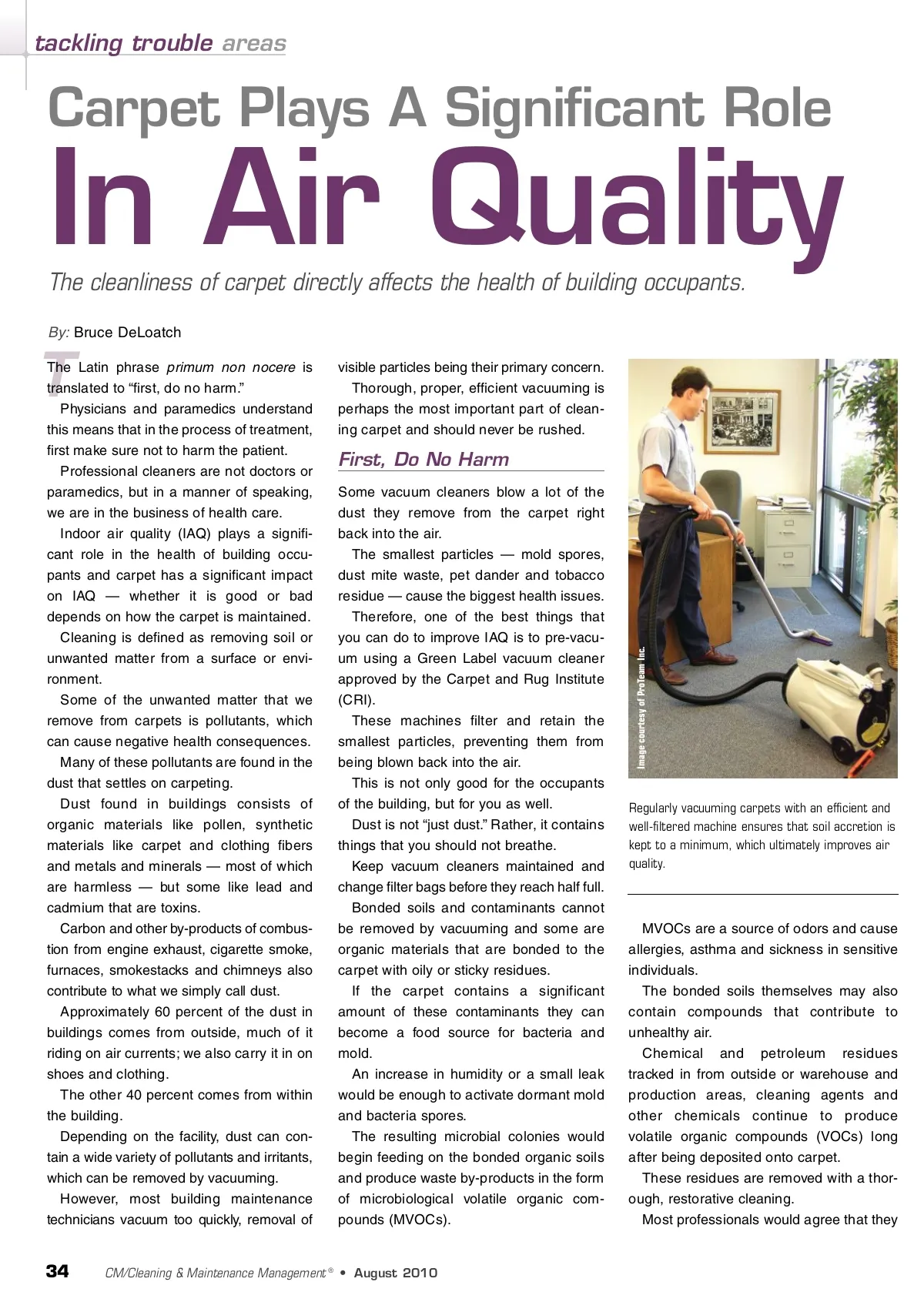
tackling trouble areas Carpet Plays A Significant Role In Air Quality The cleanliness of carpet directly affects the health of building occupants. By: Bruce DeLoatch T The Latin phrase primum non nocere is translated to “first, do no harm.” Physicians and paramedics understand this means that in the process of treatment, first make sure not to harm the patient. Professional cleaners are not doctors or paramedics, but in a manner of speaking, we are in the business of health care. Indoor air quality (IAQ) plays a signifi-cant role in the health of building occu-pants and carpet has a significant impact on IAQ — whether it is good or bad depends on how the carpet is maintained. Cleaning is defined as removing soil or unwanted matter from a surface or envi-ronment. Some of the unwanted matter that we remove from carpets is pollutants, which can cause negative health consequences. Many of these pollutants are found in the dust that settles on carpeting. Dust found in buildings consists of organic materials like pollen, synthetic materials like carpet and clothing fibers and metals and minerals — most of which are harmless — but some like lead and cadmium that are toxins. Carbon and other by-products of combus-tion from engine exhaust, cigarette smoke, furnaces, smokestacks and chimneys also contribute to what we simply call dust. Approximately 60 percent of the dust in buildings comes from outside, much of it riding on air currents; we also carry it in on shoes and clothing. The other 40 percent comes from within the building. Depending on the facility, dust can con-tain a wide variety of pollutants and irritants, which can be removed by vacuuming. However, most building maintenance technicians vacuum too quickly, removal of visible particles being their primary concern. Thorough, proper, efficient vacuuming is perhaps the most important part of clean-ing carpet and should never be rushed. First, Do No Harm Some vacuum cleaners blow a lot of the dust they remove from the carpet right back into the air. The smallest particles — mold spores, dust mite waste, pet dander and tobacco residue — cause the biggest health issues. Therefore, one of the best things that you can do to improve IAQ is to pre-vacu-um using a Green Label vacuum cleaner approved by the Carpet and Rug Institute (CRI). These machines filter and retain the smallest particles, preventing them from being blown back into the air. This is not only good for the occupants of the building, but for you as well. Dust is not “just dust.” Rather, it contains things that you should not breathe. Keep vacuum cleaners maintained and change filter bags before they reach half full. Bonded soils and contaminants cannot be removed by vacuuming and some are organic materials that are bonded to the carpet with oily or sticky residues. If the carpet contains a significant amount of these contaminants they can become a food source for bacteria and mold. An increase in humidity or a small leak would be enough to activate dormant mold and bacteria spores. The resulting microbial colonies would begin feeding on the bonded organic soils and produce waste by-products in the form of microbiological volatile organic com-pounds (MVOCs). Regularly vacuuming carpets with an efficient and well-filtered machine ensures that soil accretion is kept to a minimum, which ultimately improves air quality. MVOCs are a source of odors and cause allergies, asthma and sickness in sensitive individuals. The bonded soils themselves may also contain compounds that contribute to unhealthy air. Chemical and petroleum residues tracked in from outside or warehouse and production areas, cleaning agents and other chemicals continue to produce volatile organic compounds (VOCs) long after being deposited onto carpet. These residues are removed with a thor-ough, restorative cleaning. Most professionals would agree that they 34 CM/Cleaning & Maintenance Management ® • August 2010 Image courtesy of ProTeam Inc.
CMM – Archives Aug 2010: 34