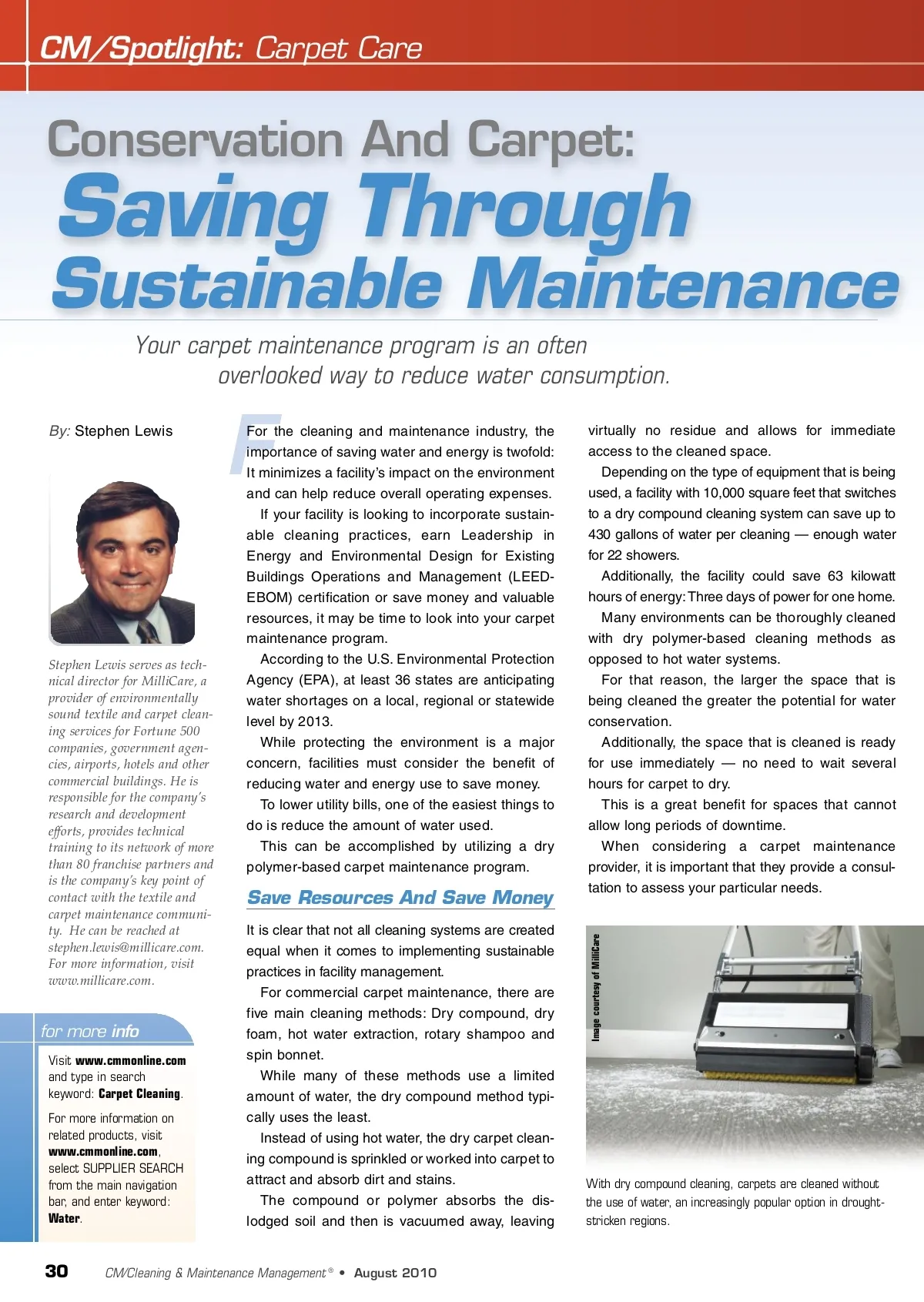
Conservation And Carpet: Saving Through Sustainable Maintenance Your carpet maintenance program is an often overlooked way to reduce water consumption. By: Stephen Lewis F Stephen Lewis serves as tech-nical director for MilliCare, a provider of environmentally sound textile and carpet clean-ing services for Fortune 500 companies, government agen-cies, airports, hotels and other commercial buildings. He is responsible for the company’s research and development efforts, provides technical training to its network of more than 80 franchise partners and is the company’s key point of contact with the textile and carpet maintenance communi-ty. He can be reached at [email protected]. For more information, visit www.millicare.com. For the cleaning and maintenance industry, the importance of saving water and energy is twofold: It minimizes a facility’s impact on the environment and can help reduce overall operating expenses. If your facility is looking to incorporate sustain-able cleaning practices, earn Leadership in Energy and Environmental Design for Existing Buildings Operations and Management (LEED-EBOM) certification or save money and valuable resources, it may be time to look into your carpet maintenance program. According to the U.S. Environmental Protection Agency (EPA), at least 36 states are anticipating water shortages on a local, regional or statewide level by 2013. While protecting the environment is a major concern, facilities must consider the benefit of reducing water and energy use to save money. To lower utility bills, one of the easiest things to do is reduce the amount of water used. This can be accomplished by utilizing a dry polymer-based carpet maintenance program. Save Resources And Save Money It is clear that not all cleaning systems are created equal when it comes to implementing sustainable practices in facility management. For commercial carpet maintenance, there are five main cleaning methods: Dry compound, dry foam, hot water extraction, rotary shampoo and spin bonnet. While many of these methods use a limited amount of water, the dry compound method typi-cally uses the least. Instead of using hot water, the dry carpet clean-ing compound is sprinkled or worked into carpet to attract and absorb dirt and stains. The compound or polymer absorbs the dis-lodged soil and then is vacuumed away, leaving virtually no residue and allows for immediate access to the cleaned space. Depending on the type of equipment that is being used, a facility with 10,000 square feet that switches to a dry compound cleaning system can save up to 430 gallons of water per cleaning — enough water for 22 showers. Additionally, the facility could save 63 kilowatt hours of energy: Three days of power for one home. Many environments can be thoroughly cleaned with dry polymer-based cleaning methods as opposed to hot water systems. For that reason, the larger the space that is being cleaned the greater the potential for water conservation. Additionally, the space that is cleaned is ready for use immediately — no need to wait several hours for carpet to dry. This is a great benefit for spaces that cannot allow long periods of downtime. When considering a carpet maintenance provider, it is important that they provide a consul-tation to assess your particular needs. for more info Visit www.cmmonline.com and type in search keyword: Carpet Cleaning . For more information on related products, visit www.cmmonline.com , select SUPPLIER SEARCH from the main navigation bar, and enter keyword: Water . With dry compound cleaning, carpets are cleaned without the use of water, an increasingly popular option in drought-stricken regions. 30 CM/Cleaning & Maintenance Management ® • August 2010
CMM – Archives Aug 2010: 30