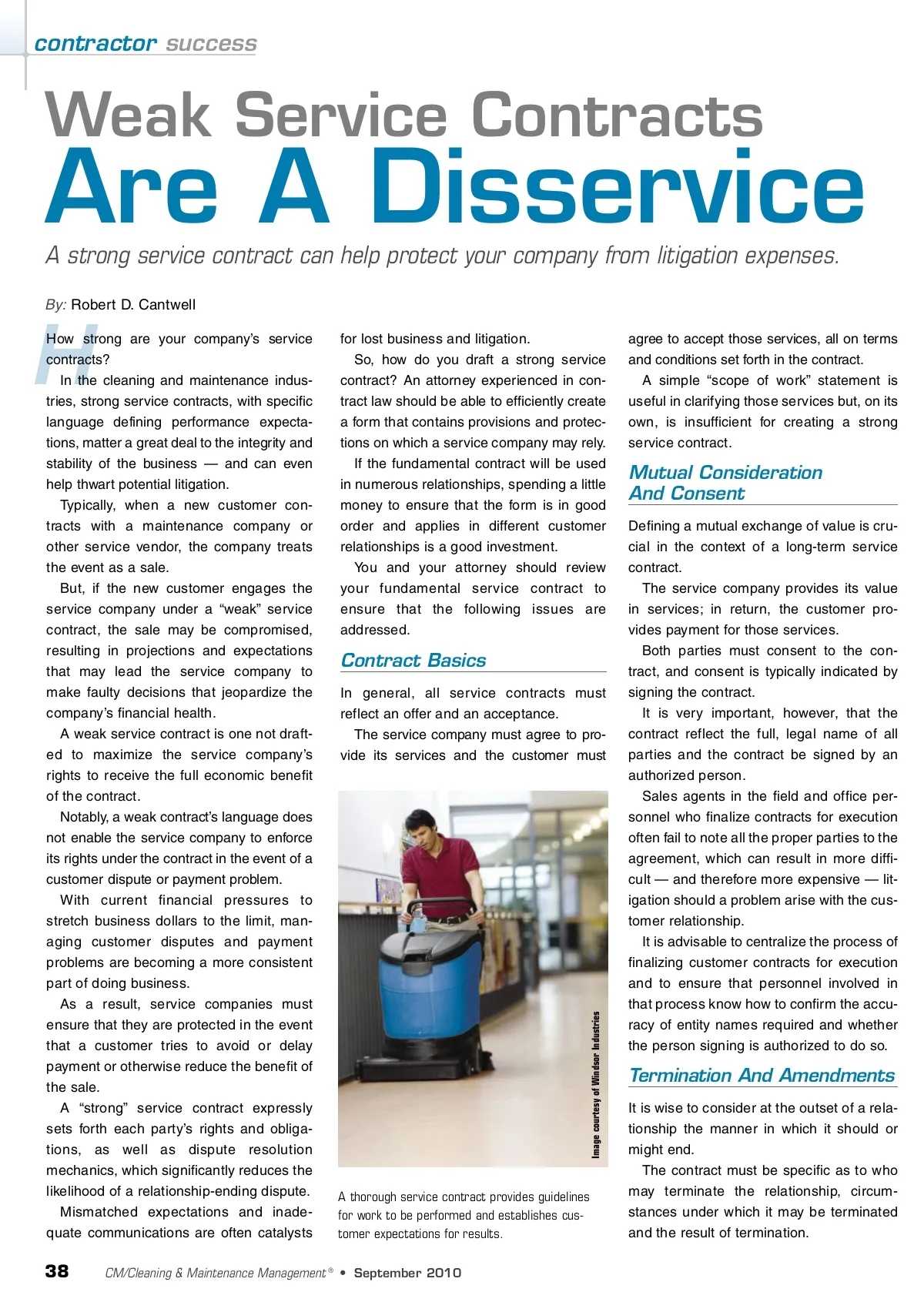
contractor success Weak Service Contracts By: Robert D. Cantwell Are A Disservice A strong service contract can help protect your company from litigation expenses. H How strong are your company’s service contracts? In the cleaning and maintenance indus-tries, strong service contracts, with specific language defining performance expecta-tions, matter a great deal to the integrity and stability of the business — and can even help thwart potential litigation. Typically, when a new customer con-tracts with a maintenance company or other service vendor, the company treats the event as a sale. But, if the new customer engages the service company under a “weak” service contract, the sale may be compromised, resulting in projections and expectations that may lead the service company to make faulty decisions that jeopardize the company’s financial health. A weak service contract is one not draft-ed to maximize the service company’s rights to receive the full economic benefit of the contract. Notably, a weak contract’s language does not enable the service company to enforce its rights under the contract in the event of a customer dispute or payment problem. With current financial pressures to stretch business dollars to the limit, man-aging customer disputes and payment problems are becoming a more consistent part of doing business. As a result, service companies must ensure that they are protected in the event that a customer tries to avoid or delay payment or otherwise reduce the benefit of the sale. A “strong” service contract expressly sets forth each party’s rights and obliga-tions, as well as dispute resolution mechanics, which significantly reduces the likelihood of a relationship-ending dispute. Mismatched expectations and inade-quate communications are often catalysts for lost business and litigation. So, how do you draft a strong service contract? An attorney experienced in con-tract law should be able to efficiently create a form that contains provisions and protec-tions on which a service company may rely. If the fundamental contract will be used in numerous relationships, spending a little money to ensure that the form is in good order and applies in different customer relationships is a good investment. You and your attorney should review your fundamental service contract to ensure that the following issues are addressed. agree to accept those services, all on terms and conditions set forth in the contract. A simple “scope of work” statement is useful in clarifying those services but, on its own, is insufficient for creating a strong service contract. Mutual Consideration And Consent Defining a mutual exchange of value is cru-cial in the context of a long-term service contract. The service company provides its value in services; in return, the customer pro-vides payment for those services. Both parties must consent to the con-tract, and consent is typically indicated by signing the contract. It is very important, however, that the contract reflect the full, legal name of all parties and the contract be signed by an authorized person. Sales agents in the field and office per-sonnel who finalize contracts for execution often fail to note all the proper parties to the agreement, which can result in more diffi-cult — and therefore more expensive — lit-igation should a problem arise with the cus-tomer relationship. It is advisable to centralize the process of finalizing customer contracts for execution and to ensure that personnel involved in that process know how to confirm the accu-racy of entity names required and whether the person signing is authorized to do so. Contract Basics In general, all service contracts must reflect an offer and an acceptance. The service company must agree to pro-vide its services and the customer must Image courtesy of Windsor Industries Termination And Amendments It is wise to consider at the outset of a rela-tionship the manner in which it should or might end. The contract must be specific as to who may terminate the relationship, circum-stances under which it may be terminated and the result of termination. A thorough service contract provides guidelines for work to be performed and establishes cus-tomer expectations for results. 38 CM/Cleaning & Maintenance Management ® • September 2010
CMM – Archives Sept 2010: 38