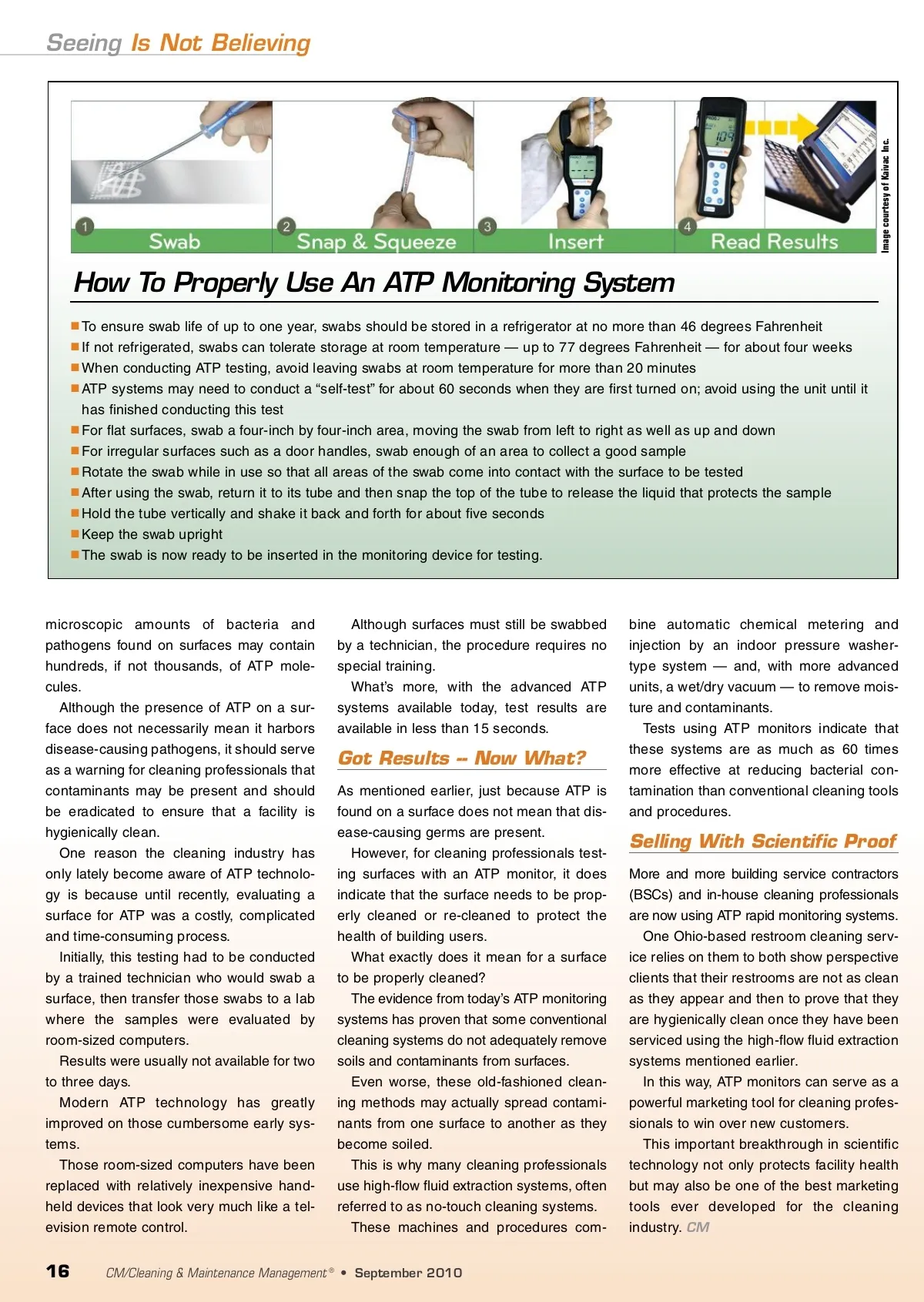
Seeing Is Not Believing How To Properly Use An ATP Monitoring System To ensure swab life of up to one year, swabs should be stored in a refrigerator at no more than 46 degrees Fahrenheit If not refrigerated, swabs can tolerate storage at room temperature — up to 77 degrees Fahrenheit — for about four weeks When conducting ATP testing, avoid leaving swabs at room temperature for more than 20 minutes ATP systems may need to conduct a “self-test” for about 60 seconds when they are first turned on; avoid using the unit until it has finished conducting this test For flat surfaces, swab a four-inch by four-inch area, moving the swab from left to right as well as up and down For irregular surfaces such as a door handles, swab enough of an area to collect a good sample Rotate the swab while in use so that all areas of the swab come into contact with the surface to be tested After using the swab, return it to its tube and then snap the top of the tube to release the liquid that protects the sample Hold the tube vertically and shake it back and forth for about five seconds Keep the swab upright The swab is now ready to be inserted in the monitoring device for testing. microscopic amounts of bacteria and pathogens found on surfaces may contain hundreds, if not thousands, of ATP mole-cules. Although the presence of ATP on a sur-face does not necessarily mean it harbors disease-causing pathogens, it should serve as a warning for cleaning professionals that contaminants may be present and should be eradicated to ensure that a facility is hygienically clean. One reason the cleaning industry has only lately become aware of ATP technolo-gy is because until recently, evaluating a surface for ATP was a costly, complicated and time-consuming process. Initially, this testing had to be conducted by a trained technician who would swab a surface, then transfer those swabs to a lab where the samples were evaluated by room-sized computers. Results were usually not available for two to three days. Modern ATP technology has greatly improved on those cumbersome early sys-tems. Those room-sized computers have been replaced with relatively inexpensive hand-held devices that look very much like a tel-evision remote control. Although surfaces must still be swabbed by a technician, the procedure requires no special training. What’s more, with the advanced ATP systems available today, test results are available in less than 15 seconds. Got Results --Now What? As mentioned earlier, just because ATP is found on a surface does not mean that dis-ease-causing germs are present. However, for cleaning professionals test-ing surfaces with an ATP monitor, it does indicate that the surface needs to be prop-erly cleaned or re-cleaned to protect the health of building users. What exactly does it mean for a surface to be properly cleaned? The evidence from today’s ATP monitoring systems has proven that some conventional cleaning systems do not adequately remove soils and contaminants from surfaces. Even worse, these old-fashioned clean-ing methods may actually spread contami-nants from one surface to another as they become soiled. This is why many cleaning professionals use high-flow fluid extraction systems, often referred to as no-touch cleaning systems. These machines and procedures com-bine automatic chemical metering and injection by an indoor pressure washer-type system — and, with more advanced units, a wet/dry vacuum — to remove mois-ture and contaminants. Tests using ATP monitors indicate that these systems are as much as 60 times more effective at reducing bacterial con-tamination than conventional cleaning tools and procedures. Selling With Scientific Proof More and more building service contractors (BSCs) and in-house cleaning professionals are now using ATP rapid monitoring systems. One Ohio-based restroom cleaning serv-ice relies on them to both show perspective clients that their restrooms are not as clean as they appear and then to prove that they are hygienically clean once they have been serviced using the high-flow fluid extraction systems mentioned earlier. In this way, ATP monitors can serve as a powerful marketing tool for cleaning profes-sionals to win over new customers. This important breakthrough in scientific technology not only protects facility health but may also be one of the best marketing tools ever developed for the cleaning industry. CM 16 CM/Cleaning & Maintenance Management ® • September 2010 Image courtesy of Kaivac Inc.
CMM – Archives Sept 2010: 16