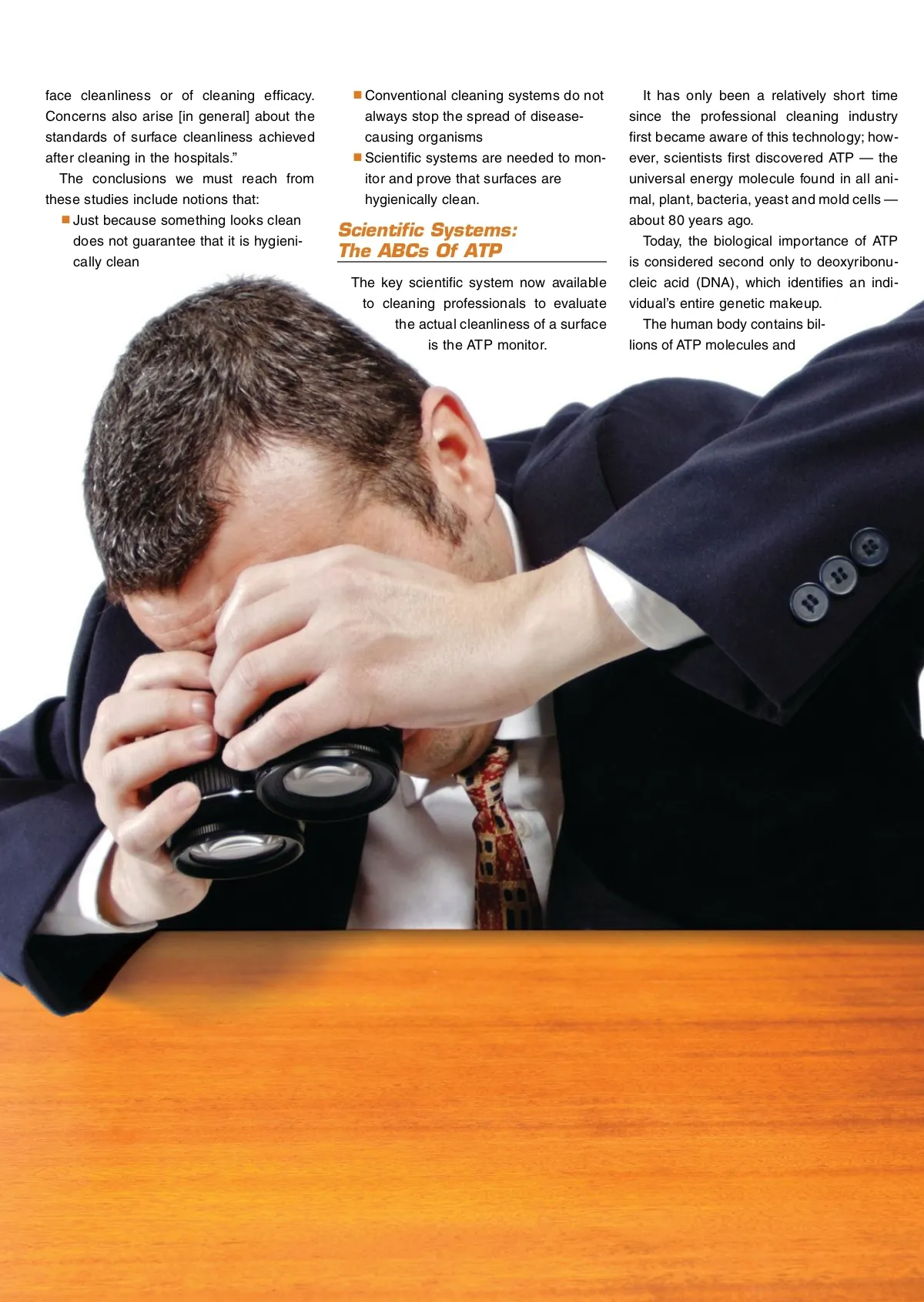
face cleanliness or of cleaning efficacy. Concerns also arise [in general] about the standards of surface cleanliness achieved after cleaning in the hospitals.” The conclusions we must reach from these studies include notions that: Just because something looks clean does not guarantee that it is hygieni-cally clean Conventional cleaning systems do not always stop the spread of disease-causing organisms Scientific systems are needed to mon-itor and prove that surfaces are hygienically clean. Scientific Systems: The ABCs Of ATP The key scientific system now available to cleaning professionals to evaluate the actual cleanliness of a surface is the ATP monitor. It has only been a relatively short time since the professional cleaning industry first became aware of this technology; how-ever, scientists first discovered ATP — the universal energy molecule found in all ani-mal, plant, bacteria, yeast and mold cells — about 80 years ago. Today, the biological importance of ATP is considered second only to deoxyribonu-cleic acid (DNA), which identifies an indi-vidual’s entire genetic makeup. The human body contains bil-lions of ATP molecules and
CMM – Archives Sept 2010: 15