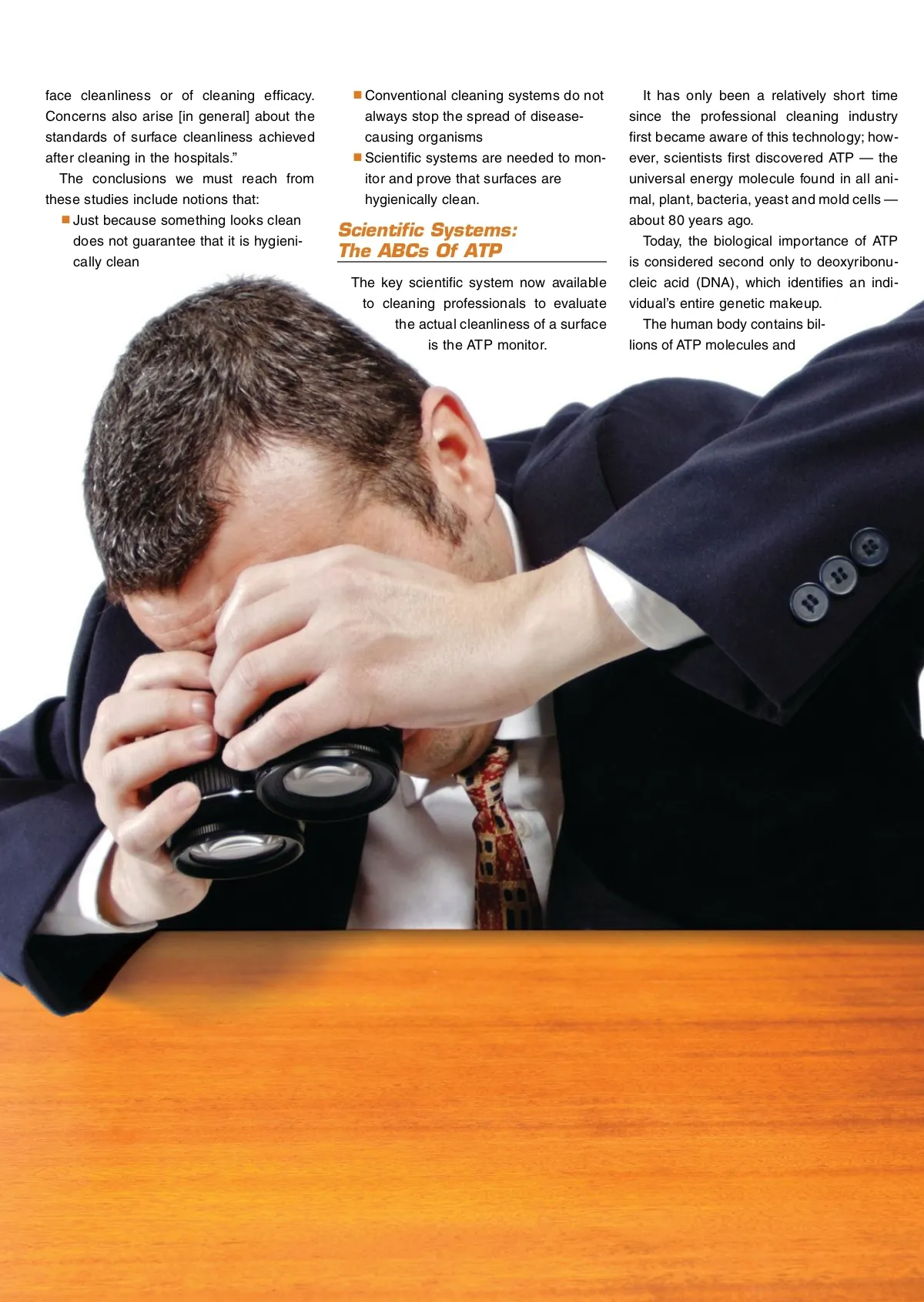
Cover Story Seeing By: John Richter John Richter is the technical director for Kaivac Inc., devel-opers of the Kaivac No-Touch Cleaning ® system. He is a fre-quent author and presenter discussing hygienic cleaning issues and related topics. Richter has both a Bachelor’s and Master’s Degree in Mechanical Engineering from the University of Dayton. With an emphasis on thermal sciences and fluid dynamics. His background includes man-agement and leadership roles in new product development with leading companies in the electrical distribution industry. Richter also is a Six-Sigma Green Belt. Six Sigma is a business management strategy, initially implemented by Motorola, that today enjoys widespread application in many sectors of industry. A clean appearance does not guarantee germs and bacteria are not present. Believing same exact conclusions — proving that many hos-pitals still need to update their cleaning methods. In this more recent study, researchers once again evaluated a range of surfaces after they were cleaned with conventional tools and methods and concluded that these surfaces were visu-ally clean. The same surfaces were then evaluated using an ATP device. The report concluded: “Cumulatively, the results indi-cate that visual assessment is not a reliable indicator of sur-Is Not I for more info Visit www.cmmonline.com and type in search keyword: Cleaning . For more information on related products, visit www.cmmonline.com , select SUPPLIER SEARCH from the main navigation bar, and enter keyword: Measurement . In December 1999, a four-part study was con-ducted assessing the cleanliness of 113 surfaces in various hospitals over a 14-day period. The surfaces were cleaned using conventional cleaning methods — sprayers, cleaning cloths, mops and buckets — and then visually inspected by the researchers, who concluded that the sur-faces “looked clean.” The cleanliness of these same surfaces was then evaluated using an adenosine triphosphate (ATP) bioluminescence monitoring system. This time, the results were quite different: According to the researchers, as much as 76 per-cent of the surfaces were determined to be “unac-ceptable after cleaning.” The researchers also reported that “the sites most likely to fail were in restroom and food serv-ice areas … which are frequently implicated in the spread of infectious intestinal diseases.” One would hope that this report came from an old study and that today’s hospital administrators and cleaning professionals use cleaning systems and procedures that more thoroughly clean sur-faces, preventing the spread of infection. Unfortunately, although this report is more than 10 years old, many health care facilities have still not changed their cleaning methods. In fact, another study conducted 10 years later in four hospitals in England and Wales came to the 14 CM/Cleaning & Maintenance Management ® • September 2010
CMM – Archives Sept 2010: 14