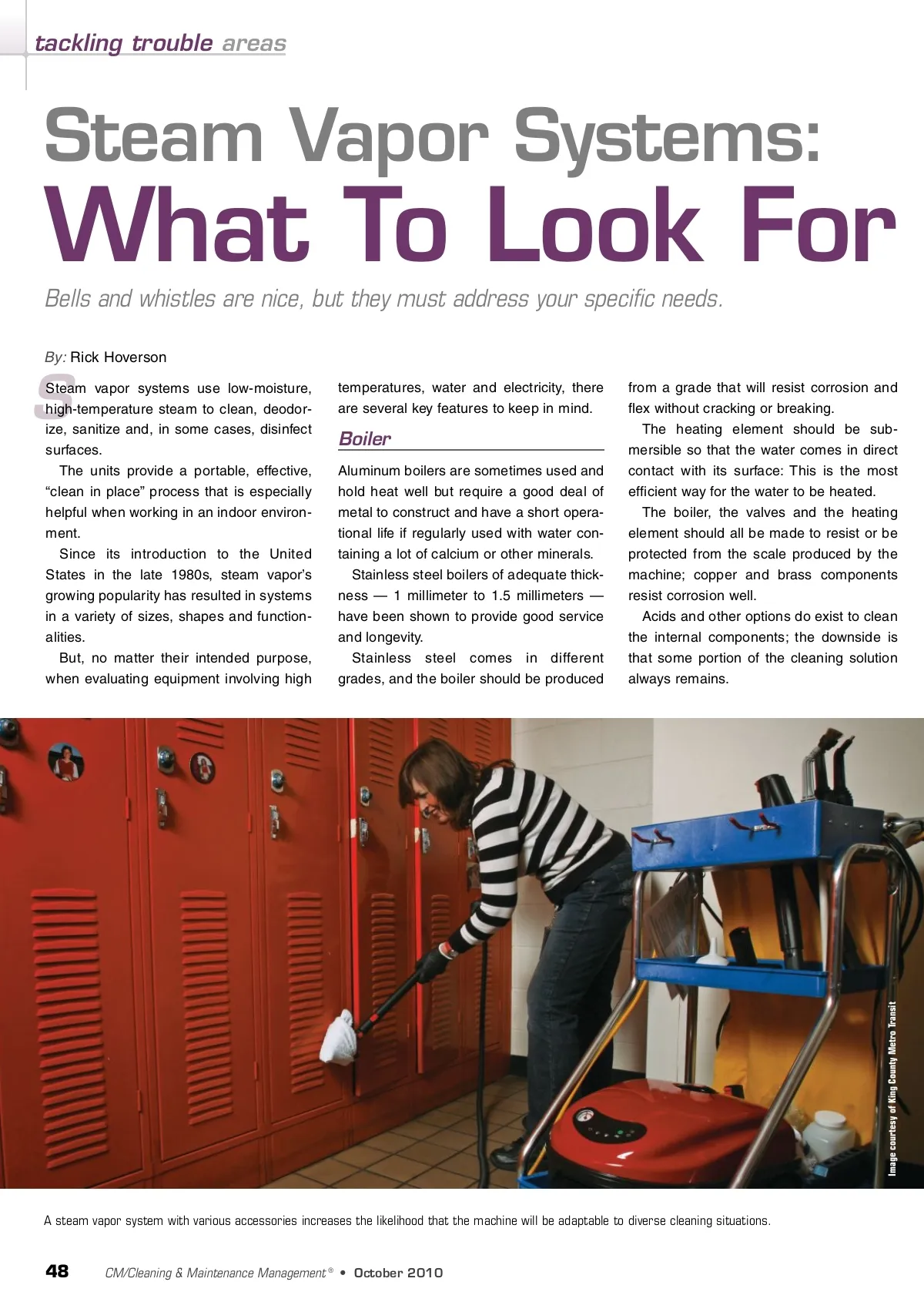
The leftover solution may corrode or eat away at the different surfaces in the system, which may lead to failures or greatly reduce the life of the unit. To help avoid this, the operator should be able to drain the boiler completely. Some units do not have boiler drains or the drain is the same point at which the solution is added, which can limit the boil-er’s ability to be completely drained. It’s important to have redundant safety measures engineered into the boiler sys-tem to prevent overheating, over-pressur-ization or any other situation that might arise as a result of using a portable pres-sure vessel. Reservoir The reservoir holds the system’s water sup-ply and, in a single-tank system, the boiler also serves as the reservoir. A drawback to this design is that the unit requires a cool-down period before it can be refilled and the operator must wait for the unit to again reach operating tempera-tures and pressures — up to 30 minutes, depending on the boiler’s characteristics — before work can continue. In two-tank systems, a separate reservoir feeds the boiler automatically, resulting in a constant, uninterrupted supply of steam vapor. Two-tank systems allow water to be added any time during operation, eliminat-ing the downtime experienced during the refill of a single-tank system. Single-tank units require a high degree of care by the user, as adding water to a hot boiler during a refill operation can be prob-lematic. The system should be engineered so that if the water reservoir is empty, the operator cannot draw steam from the boiler. This prevents situations where someone drains the boiler of all water and steam and then attempts to use the unit, which can create an overheating situation. The steam curve is not linear; getting the boiler hotter does not necessarily make the steam hotter. The optimal operational point is reached when the steam flow matches the capabili-ty of the boiler to produce steam; that is, when the amount of steam being produced matches the amount of steam being used. A pressure gauge can be helpful and allows the operator to verify that the flow out is balanced with the production of steam in the boiler — assuming there is a steam volume control or that the volume is adjustable and built into the system. Low boiler pressures result in cooler, wet-ter steam; higher pressure produces hotter, drier steam. Systems able to achieve surface temper-atures of 220 degrees Fahrenheit to 230 degrees Fahrenheit at the tool interface have been shown to deactivate bacteria and germs, as well as dust mites, bedbugs and fleas. The hose assembly carries the steam from the boiler to the application tool and will be the most abused part of the system — perhaps its weakest link. Hoses should be removable to allow for repair or replacement. The hose should be lightweight enough to be convenient to use, flexible and user-friendly, yet durable enough to last. A hose should be well-insulated, both to maintain higher steam heat levels between boiler and the application tool and for oper-ator safety. Tools and attachments should be easy to take on and off safely, as well as being easy to use and maintain. The system should be able to adapt to a user’s requirements for a particular facility, area of use, etc. Mobility and operational flexibility should be considered when evaluating different units. Training And Support New users will require instruction as to a system’s operation, its capabilities, etc. In some industries such as health care, the unit may be used primarily for dis-infection. Users need to gain understanding about subjects like biofilm, how bacteria are spread, the ability of heat to penetrate pores and how improper practices may result in incomplete disinfection. The systems are easy to use but are dif-ferent from what many technicians are accustomed to using when cleaning and disinfecting surfaces. Small yet crucial maintenance proce-dures should be laid out during initial instruction. For example, the boiler should be drained once a month, both to combat scale buildup and because solutions other than plain water could be introduced to the boiler. Draining the boiler water frequently can limit any undesired consequences from this or other actions. Aftermarket technical service support, repairs, parts, etc., should be easy to access and customer service should be responsive. As with most equipment purchases, good customer service and support cannot be overemphasized when it comes to selecting a steam vapor system. CM Rick Hoverson is the principal of Advanced Vapor Technologies LLC, Edmonds, Washington. The simplified, water-only protocol for Advanced Vapor Technologies’ proprietary thermo accelerated nano-crystal sanitation (TANCS ® ) steam vapor cleaning and disinfection system means fewer consumables, less room for error and less mess. Reduced health risks than those associated with typical chemical cleaners mean a healthier, more comfortable work environment and fewer lost workdays for your staff and less risk for you. For more information, visit www.advap.com. User-friendly Operation Simple, straightforward controls dramatical-ly shorten the learning curve and allow the new user to get up to speed quickly. Steam volume controls allow the user to vary the amount of steam being dispersed, and controls located on the hose handle provide the operator with continuous com-mand of the system. Color-coded pressure gauges and well-placed warning lights or audible alarms help ensure machine and operator safety. As with any cleaning process, the opera-tor should expect to confront a variety of surface types and wide-ranging soil condi-tions; therefore, a variety of tools should be available to meet those special needs. Heat And Hoses A good steam vapor system will be able to achieve heat around 300 degrees Fahrenheit to 320 degrees Fahrenheit in the boiler, which will provide an appropriate water droplet size in the steam vapor and provide good energy transfer within the steam. www.cmmonline.com 49
CMM – Archives Oct 2010: 49