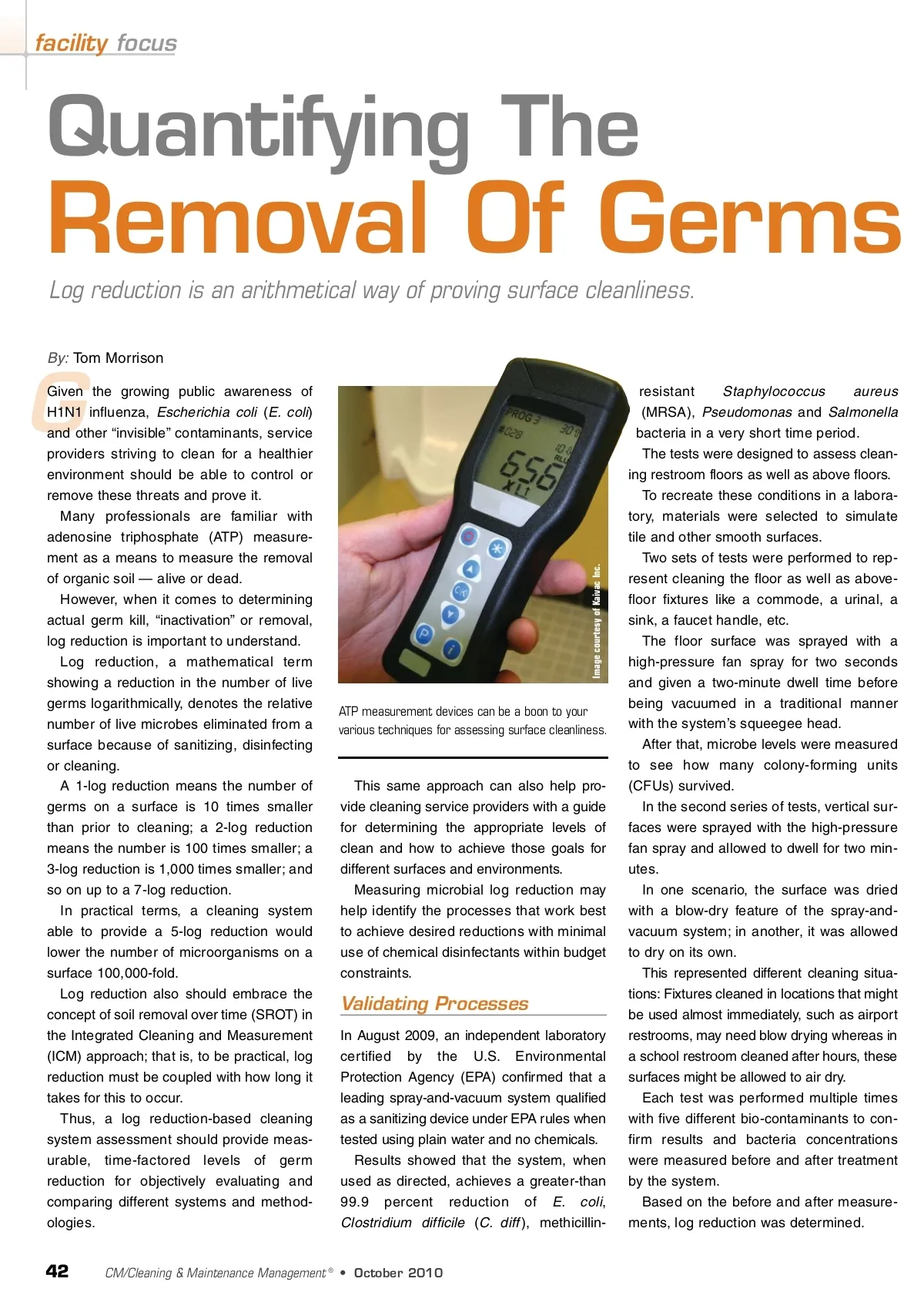
facility focus Quantifying The Removal Of Germs Log reduction is an arithmetical way of proving surface cleanliness. By: Tom Morrison G Given the growing public awareness of H1N1 influenza, Escherichia coli ( E. coli ) and other “invisible” contaminants, service providers striving to clean for a healthier environment should be able to control or remove these threats and prove it. Many professionals are familiar with adenosine triphosphate (ATP) measure-ment as a means to measure the removal of organic soil — alive or dead. However, when it comes to determining actual germ kill, “inactivation” or removal, log reduction is important to understand. Log reduction, a mathematical term showing a reduction in the number of live germs logarithmically, denotes the relative number of live microbes eliminated from a surface because of sanitizing, disinfecting or cleaning. A 1-log reduction means the number of germs on a surface is 10 times smaller than prior to cleaning; a 2-log reduction means the number is 100 times smaller; a 3-log reduction is 1,000 times smaller; and so on up to a 7-log reduction. In practical terms, a cleaning system able to provide a 5-log reduction would lower the number of microorganisms on a surface 100,000-fold. Log reduction also should embrace the concept of soil removal over time (SROT) in the Integrated Cleaning and Measurement (ICM) approach; that is, to be practical, log reduction must be coupled with how long it takes for this to occur. Thus, a log reduction-based cleaning system assessment should provide meas-urable, time-factored levels of germ reduction for objectively evaluating and comparing different systems and method-ologies. ATP measurement devices can be a boon to your various techniques for assessing surface cleanliness. This same approach can also help pro-vide cleaning service providers with a guide for determining the appropriate levels of clean and how to achieve those goals for different surfaces and environments. Measuring microbial log reduction may help identify the processes that work best to achieve desired reductions with minimal use of chemical disinfectants within budget constraints. Validating Processes In August 2009, an independent laboratory certified by the U.S. Environmental Protection Agency (EPA) confirmed that a leading spray-and-vacuum system qualified as a sanitizing device under EPA rules when tested using plain water and no chemicals. Results showed that the system, when used as directed, achieves a greater-than 99.9 percent reduction of E. coli , Clostridium difficile ( C. diff ), methicillin-Staphylococcus aureus resistant (MRSA), Pseudomonas and Salmonella bacteria in a very short time period. The tests were designed to assess clean-ing restroom floors as well as above floors. To recreate these conditions in a labora-tory, materials were selected to simulate tile and other smooth surfaces. Two sets of tests were performed to rep-resent cleaning the floor as well as above-floor fixtures like a commode, a urinal, a sink, a faucet handle, etc. The floor surface was sprayed with a high-pressure fan spray for two seconds and given a two-minute dwell time before being vacuumed in a traditional manner with the system’s squeegee head. After that, microbe levels were measured to see how many colony-forming units (CFUs) survived. In the second series of tests, vertical sur-faces were sprayed with the high-pressure fan spray and allowed to dwell for two min-utes. In one scenario, the surface was dried with a blow-dry feature of the spray-and-vacuum system; in another, it was allowed to dry on its own. This represented different cleaning situa-tions: Fixtures cleaned in locations that might be used almost immediately, such as airport restrooms, may need blow drying whereas in a school restroom cleaned after hours, these surfaces might be allowed to air dry. Each test was performed multiple times with five different bio-contaminants to con-firm results and bacteria concentrations were measured before and after treatment by the system. Based on the before and after measure-ments, log reduction was determined. 42 CM/Cleaning & Maintenance Management ® • October 2010 Image courtesy of Kaivac Inc.
CMM – Archives Oct 2010: 42